The organizational playbook for building companies hasn't meaningfully changed in decades. Hierarchies, middle management, coordination layers — these concepts trace back to the Roman legions projecting power across continents. Information flowed up through named individuals with defined spans of control, and orders flowed back down.
Most companies today still operate this way: human beings as the primary conduit for information.
That model is now obsolete.
🧠 From Productivity Tools to Intelligence Layers
A year ago, the conversation around AI in business centered on productivity gains — co-pilots making engineers 20% more effective, bolting AI onto existing workflows to ship more software. But this framing misses the larger transformation underway.
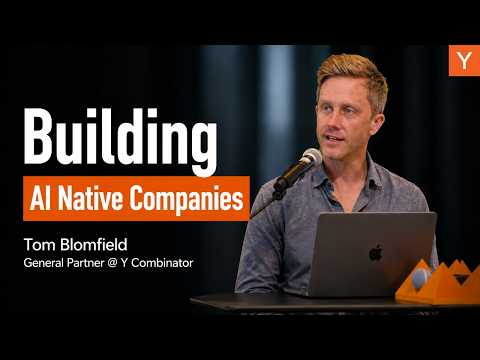
As one speaker put it: "AI isn't something you bolt onto the side of a company. It's not a tool you give to engineers to make them more productive. You can reimagine what a company is as a set of recursive self-improving AI loops."
The breakthrough isn't about doing the same work faster. It's about redefining what a company is — moving from hierarchical coordination to AI-native organizations that improve autonomously, even while founders sleep.
🔁 The Anatomy of a Self-Improving AI Loop
The conceptual model here is elegant and actionable. A self-improving company operates through several interconnected layers:
- Sensor Layer: Inputs from the real world — customer emails, support tickets, code changes, churn events, product telemetry. This is how the system "sees" what's happening.
- Policy/Decision Layer: Rules that govern what the AI can do autonomously, what requires human approval, and what must be logged or reviewed.
- Tool Layer: Deterministic APIs and skills — querying databases, accessing calendars, executing predefined actions. This is where the AI "acts."
- Quality Gate: Evals, safety filters, and human review for high-risk decisions.
- Learning Mechanism: The system logs outcomes, identifies failures, and loops improvements back into the top of the stack.
When every step runs with minimal human intervention, the company doesn't just execute — it evolves. The system gets smarter overnight.
💡 A Real-World Example: The Monitoring Agent
Consider this progression at YC:
Version 1: An agent that could answer deterministic queries — "When did I last have office hours with this company?" Useful, but basic.
Version 2: The agent gets smarter — a partner asks for introductions to founders in petrochemicals, and the system queries the database in multiple ways, uses retrieval-augmented generation (RAG), and surfaces five relevant matches. This is the "co-pilot" model: AI as a sidekick, making humans 20–30% more effective.
Version 3 (The Breakthrough): A monitoring agent sits on top of the query agent. It watches every query from every YC employee, identifies failures, diagnoses root causes, and asks: Do we need different tools? A new database view? An updated skills file?
Then — and this is the key — it writes the code, submits a merge request, has another agent review it, and deploys it. Overnight. The next day, when a human asks the same query, it succeeds.
"For me, that was the holy shit moment. That's not just AI making you 20 or 30% more valuable. It is the AI going through this loop to figure out how to self-improve."
📈 Other Self-Improving Loops
This pattern can be applied across functions:
- Product Optimization: An agent analyzes product analytics, identifies friction points in the funnel, researches best practices, deploys an A/B test, runs it for a week, picks the winner, and ships the change. Then repeats.
- Customer Service: Suggestions come in, an agent triages them against the product roadmap (acting as a virtual CPO/CTO), writes the code for feasible requests, deploys it, and ships it back to the customer — all without human involvement.
If each part of a company can be structured as a self-optimizing recursive loop, the organization becomes fundamentally different from the hierarchical Roman legion model.
🔥 Burn Tokens, Not Headcount
The implications for how companies scale are profound:
- Companies reaching demo day now generate roughly 5x more revenue per employee than they did 18 months ago. This trend is expected to continue through Series A and B.
- The constraint will shift from headcount to token usage.
- While tracking token usage can be gameable and imperfect, directionally it's correct: "Figure out who in your organization is token-maxing, who is not. That's a good way to think about which employees you should be spending your time with."
⚰️ Middle Management Is Done
If AI can handle coordination, information flow, and iterative improvement, middle management as a layer becomes obsolete.
The new org chart has two roles:
- ICs (Individual Contributors): Builders and operators who interface directly with reality.
- Directly Responsible Individuals (DRIs): Named humans accountable for outcomes — not committees, not groups. Single points of accountability.
This isn't about eliminating people. It's about eliminating coordination overhead and letting intelligence do what it does best: synthesize, decide, and act.
📹 Make Everything Legible to AI
For this vision to work, the organization must be readable by AI. That means:
- Record everything: All partner emails, Slack messages, DMs, office hours. If it's not recorded, it didn't happen — at least not to the AI.
- Diarize and synthesize: You can't pump 100,000 hours of recordings into a context window. The system must aggregate, categorize, and surface the important parts.
One practical example: YC recently had 2,000 hours of recorded office hours from the last three months. Over a weekend, an engineer used those recordings to regenerate the YC User Manual — producing a 150-page document that was dramatically better than the existing version, which was written 5–10 years ago.
Now, the manual can be updated every month. Every new piece of advice gets compared to the existing manual and either incorporated or discarded. The manual becomes a living, self-improving brain of founder advice.
And it doesn't stop there. Pump that manual into an AI agent, and suddenly you can query the combined wisdom of 16 YC partners in one interface. But only if the underlying data is legible.
🛠️ Software as Ephemeral, Data as Sacred
Another key principle: store all data preciously, but treat software as disposable.
- Internal dashboards and workflows should be generated on-demand using tools like Claude Sonnet 3.5, which can now one-shot most simple internal software to a high level of quality.
- The valuable part is the business context, the skills, the understanding of how a function works.
- The software that executes those functions? Regenerate it as models improve. Throw it away and rebuild it with better instructions and better models.
"I think the business context and skills are the valuable part. The software on top of it is ephemeral."
🧑💼 What Are Humans For?
In this model, the company has a brain — a central layer of intelligence built from data, emails, DMs, skills, and context.
Humans sit around the edge, interfacing with reality:
- Novel situations
- Ethical considerations
- High-stakes, high-emotion moments (e.g., co-founder disputes)
- Sales conversations (expected to remain human-driven for the next 20 years)
Humans reach into places the models can't go yet. They operate at the boundary where intelligence meets the real world.
✅ If You Were Building Your Company Today…
The closing question posed to founders: "If you were building your company today, would you start it in this shape?"
For most early-stage teams, the answer should be yes — and the good news is, you're small enough to rebuild it right.
Several founders are already in the process of ripping up their org structures and rebuilding them as AI-native, self-improving systems.
The companies that do this earliest — that burn tokens instead of headcount, eliminate coordination layers, and make their operations legible to AI — will compound advantages faster than competitors still organized like Roman legions.
"Your company will get better while you're sleeping."
That's not hyperbole. It's the new competitive baseline.