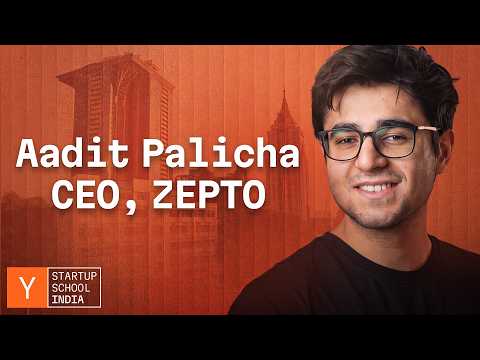
🚀 From Stanford Dropout to India's Grocery King: The Zeppto Story
Most billion-dollar companies don't start in a co-founder's apartment. Most don't begin as a WhatsApp group serving 30 neighbors. And most certainly aren't built by teenagers who turned down Stanford to deliver groceries themselves.
But Zeppto isn't most companies.
What began as two 17-year-olds trying to solve a neighborhood problem during COVID-19 lockdowns has evolved into India's largest fruits and vegetables seller, processing millions of deliveries per day and employing over 200,000 people. The company now operates at a scale of tens of thousands of crores in revenue (billions of dollars) with hundreds of millions in advertising revenue run rate.
This is the story of how Adit Palicha and his co-founder Kaivalya Vohra built Zeppto — not by following conventional wisdom, but by obsessively focusing on customer experience while everyone else optimized for unit economics.
🏠 The Accidental Startup: When College Plans Met Reality
In early 2020, Palicha and Vohra were two teenagers with plans to study computer science in California. When the pandemic forced them back to Mumbai, they found themselves with an unexpected gap year and a simple observation: people couldn't get groceries in their neighborhoods.
"The small mom and pop stores had issues with labor. The big guys that were delivering next day were all backlogged," Palicha explained. The solution started modestly — a WhatsApp group where they personally delivered groceries to neighbors in Mumbai's Andheri neighborhood.
But here's where the story gets interesting. This wasn't some grand strategic vision. There was no elaborate business plan. Just two kids solving a problem for roughly 30 customers in their immediate vicinity.
"We never started with a thought process of building a company," Palicha noted. "We started from a thought process of just solving a problem for like the 30 aunties in our neighborhood."
💡 The Power of Constrained Focus
What emerged from those early days became Zeppto's secret weapon: an obsessive focus on a tiny customer base with zero distraction.
"Being in COVID, locked in a room, it cut out all the noise of startups and VCs and 'this is the way to do it' and 'read this blog post,'" Palicha explained. "It was just like this person just doesn't like us and we would just sit and talk between ourselves of why doesn't she order from us, why does he order from us, why can't we get everybody to order from us."
This bottom-up, customer-obsessed approach led to a crucial insight: existing grocery delivery models weren't satisfying customers. Not because of small tweaks needed here or there, but because of fundamental structural problems with how the service was delivered.
Customers told them directly: selection was incomplete, pricing was too high, and delivery times were unreliable.
🔄 The Pivot That Changed Everything
The first version of the company — originally called "Kiranakart" — operated by doing doorstep delivery from existing mom-and-pop stores. It seemed logical: leverage existing inventory, minimize capital requirements, and get to market quickly.
But the data told a different story.
In early 2021, Palicha and Vohra made a radical decision. They took stock and put it directly into Vohra's apartment — creating the first "dark store" by necessity, not strategy. The results were immediate and dramatic.
"The one neighborhood where we were doing a dark store versus all the other neighborhoods that we were doing just mom and pop shop delivery — the one area where we were doing it from a dark store had three to four times the volume of the rest of the city for us."
This wasn't incremental improvement. This was a 10x difference in customer response.
The insight was clear: controlling the entire customer experience — from inventory to packaging to delivery — created dramatically better outcomes. This led to the birth of Zeppto's signature model: mini-warehouses (dark stores) promising 10-minute delivery.
🎯 Working Backwards From the Impossible
When Zeppto launched 10-minute delivery, industry veterans were skeptical. The model seemed financially untenable. Conventional wisdom said to start with what's operationally feasible and work forward to customer experience.
Zeppto did the opposite.
"If you remove all constraints and you just remove all the laws of physics and you just think from first principles, what's the most extreme positive customer experience you can give?" Palicha asked. "You start from there and then you work backwards from how can I make that possible."
This approach — inspired by Airbnb's Brian Chesky's famous "5-star, 7-star" framework — led to an unexpected discovery: when customer experience is exceptional, the unit economics actually improve.
"Because we nailed the customer experience of 10-minute delivery, doing the right selection, doing the right pricing, and doing this mini warehouse model, we got far more throughput and far more volume in our warehouses than people expected," Palicha explained. "And when you get to such a high volume in the same mini warehouse, all your costs become much lower by nature."
The lesson: when customers pull your product from your hands instead of you shoving it down their throats, magical things happen — including on the P&L.
🏭 Beyond the App: Building Physical Infrastructure at Scale
Most consumers experience Zeppto as a slick mobile app. But beneath that interface lies one of India's most sophisticated logistics and supply chain operations.
"If you remove all the software and the tech and the dark stores, fundamentally we're selling day-to-day groceries to the customer," Palicha emphasized. "The customer thinks of us as where they get their rice from. They don't think of us as some grand software company."
The company now operates:
- Hundreds of dark stores with minute design optimizations for speed and efficiency
- Industrial-grade automation in backend supply chain operations
- A dedicated hardware and robotics team within the tech organization
- India's largest fruits and vegetable supply chain, sourcing millions of units per week directly from farmers
- Sophisticated machine learning algorithms for demand forecasting that replaced days of manual work
"We employ north of 200,000 people," Palicha noted, "including delivery partners, pickers, packers, and truck drivers."
Every efficiency gain in this complex system translates directly to customer value: "Every rupee of cost you save across the supply chain by becoming more efficient is a rupee you've saved the customer or a rupee that you can invest in better selection, better delivery times."
💰 The Hidden Revenue Stream: Advertising Infrastructure
While quick commerce was the entry point, Zeppto has quietly built another massive business: a sophisticated advertising platform generating hundreds of millions in annual recurring revenue.
Major consumer brands like Coca-Cola, Pepsi, and Nestlé now bid on search keywords within the Zeppto app — similar to Google's ad auction model but for grocery intent.
"This ads business was very small two years ago or inconsequential," Palicha said. "Now it's become a very big part of our journey."
The company has leveraged AI extensively here, building tools that help brands generate keywords and predict return on ad spend with high accuracy. When advertisers see objectively better marketing efficiency, ad revenue follows.
🤖 The AI Transformation: Doing More With Less
Zeppto's embrace of AI hasn't been theoretical — it's driven measurable operational improvements across the business:
Supply Chain: Machine learning algorithms now forecast demand for millions of units per day, replacing manual processes that used to take teams of people days to complete. The result: higher forecast accuracy, faster dispatch times, and increased throughput in existing facilities.
Advertising: AI-powered tools help brands optimize keyword selection and predict campaign performance, directly contributing to the company's massive advertising revenue growth.
Corporate Efficiency: The company has eliminated nearly all third-party software costs, building internal tools instead. Hundreds of previously manual tasks are now automated. The result: a 500-person engineering team and 150-person analytics/product team achieving far more than headcount would suggest.
"We've cut almost all our software spends to zero," Palicha revealed. "We've been able to reduce a lot of inefficiencies and manual tasks in the system."
🎓 The Stanford Decision: When to Take the Leap
Perhaps the most frequently asked question Palicha fields: Should I drop out to start a company?
His answer is less heroic than expected — and more tactical.
"We took a year and in that period we did a lot of work to be able to get to some level of product-market fit," he explained. "We got to maybe a very early sign of PMF about 8-9 months into the journey, and that's when we started saying okay, there's retention, there's compounding in the business."
The decision point came when the business hit 10,000 orders per day and a ₹60-70 crore revenue run rate. Only then did they commit fully.
"You should have some product-market fit. You should have a real product that's working," Palicha advised. "You shouldn't take the risk before you have the proof of concept of something that's actually working."
The clincher: securing investor interest with an actual term sheet at that scale of traction.
📈 The Vision: Building India's E-Commerce Infrastructure
Looking ahead, Zeppto's ambitions extend far beyond quick grocery delivery:
Organizing India's Grocery Infrastructure: "Every major country in the world has their own form of grocery infrastructure," Palicha noted. "We basically think of ourselves as an organizing force in the grocery supply chain in the country."
The goal: become a major grocer across India's top 40-50 cities over the next four to five years.
Platform for Consumer Brands: Just as Walmart and Costco spawned entire ecosystems of consumer brands in the US decades ago, Zeppto aims to be the platform for India's next generation of consumer startups.
"If we can create 10 more large outcomes in day-to-day consumer brands, maybe someone here will start a consumer brand," Palicha suggested. "Why not?"
Employment at Scale: With over 200,000 people employed and growing, Zeppto sees job creation as core to its mission. "We're here creating employment, helping build a small part of India's infrastructure."
🎯 Lessons for Builders
Several principles emerge from the Zeppto story:
1. Start impossibly small. Thirty neighbors in a WhatsApp group beats a grand strategy deck every time. Focus creates clarity that scale obscures.
2. Customer experience compounds. When Zeppto improved delivery experience, they didn't see 10% better unit economics — they saw 3-4x higher volumes that transformed the entire business model.
3. Work backwards from delight. Don't start with what's operationally feasible. Start with what would blow customers' minds, then figure out how to make it real.
4. Vertical integration matters. Zeppto's success came from controlling the entire experience, not optimizing one piece of an existing value chain.
5. Surround yourself with people smarter than you. "We've just been incredibly lucky with the people that we've been able to surround ourselves with since the earliest stage," Palicha reflected. "You just have to be willing to look stupid and shamelessly ask questions."
⚡ The Takeaway
At 23 years old, Adit Palicha runs India's largest fruits and vegetables operation, manages over 200,000 employees, and has built one of the country's most sophisticated supply chain networks — all while maintaining the scrappy, customer-obsessed mindset that started with 30 neighbors and a WhatsApp group.
The Zeppto story isn't about having the perfect strategy from day one. It's about starting with a real problem, staying maniacally focused on customer experience, and being willing to pivot when the data demands it — even if it means turning your co-founder's apartment into your first warehouse.
As Palicha puts it: "It's impossible to build a financially viable, profitable business without customer delight. Customer delight is where financial value starts."
Everything else is just logistics.
More from Y Combinator

The Eternal Question: Why Every Ambitious Founder Should Experience the Center—A
For centuries, ambitious people working on cutting-edge pursuits have faced the same fundamental question: Should I move...

The Return of the Builder: Token Maxing, Agentic Engineering, and the Personal A
In a span of just a few months, Y Combinator President Gary Tan went from a 13-year coding hiatus to shipping hundreds o...

The Razorpay Story: When Regulatory Hurdles Become Moats and Conviction Beats Ca
📌 Introduction: From Oil Fields to India's Payments GiantFew companies embody the journey from zero to generational win...

Solving the Billion-to-One Problem: How a Diagnostics Platform Is Rewiring Healt
Key Takeaways One in 11 babies born in America this year will be screened by a genetic test that didn’t exist a decad...
Variance Emerges from Stealth with $21M Series A — Bringing Agentic AI to Risk,
SummaryVariance has come out of stealth with a $21 million Series A, unveiling a platform of purpose-built AI agents tha...

From Scaling to Symbolic: Why 2030 Looks Like an AGI Inflection Point
🚀 The Big PictureFrontier AI is entering a new regime. The most credible near-term path to broad automation runs throug...