🎯 A Simple, Repeatable Intraday Framework: Big Days, Tight Risk, Clear Rules
Perico
February 22, 2026

🎯 A Simple, Repeatable Intraday Framework: Big Days, Tight Risk, Clear Rules

Why This Matters

A refined, rules-based intraday framework just delivered a career-best single trading day and has set up one of the strongest months on record — despite a win rate hovering below 50% and even with a full week off. The edge comes from simplicity, high-probability filters, and asymmetric risk management.

“The market is effectively feeding us random information.”

The objective: eliminate discretion, trade only in high-probability conditions, and execute the same simple mechanics every day.


Philosophy: Simplicity Over Noise 🧭

  • Two core focuses remove most errors: the process targets high-probability conditions and tight, repeatable execution. The claim: dialing in these two can eliminate 90% of mistakes and bad habits.
  • Simple, measurable rules beat discretionary guessing. Without measurement, improvement is impossible.
  • Trades are selected for positive expectancy: small, contained losses and open-ended winners. As put plainly: “A+ setups, letting the winners run, and keeping the losses contained.”
“Simple checklist and simple rules is going to lead to positive expectancy in profitability over time.”

The Framework (Step 1): 15-Minute Fair Value Gaps 🎯

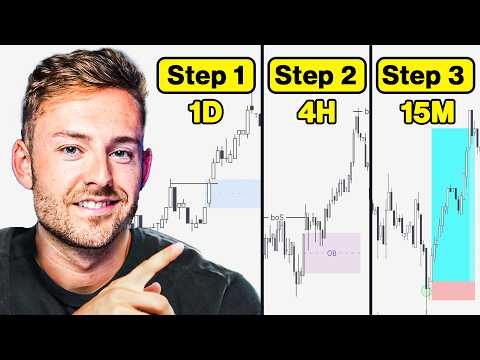
Start on the 15-minute chart, scanning the previous 2–3 days to map fair value gaps (FVGs) — three-candle sequences where the first and third wicks do not overlap, leaving a gap. These areas often behave like magnets, drawing price to refill inefficiencies before reversing.

  • Bullish FVG: in a bullish structure (price generally moving up), a three-candle sequence leaves a bullish gap.
  • Bearish FVG: in a bearish structure, the bearish gap forms similarly.
  • Key: watch whether the midpoint of the FVG is respected and price pushes away — a sign the level is meaningful.

Then, wait for the New York stock market open at 9:30. Liquidity surges, and clean responses often occur around pre-mapped FVGs.

  • Use 15m FVGs as targets or as response zones to confirm bias.
  • Aim to avoid intraday chop by letting higher-timeframe structure do the filtering.

The Framework (Step 2): 1-Minute Entry Model ⚙️

Once a 15m FVG response is in place and price displaces off the midpoint, drop to the 1-minute chart for entry timing.

  • For longs: after a 15m bullish response, wait for a 1m break in the lower-low/lower-high sequence that shows signs of strength and leaves a bullish FVG above a prior high. Enter at the FVG midpoint; stop below the FVG-producing candle.
  • For shorts: after a 15m bearish response, wait for a 1m break lower that leaves a bearish FVG below a prior low. Enter at the FVG midpoint; stop above the FVG-producing candle.
  • Initial target: set at 1:4 R and extend if structure allows.
  • Risk control: after price closes beyond the recent pivot in the trade direction, reduce stop to breakeven.
“At first setting my take profit at at least 1 to four.”
“That’s where I’m reducing my stop loss to break even.”

Confluences That Improve Selectivity 📐

More confirmation means fewer trades but a higher win rate. One powerful addition:

  • Underside/Overside Retest: map 1m trend structures (uptrends/downtrends) with trendlines and prioritize entries where a strong FVG candle breaks a level that previously held, then price retests the opposite side. This aligns the entry with structural shifts and improves the odds of an initial response sufficient to move stops to breakeven.

How It Plays Out: Real Trade Mechanics 📈

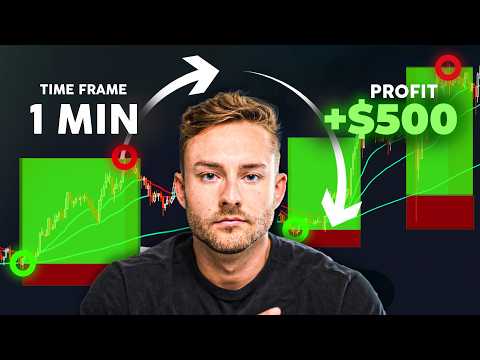
  • Short from 15m bearish FVG response: 1m bearish displacement created the entry. A $100 risk returned $5565.5R. After the next swing low broke, stops moved to breakeven; target hit at the midpoint of the next bullish FVG.
  • Long after 15m bullish response: 1m bullish displacement printed; a $100 risk produced $411. Partial profit taken at the first 1m FVG; remainder exited at a higher 15m FVG midpoint. The full move “would have been an 8x.”
  • Bearish continuation into next FVG: managing to breakeven after structure break, then targeting the next 15m FVG midpoint yielded $1,427 on $100 risk.
  • NY open drive to downside: entry at the 1m FVG midpoint into the next bullish FVG printed 6.7Rabout $635 on $100 risk.
“These trade opportunities present themselves on a daily basis.”

Scaling up uses the same process. For context, positions sized at $2,000 risk are cited alongside outcomes like “14R times the 2K risk” and a live example showing being “up 7K” before closing the trade into a 15m FVG target.


The Execution Checklist ✅

  • 15m Context: Has price responded to a mapped FVG and respected its midpoint?
  • Displacement: Is there a decisive move away from that FVG on the 15m, setting directional bias?
  • 1m Trigger: Did a clear structural shift occur (change of character) that leaves an FVG in the trade direction?
  • Entry & Risk: Enter at 1m FVG midpoint; stop beyond FVG-producing candle; initial TP at 1:4 R.
  • Risk Reduction: Once the last pivot is broken in favor, move stop to breakeven.
  • Confluence (optional): Prioritize setups aligned with an underside/overside retest of a broken 1m structure.

Test Before Deploying Capital 🧪

The process includes rigorous self-validation to avoid blind risk:

  • Bar Replay: Use TradingView’s bar replay to simulate sessions, place entries, and practice management.
  • Trade Journal: Log date, instrument, direction, time frame, checklist adherence, outcomes, fees, screenshots, and notes.
  • Metrics that matter: track total P&L over a set number of trades, average win, average loss, and distribution of R-multiples. Filter winners/losers to identify common traits.
  • Proof of concept first: “Test it for yourself to prove that it actually works.” Move to live capital or prop evaluation only after the data supports the edge.

Risk, Edge, and Expectations

  • This is simple but not easy. The advantage comes from repetition, patience, and strict adherence to rules.
  • A sub-50% win rate can still compound if losses stay small and winners remain open-ended.
  • More confirmation reduces trade count but improves win rate; fewer filters increase frequency but demand discipline to let the edge play out.

Bottom Line

A tight, FVG-driven, 15m-to-1m process — anchored to the 9:30 NY open, entered at 1m FVG midpoints with stops beyond the FVG-producing candle and initial targets at 1:4 R — can convert market noise into a systematic, high-expectancy playbook. The differentiator isn’t complexity; it’s the repeatable checklist, consistent risk control, and rigorous journaling that turns randomness into results.

More from Perico