🎯 From Range to Return: A 3‑Step Intraday Playbook for Consistent Execution
Perico
April 5, 2026

🎯 From Range to Return: A 3‑Step Intraday Playbook for Consistent Execution

Big Idea: Markets as Psychology Seeking Equilibrium

“All we’re doing is reacting and then playing into probabilistic outcomes over time.”

Price action is a live map of mass psychology — a blend of humans, institutions, and algorithms — continually pulled by market makers toward equilibrium and the path of least resistance. Once framed this way, the tape becomes intuitive: identify who’s in control, wait for a decisive shift, and ride the move with strict risk controls.

“Price is always trying to seek equilibrium to the path of least resistance.”

What’s New: A Repeatable 3-Step Intraday Playbook 🔧

This framework distills intraday trading into a simple, repeatable sequence:

  • Range — Define the current regime and key levels.
  • Change — Wait for a decisive shift in control.
  • Execution — Enter with precision using structural and liquidity cues.

It is designed for consistency across assets and timeframes, with a higher-timeframe map (e.g., 15-minute) feeding lower-timeframe execution (1-minute).

Step 1: Range — Establish Control and Map Liquidity

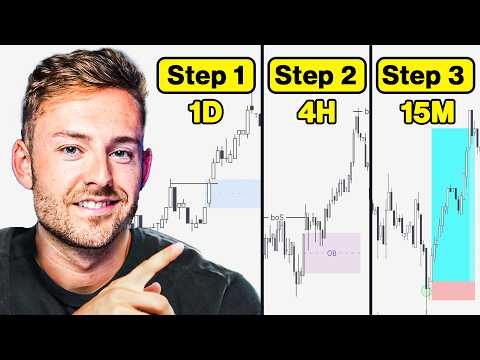
  • Start on the 15-minute to determine who’s in control. Use structure, not guesswork: track break of structure (BoS) and change of character (ChoCh) through sequences of highs and lows to define trend.
  • Mark liquidity inflection levels — the swing points and inflection areas that repeatedly anchor reactions and trend confirmation.
  • Layer tools for context:
    • Inevitrade Pro Plus — an advanced RSI with highlight strips that cluster around overbought/oversold conditions, best used with structure to time areas rather than absolute tops/bottoms.
    • IT Foundation — segments 24-hour sessions and flags the New York open (red dotted line), a frequent source of initial momentum and directional confirmation.
  • Pre-mark fair value gaps (FVGs) on the higher timeframe: a three-candle sequence where the wicks of candle 1 and candle 3 do not overlap. Drag these zones forward — price often gravitates into them.
“We can look at these two things and figure out what is likely to happen…and put ourselves in a generally great position to capitalize.”

Step 2: Change — Demand Decisive Shifts on the 1-Minute

  • Drop to the 1-minute for fresh control changes. Require:
    • A clear change of character (ChoCh) at the intraday range boundary.
    • A high-impact candle that breaks and closes through the level.
    • An FVG produced by — or very near — that decisive break.
  • This filtration avoids noisy chop and late entries. If the move lacks conviction or a clean FVG, stand aside.

Step 3: Execution — Precision Entries, Disciplined Exits 🎯

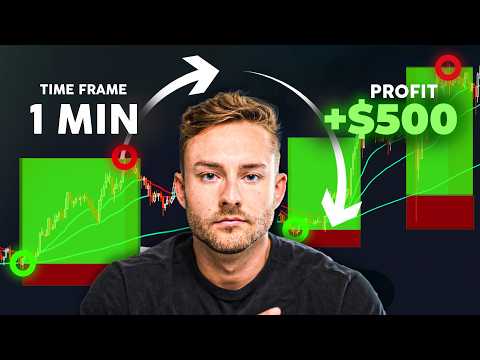
  • Entry: Place limit orders around the midpoint of the FVG that formed on the decisive shift. Enter slightly before the midpoint to improve odds of fill.
  • Stop: Tuck the stop just beyond the liquidity inflection level that defines the invalidation line for the move.
  • Initial target: Anchor around a standard 1:4 risk-reward as a baseline framework.
  • Manage risk: After a subsequent break of structure in trade direction, move the stop to break-even to eliminate downside. Avoid preemptive stop-tightening; retests to entry are normal.
  • Final targets: Aim for the next higher-timeframe FVG midpoint(s). In strong trends, runs can extend to 8–9x initial risk.

Illustrative specifics included:

  • Position sizing example: risk set to 100 with a unit size of 344 to match the defined stop and entry.
  • Reward examples discussed ranged from the base 1:4 toward multi‑R extensions such as 6R and 8–9x risk in favorable continuations.

When to Stand Down 🛑

  • High-impact fundamental news at the entry window increases variance and slippage — conditions become less optimal for this model.
  • No decisive break: If there’s only a minor close without a strong impulse or a clean FVG, the signal lacks quality.
  • Sideways chop with no high-impact candle or volume pickup: pass until the setup aligns.
“If we’re just getting in via sideways chop…these are not high-conviction areas.”

Psychology and Expectancy 🧠

“Happiness literally equals expectation minus reality.”
  • Detach outcome expectations from single trades. Focus on executing the playbook and collecting data.
  • Expect strings of losses. Streaks of four or five consecutive losing trades are normal within this approach.
  • Let winners run. A pair of 6R wins can offset several standard 1R losses (e.g., two 6R wins = +12R; minus seven or eight 1R losses still nets a positive result).

Live Session Takeaways

  • Back‑to‑back session examples followed the same process: higher‑timeframe structure → intraday ChoCh + FVG → midpoint entries → targets at higher‑timeframe FVGs.
  • Invalidations happen. Full, contained losses are part of the model — the key is to keep risk fixed and allow extension when structure confirms.

Playbook Checklist ✅

  • Map the 15-minute: Identify BoS/ChoCh, mark liquidity inflection levels, plot higher‑timeframe FVGs; note the New York open.
  • Wait for Change on the 1-minute: Demand a decisive close plus an FVG near the break.
  • Enter at FVG midpoint: Place stops just beyond liquidity inflection; consider fills slightly before midpoint.
  • Manage: Shift to break-even only after a new BoS in trade direction; avoid premature stop-tightening.
  • Targeting: Base case 1:4; then hunt higher‑timeframe FVG midpoints for extensions (e.g., 6R, 8–9x when momentum persists).
  • Stand down during high-impact news or weak/indecisive breaks.

Context and Credibility

  • The framework has been built and refined with a team of verified six‑figure funded traders and documented across public and private channels.
  • The creator has more than 5 years as a full‑time trader and investor and reports being on track to cross the six‑figure mark this year using this strategy.
“All we’re trying to do is build mechanisms that we can easily repeat over time and capitalize when we are correct.”

More from Perico