TheRollupCo5 min read
Dragonfly's Haseeb: perps beat tokenization near-term, but savers will flip that later
Guests on The Rollup traced a rotation across perps, tokenization and prediction markets, with Alpaca's Yoshi detailing how Robinhood's tokenized stocks are custodied and why they aren't "synthetic."
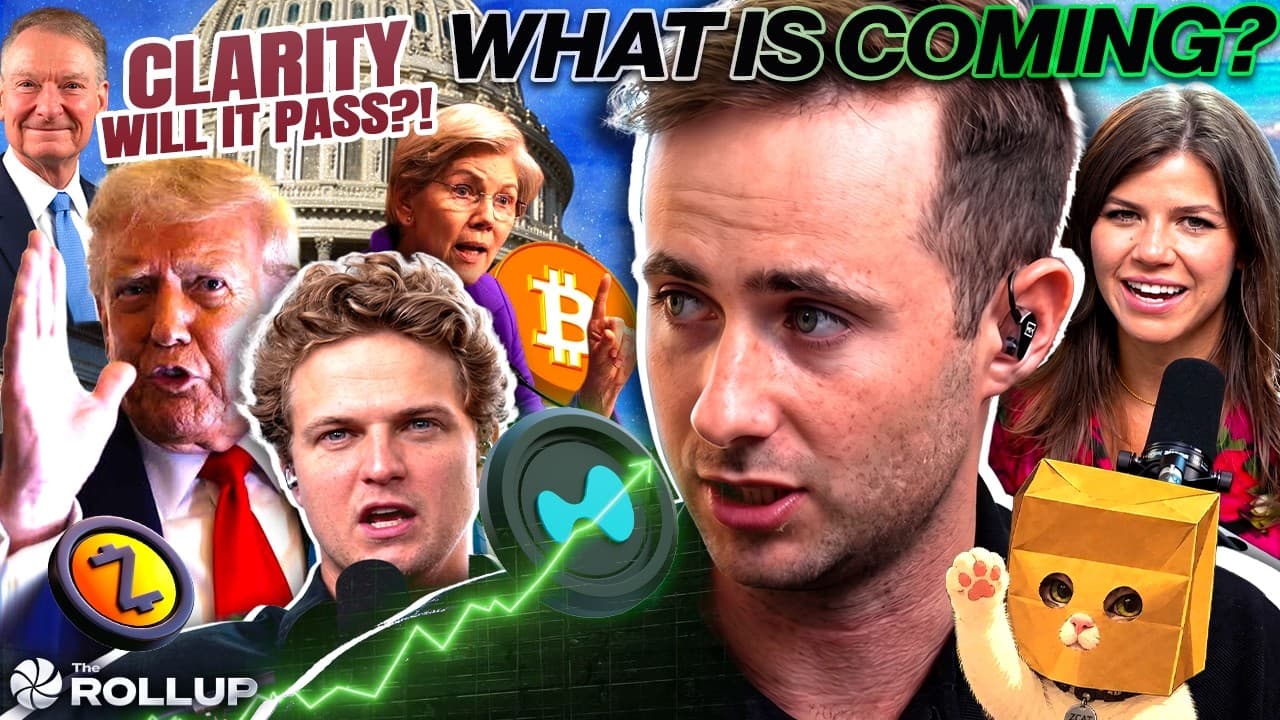
AI summary of “LIVE: TOKENIZATION SUPERCYCLE Continues! Market Wants HIGHER! Eric Conner, Haseeb & Yoshi Join”
Key takeaways
- Haseeb Qureshi of Dragonfly says perpetuals will outgrow tokenization "at least for the next year," calling Hyperliquid's real-world-asset volume the bigger long-term prize.
- Qureshi values variational at roughly $1-2 billion and lighter at 4-5% of Hyperliquid's fully diluted value, using Hyperliquid-vs-Binance market share as his benchmark.
- Eric Conner says he is "very underexposed" to ETH but sees Robinhood Chain and meme-stock liquidity (like Bonercoin) as an underrated new market meta.
- Yoshi Yokawa of Alpaca says tokenized Robinhood and Coinbase stock tokens are "cash stock tokens," not synthetic, backed one-to-one and custodying about 94% of tokenized US equities.
- Qureshi expects a Supreme Court ruling, likely next year, on whether states or federal regulators control prediction markets after New York's lawsuit against Polymarket.
Haseeb Qureshi lays out a sequencing thesis for the "big five" sectors
Haseeb Qureshi of Dragonfly, whose firm closed its fourth fund at $650 million in February bringing assets under management to roughly $4 billion, walked through how he ranks stablecoins, perpetuals, tokenization, prediction markets and vaults. He said vaults are his least favorite category because "it's not obvious to me that they're going to have a lot of defensibility," arguing issuers rather than vault platforms may capture most of the value.
On perpetuals versus tokenization, Qureshi argued perps will win in the near term because they don't require holding the underlying asset: "with a per it's all cash settled... nobody has to go out there and actually hold AMC onchain in order for you to have AMC per trading around." He said tokenization matters more for savers holding positions long-term, while most crypto-native users are speculating rather than saving, so "if you're talking about like one year from now, I would still bet on pers over tokenization."
He described Hyperliquid's addressable market as extending well beyond crypto trading, noting "already more than 50% of their volume is RWAs," and framed the ambition as more like building the next NASDAQ than competing with Coinbase. He valued variational near $1-2 billion and lighter at roughly 4-5% of Hyperliquid's size, using a static "freeze the market where it is today" framework.
Qureshi on Kalshi's wash-trading allegations and the Polymarket lawsuit
Asked about Kalshi wash-trading claims, Qureshi said "the ratio between the open interest and the trading volume on Kalshi is a little bit lopsided," calling it "not great" but not central to Kalshi's business. He said the company's public handling of the episode was "incredibly entertaining."
On New York Attorney General Letitia James calling Polymarket an unlicensed gambling operation, Qureshi said the dispute is fundamentally about state tax revenue rather than legality, and pointed to a circuit split among appellate courts on whether prediction markets are federally regulated.
"This is not like a oh my god I can't believe they did this. It's like oh every single state is fighting this fight because they all want money."— Haseeb Qureshi. He expects the case to reach the Supreme Court, likely with a ruling "probably sometime next year," and guessed the court might split jurisdiction between federal and state authority rather than rule cleanly for either side.
Qureshi and the host on Near and Zcash's privacy resurgence
Discussing Near and Zcash, both Dragonfly holdings, Qureshi tied their rise to "the reawakening of privacy as Bitcoin and crypto is institutionalizing," framing it as thesis-antithesis dynamics running in parallel. He described Near as solving account abstraction "from the other side," unifying access across chains and venues rather than through a single app like Phantom, and contrasted crypto's dual impulses to publicize gains and later "disappear into the spectre of privacy."
Eric Conner on ETH, perps and Robinhood Chain
Eric Conner, co-author of EIP-1559, said he now holds positions across multiple perpetuals platforms rather than maximalist bets, after missing part of the prior cycle by staying concentrated in ETH: "I'm never going to tie myself to just one coin again." He said he bought Hyperliquid's HYPE and sees lighter, built with Ethereum settlement guarantees, as a major eventual winner in the perpetuals space.
On ETH itself, Conner said he is "very underexposed" and does not think ETH needs a narrative to rally:
"I don't think it needs a thesis. I actually think price leads narrative."— Eric Conner. He said he could "easily see ETH hate rallying to 20K," while noting he previously jinxed ETH's price years ago.
Conner argued meme-stock tokens paired with company shares, such as Bonercoin tied to Hims & Hers, represent an underrated new meta, citing a claim that Bonercoin accounted for "10% of the onchain volume of the HIMS stock" on one trading day. He said Robinhood's tokenized-stock chain benefits from Ethereum composability, allowing instant liquidity bootstrapping through meme-coin pools that other chains could not easily replicate.
Conner and the host on mixed reactions from public company CEOs
Addressing why AMC's CEO objected to tokenized shares while Hims & Hers' CEO embraced them, Conner speculated it may stem from a misunderstanding about whether tokenized shares are "synthetic," possibly rooted in AMC's history with naked shorting disputes, though he acknowledged "I really don't know why he wouldn't be bullish here." He suggested a generational gap between older and younger CEOs in understanding tokenization.
He also flagged a structural question left unresolved: if a meme-stock token's market cap outpaces the underlying company's own market cap, as briefly happened with Hims shares trading at roughly ten times their normal price on a weekend before market makers minted more shares, "I'm not sure many people know what's going to actually happen if that occurs."
Yoshi Yokawa explains custody and disputes "synthetic" framing
Yoshi Yokawa, CEO of Alpaca, said his company custodies roughly 94% of tokenized US equities, backing over $1.5 billion in shares issued by Robinhood, Coinbase and others. He rejected the term "synthetic" applied to these tokens, distinguishing them from pre-2008 synthetic CDOs:
"What we're talking about as the SPV wrapped tokens stock tokens are not synthetic it's actually backed by real share one to one."— Yoshi Yokawa. He said in-kind redemption between tokenized and traditional shares is technically doable but requires resolving regulatory nuances, such as needing a traditional brokerage account to hold the underlying share.
Yokawa described Alpaca's work with the DTCC ahead of its tokenization pilot launching in October, noting three distinct tokenization models (sponsored tokens, DTCC custody tokens, and SPV-wrapped tokens) each carry different liquidity and settlement questions still unresolved. He also said Alpaca added Broadridge's governance stack so tokenized shareholders retain proxy voting rights, calling this necessary to attract institutional participation.
Yokawa on custody market share and where the sector is headed
Asked whether Alpaca expects to keep its roughly 94% share of tokenized equity custody, Yokawa said he expects more competitors to enter, arguing the more relevant number is how much of the $350 trillion global securities custody market — currently held roughly half by four incumbent institutions — eventually moves onchain. He said Alpaca is trying to share infrastructure rather than compete at this early stage: "we cannot be competing right now because it's so freaking small."
He also described Alpaca's "agent-first brokerage" push, arguing financial interfaces must become fully programmable for AI agents to interact directly, and noted the show discussed a same-day CFTC guidance update the host said "is providing a clear path for tokenized assets and qualifying crypto to function as collateral in regulated derivatives markets."
Written by AI from the video's transcript. It can compress, misattribute or miss context — the original video is the source. Not investment advice.