📍 The Zip Code Advantage
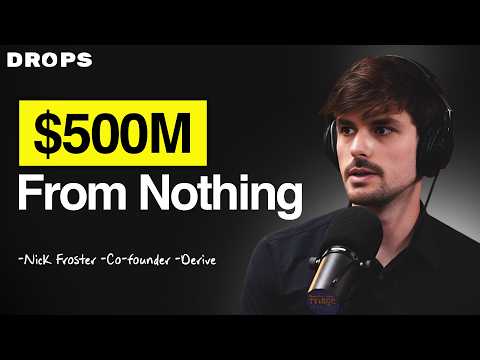
The finance industry operates on a myth that few dare to acknowledge openly: success on Wall Street is largely determined by zip code, not intelligence. This uncomfortable truth emerged from three decades inside the machine, starting from the bottom of Morgan Stanley's derivative desk and rising to partner by age 30.
Despite graduating from a college that Morgan Stanley didn't even recruit from — and being the first in the family to graduate college at all — the path upward moved surprisingly fast. Within five years, the firm asked for leadership of a new international office in Brazil. Not because of pedigree, but because the math worked.
"The metric for determining a lot of the success that is money-based in Wall Street is based on zip code. It's based on where you were born."
Growing up without money, with a father who never graduated high school and worked construction, created a unique vantage point. The realization came quickly: those born in the right zip codes had advantages that had nothing to do with raw capability. This became crystal clear after moving to Brazil and witnessing people trapped in poverty cycles, unable to leave the countryside — not due to lack of intelligence, but lack of access to education.
💰 The Sociopath Premium
Six months into the Wall Street experience revealed an uncomfortable pattern. The industry rewards a specific personality type: the bigger the sociopath risk-taker, the more likely they are to make the most money.
Here's how the math works: If ten people operate as extreme risk-takers — whether through aggressive strategies, questionable ethics, or outright rule-breaking — at least one will hit big. That single success story then becomes the model. People begin associating the big wallet with intelligence, when in reality, the correlation is weak at best.
The derivative desk proved an ideal training ground for understanding this dynamic. Skills that seemed exclusive to elite education — trading mechanics, derivative calculations, mental math — turned out to be learnable patterns. The real edge? A father who taught horse race handicapping provided better probability training than most MBA programs.
🎓 The Education Arbitrage
Traditional finance recruiting operates on prestige signals. Firms assume graduates from top schools possess superior capability. The reality inside these institutions tells a different story.
What separates Ivy League graduates from state school students isn't necessarily cognitive horsepower — it's access to better teachers, stronger networks, and institutional knowledge. They've memorized information better, been coached by smarter people, and gained cultural fluency in institutional settings.
This creates an exploitable arbitrage. Artificial intelligence is now democratizing access to world-class knowledge. Anyone with curiosity and internet access can now learn from systems that aggregate insights from thousands of the smartest practitioners across any domain.
"With artificial intelligence, you can learn from the smartest person you would ever meet in your lifetime times two, three, four, 10, 100, and just growing every day."
📊 The Money Paradox
Early career goals centered on a simple benchmark: earning $100,000 annually. For context, this represented multiples of what a construction worker father earned. It seemed like the finish line — the level that would bring lasting satisfaction.
That assumption proved completely wrong. No matter how much money accumulates, the goalpost shifts. More troubling: money becomes the primary competitive metric. In school, grades mattered only enough to keep parents satisfied (a B+ was the sweet spot). In sports, clear scorekeeping existed — baskets, goals, home runs. In finance, everything reduces to compensation.
Titles proved meaningless. Making partner at Morgan Stanley by age 30 changed nothing material about daily satisfaction. The only metric that moved was the number in the bank account, which created its own problems.
👨👩👧👦 The Generational Wealth Trap
Accumulating wealth without having grown up with it creates an unexpected challenge: how do children develop work ethic when they've never experienced scarcity?
Growing up without money provided natural motivation. Every dollar earned felt meaningful. But raising children with money removes that driving force. They look around at abundance and lose the hunger that created it in the first place.
This paradox plagues many who've built wealth from nothing. The very success that was supposed to make life better for the next generation potentially robs them of the character-building experiences that created the wealth.
🎯 Redefining Success Metrics
After three decades, the framework has shifted. Money enables experiences — travel to Japan or Italy, access to better healthcare, security for family. These benefits are real and shouldn't be dismissed.
But the pursuit of money as the primary goal creates misery. Many of the wealthiest people encountered on Wall Street rank among the most miserable. They've optimized for the wrong metric.
The emerging philosophy: "If you surround yourself with only things that bring you joy, you will have a much better life." Money should serve as a tool to enable joy, not as the scoreboard itself.
🤖 The AI Equalizer
The democratization of knowledge through artificial intelligence represents the biggest opportunity to break the zip code curse. Traditional barriers — elite education, expensive mentorship, network access — are collapsing.
Current mission: helping people across age groups leverage AI to access opportunities previously reserved for those born in the right zip codes. The arbitrage that's existed for decades is normalizing.
Virtual reality will eventually allow people to "visit" Italy or Japan without the cost barrier. But even before that arrives, AI is making world-class expertise accessible to anyone with curiosity.
✅ Key Takeaways
- Wall Street success correlates more with birthplace than intelligence — the zip code you're born in creates advantages that compound over time
- Risk-taking sociopaths succeed through volume, not skill — when enough people take extreme risks, at least one will hit big, creating a false narrative about competence
- Elite education creates access, not superior capability — the gap between top schools and regular institutions is shrinking with AI-powered learning
- Money fails as a primary success metric — no amount proves sufficient, and the wealthiest often rank among the least happy
- Wealth creates unexpected problems for the next generation — children raised with abundance lack the motivating force of scarcity
- AI is demolishing traditional barriers — access to world-class knowledge no longer requires elite credentials or expensive education
"People are much smarter than they realize. They just need to use their brain, remain curious, and talk to someone who's smarter than they are — and that's the beauty of technology and artificial intelligence."
The finance industry's dirty secret isn't complex derivatives or insider networks. It's simpler and more uncomfortable: the system was designed to favor those born into the right circumstances, then justify that advantage through narratives about merit and intelligence. Technology is finally breaking that model.