🧭 Time Horizons, Dynamic Systems, and the Engineering of Renaissance Politics
The foundation for understanding monetary scarcity wasn't built in economics textbooks—it was forged in the world of nonlinear dynamic systems and control theory at MIT. The study of feedback loops, time constants, and system behavior provided an intellectual framework for recognizing how different time horizons shape outcomes.
Consider the classic parable: algae doubling daily in a pond, filling it completely on day 30. When does the problem become visible? The answer lies in understanding time constants—the critical parameter governing how quickly feedback mechanisms operate in any system.
This thinking extended beyond biology into political economy. A mathematical model of a Renaissance Italian city-state—essentially a computer simulation of Machiavelli's Discourses—explored how different branches of government with varying time horizons create stability or chaos:
- Judiciary (lifetime appointments): Long time constant, maximum stability
- Legislative branch (two-year terms): Short time constant, high volatility
- Senate (six-year terms): Moderate time constant, conservative influence
- Executive leadership: Varies dramatically—lifelong rule versus four-year election cycles
The simulation revealed the precise dynamic patterns under which political economies either thrive or collapse. The lesson? Time preference alignment is everything. An employee with a four-year vision working under a boss with a four-week planning horizon faces inevitable failure. Traders operate on four-day or four-week cycles, while meaningful business success rarely materializes in less than four years—and truly great businesses typically require a decade of focused execution.
💡 The Scarcity Blind Spot: What Even MIT Couldn't Teach
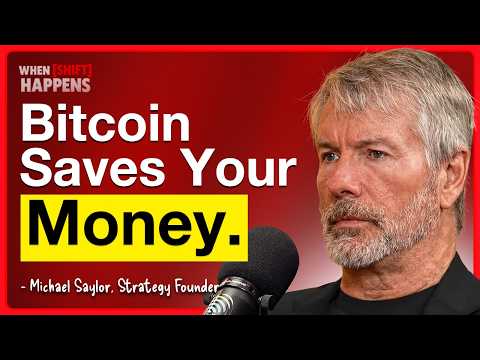
Despite graduating first in class at MIT with deep expertise in engineering and dynamic systems, there was a fundamental gap: monetary scarcity was never truly understood until the discovery of Bitcoin.
This wasn't stupidity—it was a universal blind spot. How could anyone conceptualize absolute scarcity when it had never existed in human history?
"You can't really understand scarcity until you've seen actual engineered scarcity."
Gold served as sound money for millennia, but it was only relatively scarce. The global gold supply inflates at approximately 2% annually, meaning the total supply doubles every 35-36 years. By comparison, beachfront property in Palm Beach is actually more scarce—the coastline isn't doubling every few decades.
Meanwhile, fiat currency supplies expanded far more aggressively. Over a century, dollar supply growth averaged 7% or more annually—a rate that was simply accepted as normal until a catalytic moment forced a complete reassessment.
🔥 The 2020 Wake-Up Call: When $500 Million Earned Zero
The paradigm shift arrived with brutal clarity in 2020. When the Federal Reserve slashed interest rates to zero and explicitly stated "we're not even thinking about raising interest rates," the implications were shocking for anyone holding significant cash reserves.
The scenario was equivalent to owning a building generating $25 million annually in rent, only to have a politician declare: "Rent control. Free occupancy. Zero income. For a decade. Deal with it."
This wasn't theoretical. With $500 million in cash suddenly earning nothing while the Fed printed money to fund a shuttered economy, currency became demonstrably non-scarce. The choice was stark: accept permanent value erosion or find an alternative store of value.
The initial search considered traditional hedges—gold, real estate—but the quest evolved into something more specific: digital gold with the network effects of a big tech monopoly. The Facebook of money. The Google of monetary networks.
That search led to Bitcoin.
⚡ The Thermodynamic Revolution: Absolute Scarcity Discovered
Studying Bitcoin revealed something unprecedented: Satoshi Nakamoto's protocol included a hard cap of 21 million coins. This wasn't inevitable—the code could have specified 2% annual inflation, mirroring gold's supply expansion. Instead, it mandated zero supply growth.
This created the first absolutely scarce commodity in human history. Not silver. Not gold. Not palladium. Not diamonds. Not even land—Boston added half its landmass through reclamation, and half of Miami Beach is built on former swampland.
For someone trained in aeronautical engineering and thermodynamics, the implications were immediately clear: Bitcoin represented an adiabatic system—a closed, thermodynamically sound, conservative energy system with zero heat loss and zero energy leakage.
"In engineering, you can't solve a problem unless you assume an adiabatic system—a closed energy system."
This is foundational. When designing an aircraft wing or any complex system, engineers must assume closed-system dynamics. An open system introduces catastrophic variables: lightning strikes, pressure leaks, oxygen depletion. When designing a sealed room, you don't want "energy lapse"—otherwise, everyone suffocates or freezes.
Bitcoin was the monetary equivalent: a closed system that doesn't lose 2% of its energy annually like gold.
📉 The Half-Life Analysis: 10 Years, 36 Years, or Infinity?
This insight enabled a stark comparative analysis using the concept of half-life—the time required to lose half of an asset's purchasing power:
- U.S. Dollar (7% annual inflation): Half-life of approximately 10 years
- Gold (2% annual supply growth): Half-life of 36 years
- Weaker currencies: Half-life potentially as short as 5 years
- Bitcoin (0% inflation post-halvings): Half-life of infinity
The mathematical realization was profound:
72 ÷ 2% = 36 years
72 ÷ 0% = ∞
The difference between 2% inflation and 0% inflation isn't incremental—it's the difference between eventual decay and immortality. Between living 36 years (half-power) or 100 years versus living forever.
This wasn't "slightly better than gold." This was infinitely superior to every capital asset or monetary asset ever created.
🌍 The Pre-Electricity Problem: Imagining What You've Never Seen
The challenge of explaining Bitcoin's significance mirrors the impossibility of describing electricity in the year 1500. How do you conceptualize clean, infinite, silent, efficient power transmission when you've never witnessed it?
Electricity is colorless, odorless, and invisibly powerful—running lights, machines, communications. Every economist before Bitcoin was like an author in 1500 trying to explain energy without ever seeing electrical current.
"How do you understand economics if you've never seen perfect money—perfect economic energy?"
Bitcoin represents economic energy moving through time and space with zero energy lapse. It's as fundamental as light or electricity, yet entirely unprecedented. Aristotle couldn't imagine electricity because he never observed it. Similarly, traditional economic frameworks couldn't conceptualize absolute monetary scarcity because it never existed.
But once seen, it cannot be unseen.
🔬 Paradigm Shifts Require Crisis: The Max Planck Principle
Max Planck famously observed: "Science advances one funeral at a time." The old guard rarely embraces revolutionary ideas because they don't need to. When you possess money, power, fame, and respect built on existing frameworks, why adopt a new paradigm?
Paradigm shifts require near-death experiences—wars, economic collapse, or generational displacement. The people who need new ideas are the 20-somethings and 30-somethings with everything to gain and nothing to lose. Especially when following the previous generation's playbook guarantees failure.
This is the lived reality: an entire generation aged 25-35 cannot afford housing. The 40-year-old Uber driver isn't an outlier—it's a warning signal. When traditional paths to wealth accumulation are severed by monetary debasement and asset inflation, new solutions aren't optional.
⚡ The Speed of Money in a Digital Age
The modern imperative is clear: if you move fast, your money should too. Legacy banking infrastructure—with delays, friction, and geographic restrictions—is incompatible with global, instant commerce.
Emerging solutions allow spending stablecoins across 170+ countries with cards accepted at 150 million+ merchants. No waiting. No bank intermediaries. Just money that keeps pace with the speed of modern life and business.
In a world where monetary half-lives determine generational outcomes, the discovery of absolute scarcity isn't academic—it's existential. The thermodynamic perfection of a closed monetary system offers what no previous generation could access: economic energy that doesn't decay.
The question isn't whether this represents a revolution in economic thinking. The question is how quickly the paradigm shift accelerates—and who positions themselves accordingly before the old guard's final funeral.