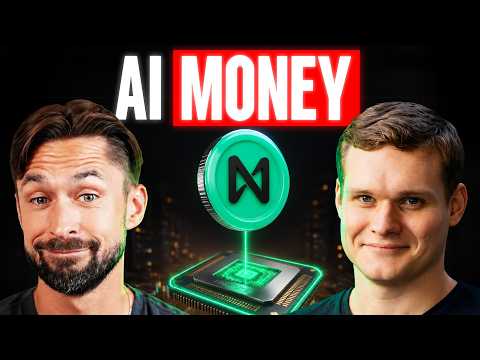
🤖 Near Token's AI Upgrade: Stake for Inference in the Agentic Economy
🔥 A New Primitive: Staking Near for AI Inference
The Near ecosystem has introduced a significant upgrade to the Near token, establishing a formal integration between the Near AI Cloud and the Near token itself. The mechanism is straightforward: stake Near, receive free AI inference for personal use or for agents. This shifts the economic relationship between token holders and AI compute, creating what Illia Polosukhin, co-founder of Near and co-author of the Transformer paper, describes as "universal basic AI."
Unlike traditional models where AI inference requires recurring subscription fees or pay-per-use structures, Near's approach allows token holders to trade off their staking yield to access continuous inference capacity. This matters for a specific reason: autonomous agents require 24/7 uptime and constant access to intelligence — a property that becomes economically unsustainable under traditional credit-based AI pricing models.
"If you're holding Near, you should have access to some amount of AI inference that is available to you. You can use it in your agent or in other applications."
📊 The Vertically Integrated Stack: Blockchain, Intents, and AI
Near's architecture is best understood not as a collection of products, but as a vertically integrated stack where each layer reinforces the others:
- Near Blockchain: The foundational layer providing cryptographic primitives, security, and settlement
- Near Confidential Intents: A compute and transaction layer that routes assets, creates liquidity for compute hours, and captures protocol fees
- Near AI Cloud: A confidential and verifiable inference platform built on trusted execution environments
The AI Cloud offers two critical properties that differentiate it from centralized providers like OpenAI or Anthropic:
1. Confidentiality: End-to-end encryption ensures that no third party — including Near itself — can access user prompts or responses. The platform uses trusted execution environments (TEEs) to enforce this, relying on hardware-level security assumptions around manufacturers like Intel.
2. Verifiability: Every inference call generates a cryptographic attestation proving which model was used, what prompt was submitted, and what output was returned. This chain of provenance includes the specific GPU and CPU involved, with all hashes and signatures available for inspection.
"You get the attestation signed with a chain of provenance including the specific GPU you had, specific Intel CPU you had, and the encryption of that… the hashes and everything. In our front end, you can actually see the full stack of signatures and message hashes."
This matters particularly for agentic systems, where unverifiable outputs could result in manipulated tool calls, file deletions, or responses containing malware. Polosukhin noted research showing that third-party API routers can inject malicious outputs into agent workflows, making verifiability a security requirement, not a feature.
⚙️ How the Economics Work: Yield-for-Inference
The staking mechanism functions as a yield trade-off. Normally, staking Near generates yield for token holders. Under the new model, that yield is redirected to compute providers who supply the GPUs powering the Near AI Cloud.
Here's how the supply chain connects:
- Users stake Near tokens to the Near AI validator (or similar mechanisms in development)
- The staking yield is distributed to compute providers who connect GPU clusters to the network
- These providers receive Near emissions proportional to the inference they deliver
- Users receive inference capacity proportional to the amount of Near they stake
Near initially bootstrapped the network using its own GPU infrastructure, but the design is built to decentralize over time. Third-party compute providers can join the marketplace, verify their hardware through attestation, and begin earning Near emissions. The confidential nature of the platform ensures providers cannot access user data, reducing compliance and trust barriers.
"The idea is you stake, the yield is being generated by staking to Near AI validator… that is being distributed to the compute providers."
🔐 Confidential Intents: The Commerce Layer for AI
Near Confidential Intents serve as the settlement and routing layer for the entire stack. Originally launched for crypto asset swaps, the system now extends to compute markets, enabling:
- Trading and creating liquidity for GPU hours as an asset
- Facilitating secure, private transactions for AI inference
- Capturing protocol fees from every transaction, which contribute to Near's buyback-and-burn mechanism
According to the revenue.near.org dashboard, protocol fee capture has ranged between 20% and 50% of Near emissions, driven by activity from both the blockchain itself and the Intents product. With the AI Cloud now integrated, Near expects similar revenue mechanics to emerge as adoption scales.
Polosukhin described the goal as creating a transparent, liquid compute market — a stark contrast to the current opaque, contract-heavy GPU market where pricing, availability, and quality are difficult to assess.
"The compute market right now is a complete disaster. It's very opaque. Every cloud is deal-making left and right. This is exactly what blockchain is made for: creating transparency, liquidity, allowing people to reduce risk."
🤖 Autonomous Businesses: The 24/7 Agent Economy
The vision Near is building toward involves autonomous agents operating continuously without human intervention. These agents would:
- Hold Near on their balance sheet to ensure uninterrupted access to AI inference
- Execute on-chain transactions and interact with real-world services via Intents
- Hire other agents, verified through cryptographic attestation, in a decentralized agent marketplace
- Operate businesses, manage supply chains, conduct research, or perform financial operations — all autonomously
Near's IronClaw agent framework is the consumer-facing product enabling this. It provides a full agent capable of writing code, managing emails, replying in Slack, and performing other organizational tasks. IronClaw is unique in being a multi-tenant agent system, where each user is cryptographically isolated within the same instance — a feature Near claims no other platform currently offers.
"If you want true autonomy, you need properties where it can run 24/7, has access to intelligence, has access to finances, and is able to execute actions in the digital world and ideally the real world."
This is the future Near is building toward: agents that think, transact, and operate continuously — not just in response to human prompts, but as persistent, self-directed entities.
🌐 Adoption: Venice, Brave, and Beyond
Near AI Cloud is being integrated by major consumer-facing platforms:
- Venice: Offers end-to-end encrypted inference modes powered by Near
- Brave: Integrating Near AI Cloud into its browser, which serves over 100 million users
- Government of Bermuda: Using Near AI for handling sensitive financial and pension data with strict privacy and verifiability requirements
- Abound: A remittance platform for Indians in the US sending money to India, using Near AI for concierge services and Near's payment infrastructure for stablecoin transactions
These partnerships reflect Near's hub-and-spoke model: Near AI Cloud acts as the infrastructure hub, while consumer-facing products like Venice and Brave serve as the spokes, delivering privacy-first AI experiences to end users.
📈 Value Capture: AI Money with Sovereign Security
Near's value capture thesis is multifaceted, but Polosukhin summarized it as "AI money with sovereign security."
The Near token serves three roles:
- Store of Value: Backed by blockchain security and programmability
- Access to AI: Staking provides continuous inference capacity
- Transaction Settlement: Intents capture fees from every interaction, with buybacks reducing supply
Near is also one of the few blockchains where smart contracts can call AI inference mid-transaction. A transaction can pause, send a prompt to the AI Cloud, receive a verifiable response, and continue execution based on that output. This is only possible because the inference is cryptographically verifiable and integrated into the blockchain's execution environment.
"You can actually call an AI inference out of your smart contract because the transaction can pause, wait for AI inference, and unpause the transaction and continue. Inside a token transfer, you can call AI, get the response, and decide how you want to transfer a token."
This matters for use cases like insurance settlement, autonomous businesses, or any scenario where financial outcomes depend on AI-generated outputs. Without verifiability, such integrations would be impossible.
🔮 What's Next: Compute Markets and Real-World Assets
Near's roadmap includes:
- Scaling the decentralized compute marketplace to allow third-party GPU providers to join
- Creating liquidity for compute as an asset, enabling trading, financial instruments, and risk reduction
- Expanding Real-World Assets (RWAs) and yield products within the Intents framework
- Launching prediction markets and other DeFi primitives on Near.com
- Continuing development of IronClaw 1.2, which will generate custom, user-specific interfaces on the fly
Polosukhin emphasized that Near is positioning itself at the intersection of two major trends: the shift toward AI-driven computing and the need for blockchain-based trust, identity, and settlement.
"All the economy is moving to AI and blockchain. That's the TAM."
🧠 Open Questions: The Future of AI and Software
Polosukhin raised several unresolved questions about the future of AI:
Will AI collapse the SaaS stack? If users can generate custom software on demand, do they still need Instagram, Salesforce, or Figma? Or will these companies integrate AI to remain competitive, serving hyper-personalized experiences at scale?
How will compute markets emerge? Compute is both like oil (variable quality, difficult to standardize) and like electricity (cannot be stored, must be consumed immediately). Blockchain may be the only infrastructure capable of creating transparent, liquid markets for such a complex asset.
Where does value accrue in the AI stack? With Chinese open-weight models like DeepSeek offering near-frontier performance at a fraction of the cost, the economic moat of training large models is being challenged. Near's bet is that value accrues to infrastructure that enables confidentiality, verifiability, and autonomous operation — not just model performance.
✅ Final Thoughts
Near's evolution represents a structural shift in how blockchains capture value from AI. By integrating staking with inference, Near has created a model where token holders gain continuous access to intelligence, agents can operate autonomously, and compute providers earn sustainable yield.
This is not just a token upgrade. It's a bet that the future of AI is autonomous, verifiable, and always-on — and that the infrastructure enabling that future will look a lot like a blockchain.
The pieces are in place. Now it's time to see if the market catches up.
More from Bankless
The Case Against EIP Stake Tapering: Security, Yield, and the Future of Ethereum
📌 A Controversial Proposal EmergesA new Ethereum Improvement Proposal (EIP) has sparked intense debate across the Ether...

Markets Recover, UniSwap Ships, and the Battle Over Ethereum's Monetary Policy H
📊 Markets Pull Off a V-Shaped Recovery Despite Last Week's BloodbathThe S&P 500 hit new all-time highs this week in a d...
Why Tokenized Securities Just Got Real: Securitize Goes Public at $1.25B Valuati
🎯 The Moment Has ArrivedOn July 1st, 2025, Securitize completed its SPAC merger with Cantor Equity Partners, raising $4...

Solana's Infrastructure Evolution & The JTX Thesis: Trading, Tokenized Equities,
📊 The State of Solana: Full Steam Ahead Despite Market UncertaintyThere's a curious disconnect in crypto markets right ...

Is Bitcoin Going According to Plan? An OG Bitcoiner Weighs In
Fifteen years into Bitcoin's existence, the protocol has undergone a dramatic transformation—from rebellious, anti-estab...
Inside Multicoin's Bold Hyperliquid Thesis: From Perp Platform to Portfolio Marg
Perpetual futures exchanges have captured the attention of not just crypto, but traditional finance—and the incumbents a...