🏛️ Beyond Trading: How States, Casinos & Stablecoins Are Building the Next Visa Network
📍 Introduction: A Different Kind of Bear Market
In a market environment where prices don't scream optimism but business development flourishes behind the scenes, a striking disconnect has emerged. While some market participants wait for "the big collapse" — a moment reminiscent of Terra Luna or FTX — the reality on the ground in Las Vegas tells a vastly different story.
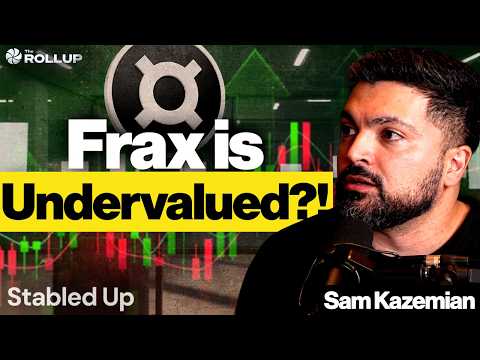
Sam Kazemian, founder of Frax Finance, sat down to discuss what makes this cycle fundamentally different from past downturns: the active participation of institutional actors, state governments, and major corporations in building crypto infrastructure from day one. This isn't speculation; it's foundation-building.
🏦 The State-Level Opportunity: Nevada as a Case Study
One of the most striking revelations: Kazemian recently held discussions with the Nevada Secretary of State about integrating stablecoin infrastructure directly into the state's corporate formation process. This isn't a distant regulatory conversation — it's an active, immediate opportunity.
"Before in a bear market, you didn't see the Secretary of State or senators or institutions actually participating on the ground floor. Here, I was just talking to the Nevada Secretary of State... a lot of opportunities that are not usually talked about."
The vision extends beyond retail crypto adoption. Imagine:
- Digital incorporation workflows that instantly provision neo-bank accounts during business registration
- Instant payroll infrastructure powered by stablecoins for newly formed companies
- Immediate DeFi access for corporate treasuries on day one of incorporation
Nevada, with its status as the second-most-popular state for business incorporation (after Delaware), represents a strategic laboratory for these innovations. Unlike traditional crypto card offerings aimed at retail traders, these use cases target entirely new demographics: small businesses, corporate treasurers, and state-level financial operations.
🎰 Public-Private Synergies: The Casino Connection
Nevada's economy provides a unique structural advantage. As a state heavily reliant on casino tax revenue, both public and private sectors share aligned incentives to modernize payment infrastructure. The opportunity space includes:
- Reserve optimization: States and casinos deploying idle capital into yield-bearing stablecoin accounts
- Structural deposit arrangements: Collateralizing Genius-compliant stablecoin reserves in FDIC-insured banks that already handle casino payout infrastructure
- Efficiency gains: Instant settlement for gaming operations, reducing float time and operational friction
These arrangements create triple-win scenarios — improved capital efficiency for casinos, increased tax revenue for states, and expanded utility for stablecoins.
🏛️ The OCC Charter Gold Rush
A regulatory development flying somewhat under the radar: the Office of the Comptroller of the Currency (OCC) has been issuing bank charters to crypto-native companies at an accelerating pace. As one participant noted, they're "giving them out like candy."
Frax Finance recently partnered with Airbase, one of these newly chartered entities, establishing an official FBO (For Benefit Of) Frax USD reserve account that is both Genius-compliant and FDIC-insured. This partnership enables:
- Direct custody of stablecoin reserves in regulated banking infrastructure
- Potential for strategic credit creation in specific geographic regions or sectors
- Hypothecation arrangements that allow partner banks to deploy reserves for mortgages and business lending
"Imagine if we deposit nine figures at Airbase, and then we say, 'Our predominant business base is in Nevada... Could you extend them credit based on your own risk analysis but prefer credit creation in this region?' That's a win-win-win."
Strategic timing matters: Frax indicated they're evaluating pursuing their own OCC charter, with a tentative timeline for next year. The decision hinges on which services a stablecoin issuer wants to offer and in what order.
💳 The Card Wars: Going Direct to Visa
An estimated 200+ crypto card offerings currently exist, most targeting the same demographic: crypto traders who want to spend stablecoins and earn token rewards. Frax is taking a fundamentally different approach.
Rather than using API integrations with third-party BIN sponsors (the typical route), Frax is pursuing a direct BIN relationship with Visa. This harder path enables unique capabilities:
- 100% interchange pass-through to users
- Hybrid credit-crypto architecture — most crypto cards can only offer debit functionality due to regulatory and compliance constraints
- Novel programmable features that distinguish it from commoditized offerings
The direct relationship was necessary because third-party BIN sponsors wouldn't accept the liability of issuing credit against innovative crypto-native architectures. Going direct meant taking full responsibility — and unlocking differentiation.
Expected launch timeframe: Q4 of this year.
🤝 The OpenUSD Alliance: Strategic Positioning
Recent commentary from Visa's earnings call clarified the payment giant's stance on stablecoins. When asked if OpenUSD (the Stripe-led stablecoin initiative) would compete with Circle and Tether, Visa responded:
"Visa going forward would remain multi-coin, multi-chain. Our role is not to pick winners. Our role is to help clients connect to the stablecoin ecosystem securely and at scale regardless of which stablecoin network or infrastructure ultimately gains adoption."
Frax just joined the OpenUSD Alliance as one of its newest members. The strategic calculus is nuanced:
- For stablecoin issuers like Frax: OpenUSD provides instant acceptance across consortium members, clearinghouse capabilities, and one-to-one mint/redemption infrastructure
- For card networks and payment processors: OpenUSD integration ensures they're not left out if adoption accelerates, without requiring full strategic commitment
- For asset managers like BlackRock: Accepting OpenUSD alongside USDC expands optionality without heavy lifting
The key insight: consortium membership doesn't require members to exclusively promote OpenUSD over their own stablecoins. It simply ensures interoperability and acceptance — which is half the battle for any new stablecoin trying to gain traction.
"Imagine you're starting a stablecoin that's not in a consortium. You'd have to have Visa accept it directly as a settlement stablecoin on Visa net... now they do OUSD and USDC. That's a very substantive thing that I think people are missing."
🌐 The Network Effect: Building the Next Visa Net
A compelling thesis emerged: the next-generation payment network may not be a single entity like Visa or Mastercard, but rather a super-network of interconnected consortiums and clearinghouses.
Consider the architecture taking shape:
- Multiple stablecoin consortiums (OpenUSD, Fraxnet clearinghouse, others)
- Cross-compatibility layers enabling one-to-one redemptions between different stablecoins
- Card network integration from legacy players like Visa and Mastercard
- Self-custodial rails that let users withdraw to web3 wallets between transactions
This differs fundamentally from traditional payment rails. With legacy systems, users face FX fees, chargebacks, and vendor lock-in. With stablecoin super-networks, assets remain self-custodial between transactions — users can withdraw to their own wallets, switch providers, or route through whichever clearinghouse offers the best terms at any moment.
"Maybe the next Visa net is all of these consortiums being joined together... maybe that is where most commerce will be in five years."
📊 Market Structure: Monist or Pluralist?
When pressed on whether the stablecoin market would consolidate around a single winner or fragment across many, Kazemian offered an 80/20 framework:
- 80% of market cap will concentrate in approximately five major stablecoins
- 20% long tail will consist of hundreds of specialized or regional stablecoins
- Total market size projection: Multiple trillions of dollars by 2030 (consistent with estimates from analysts like Scott Benson)
Frax itself operates an issuance system for other chains — already powering Sonic's USD and Somnia's USDSO. These partner stablecoins immediately inherit Frax's infrastructure: one-to-one redemption, full payment rails, and integration across decentralized exchanges.
The implication: rather than winner-take-all, the stablecoin market may evolve toward a handful of dominant liquidity hubs that orchestrate flows between dozens of smaller, purpose-specific stablecoins.
⚖️ Genius Compatibility: What It Actually Means
The term "Genius-compatible" appears frequently in Frax's positioning, but what does it mean when final Genius rulemaking hasn't been completed?
Frax's approach:
- Reserve composition: Backed entirely by money market fund securities, treasuries, and FDIC-insured bank deposits
- Custodial structure: Assets held in segregated BEO (Beneficial Ownership) accounts at qualified custodians
- Redemption capability: 100% of circulating supply can be redeemed against these reserves
"To the best of our understanding and our counsel... we think it matches the Genius act. Obviously no one's been licensed... so we can't say it's Genius compliant — we say Genius compatible."
This distinction matters immensely for business development. Major corporations and state governments considering holding stablecoins in reserves or accepting them for payments require regulatory clarity. A "decentralized stablecoin" might be excellent for DeFi and on-chain applications — but it's often a deal-breaker for institutions that need to hold balances longer than a millisecond.
Genius compatibility — even ahead of final licensing — provides enough regulatory comfort for partnerships to move forward. Frax confirmed that multiple companies (including well-known Vegas-based entities) have agreed to hold Frax USD based on this framework.
🔮 What's Coming: Q3 & Q4 2024
Several announcements are in the pipeline:
- Major partnership announcements with states and private sector companies (potentially Vegas-based hospitality/gaming entities)
- Frax Card launch with direct Visa BIN integration (expected Q4)
- Airbase integration expansion — additional features and use cases for the FBO reserve account
- Additional stablecoin issuance partnerships beyond Sonic and Somnia
The emphasis throughout: bringing crypto infrastructure to non-crypto-native markets — businesses, states, and sectors that don't fit the "crypto trader" archetype but stand to benefit from programmable, instant, yield-bearing digital dollars.
✅ Key Takeaways
This cycle feels different because it is different, in ways that can be clearly articulated:
- Institutional engagement is live, not theoretical. Secretaries of State, senators, and major corporations are actively building on stablecoin infrastructure.
- Regulatory pathways are opening rapidly. The OCC is issuing bank charters to crypto-native companies at pace, enabling compliant custody and credit creation.
- Use cases are diversifying beyond speculation. From state-level incorporation processes to casino payment rails to hybrid credit-crypto cards, real economic activity is being re-architected.
- Genius compatibility acts as a gatekeeper. Institutions require regulatory clarity before holding stablecoins in treasury — and compatibility frameworks are sufficient to unlock partnerships today.
- The network is the product. Interoperable consortiums and clearinghouses may form the backbone of a new global payment infrastructure — one that's self-custodial, programmable, and open.
No giant dead body lies beneath the crypto ocean this cycle. The macro environment remains uncertain, but the infrastructure being built — quietly, deliberately, and at the state level — suggests a fundamentally different trajectory than past bear markets. The shift from speculation to utilization is underway.
More from TheRollupCo

When AI Gets Too Smart: Government Bans, National Security, and the Race for Int
The release and subsequent restriction of frontier AI models has sparked a fascinating debate about national security, c...

The Hidden Constraint: Inside the GPU and Memory Shortage Reshaping AI Economics
The AI market narrative has shifted dramatically in recent weeks. Following the release of DeepSeek's Kimi K3 model, man...

Inside Robinhood Chain: How 105M Transactions in Three Weeks Signals the Next Wa
Three weeks into mainnet, Robinhood Chain has emerged as one of the most successful blockchain launches in recent memory...

Inside Wisdom Tree's Tokenization Strategy: Building the Future of 24/7 Asset Ma
📊 The Convergence Thesis: Why Tokenization Is No Longer OptionalThe financial industry is witnessing a structural shift...

Irresponsibly Long Crypto: Why the Four-Year Cycle Isn't Dead and What's Really
📊 Portfolio Positioning: Still All-In on CryptoDespite widespread institutional skepticism, veteran crypto investors re...

The Convergence of Intents, AI, and Privacy: Inside Near's Vision for Agentic Co
💡 The Big Picture: Privacy, Intelligence, and Commerce Are MergingThe evolution of crypto infrastructure is no longer j...