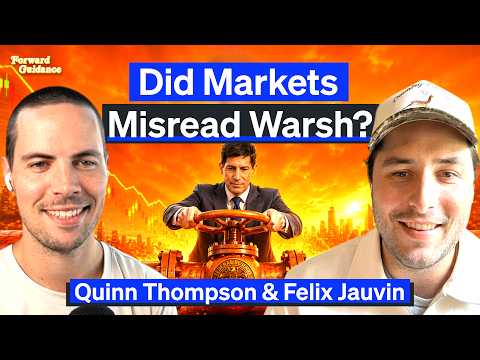
🔥 The Leopold Liquidation, Walsh's Market Shock & What Comes Next
📉 The Leopold Ashenbrenner Liquidation: A Cautionary Tale
The AI trade experienced a dramatic unraveling this week as Leopold Ashenbrenner, one of the most successful AI-focused investors, was forced to liquidate his entire public markets position. What began as whispers about capital raising attempts quickly escalated into a full-scale forced sale — with Ken Griffin's Citadel emerging as the single buyer on the other side.
Ashenbrenner's fund, which reportedly started with around $225 million and grew into the billions on the back of the semiconductor and AI rally, became a victim of its own success. The combination of leverage, concentrated positioning, and deteriorating market conditions created a perfect storm.
"Path dependency is so important. Leopold's thesis may be proven completely correct a year from now, but he's been carried out because of how he implemented and executed that strategy."
The forced liquidation highlights several critical dynamics that had been building in the AI trade:
- Extreme leverage: Korean margin calls, 3x levered semiconductor ETFs whose AUM had ballooned from $25-30 billion to $100 billion, and concentrated hedge fund positioning
- Momentum exhaustion: SK Hynix delivered the first meaningful earnings miss from the semiconductor complex
- Market structure fragility: When sharks smell blood, they test positions — and the market clearly sensed vulnerability
The aftermath saw a sharp mean reversion rally, with some names up 20% as the major forced seller was removed from the market. However, this doesn't necessarily signal an all-clear for the sector.
🎯 Understanding the Damage & What Comes Next
The psychological and technical damage to the AI trade cannot be understated. When a sector experiences this level of leverage-induced volatility, the recovery period tends to be extended.
Consider recent analogies: the metals complex (gold and silver) saw aggressive rallies followed by six-month consolidation periods. Traders who simply stepped aside during the chop and returned later often outperformed those who tried to catch every knife.
Key takeaway: Just because a stock or sector doubles from a liquidation low doesn't mean it's headed straight back to all-time highs. For context, Nvidia would need to double from recent levels just to reclaim previous peaks — a move that required massive leverage to achieve the first time.
"When you really injure and damage that buyer base and reaction function, it can take a pretty long period of digestion. Maybe it's best to avoid the brain damage of the sector for six months."
The broader lesson: time horizons, risk sizing, and leverage awareness are critical. The fundamental AI thesis may remain intact, but implementation and path dependency determine outcomes. Markets are unforgiving to those who are right but early — or right but overleveraged.
🏦 The Walsh Fed: A Communication Disaster or Deliberate Strategy?
Fed Chair Kevin Walsh's second FOMC meeting on Wednesday triggered one of the most unusual market reactions in recent memory. Going into the decision, markets priced approximately 60% odds of a pause and 40% odds of a hike. The Fed delivered the pause, but with three dissents — signaling deep internal disagreement.
The initial market reaction was relief: yields fell, stocks rallied. But then Walsh's press conference began, and everything reversed. The 30-year Treasury sold off sharply, credit spreads widened, and equities gave back gains. Commentators declared it a "disaster," a "credibility shock," and evidence of a Fed chair losing control of the narrative.
But was the communication really that poor — or was the market simply not paying attention?
🔍 What Walsh Actually Said (And Why It Matters)
According to observers who have followed Walsh's speeches and writings over multiple years, his message was entirely consistent with his previous views. The confusion stemmed from three key areas:
1. The Inflation Target Question
Walsh was asked about the Fed's inflation gauge and whether they would continue to rely on the official PCE measure. He indicated that "his own lens is broader" and suggested the central bank's strategy statement — which gets reissued each January — could evolve. For bond investors accustomed to clear targets, this ambiguity was unsettling.
2. The Rate Hike Ambiguity
When asked whether higher rates were the remedy for persistent inflation, Walsh suggested they "could be part of the solution" but wouldn't confirm they were the main tool. He noted that market tightening had already done some of the Fed's work — a clear signal that he sees other policy tools as equally important.
3. The Balance Sheet Focus
This was the most important signal, yet it seemed to fly over many heads. Walsh explicitly stated that a core question he posed to the committee was: "How much accommodation is the Fed's balance sheet providing to the long end?"
The answer? A lot. The yield curve remains historically flat despite the Fed having doubled its balance sheet during COVID without fully unwinding it. The Fed simply hiked short rates while leaving the long end suppressed.
"To properly rebalance monetary policy and the economy — which has been extremely imbalanced and helpful to tech and large cap corporates over small business and consumers — you need to let the long end see free market prices."
Walsh's message was clear: Let the Treasury market price the long end at fair value. Remove Fed accommodation. Allow real market clearing.
📊 The Market Heard Him Loud and Clear
Despite claims of a communication failure, the market's reaction validated Walsh's intent:
- Long-end yields rose as he discussed removing balance sheet accommodation
- Real yields increased, raising the discount rate and restricting valuations
- Credit spreads widened, tightening financial conditions
- Forward inflation expectations fell as real rates climbed
- Equity momentum slowed, particularly in high-duration growth stocks
In other words: everything Walsh wanted to happen, happened.
If the long end reprices another 50-75 basis points higher due to reduced Fed intervention, the economy will slow, inflation will moderate, and the Fed won't need to hike short rates aggressively. This is restrictive policy without traditional rate hikes.
"He was trying to basically steer the market towards his view without having the approval and sign-off of the committee to go there and say we are definitively going to do this. But he was trying to guide the market towards it."
💡 The Composition of the Yield Curve Move
Breaking down the components of the yield curve move reveals a nuanced picture:
- Short end (2s and 5s): The move was primarily driven by TIPS yields (inflation expectations rising as rate hike odds fell)
- Long end (30s): The move was driven by real yields rising, reflecting reduced Fed accommodation and higher term premium
This compositional difference is critical. The short end reacted to the absence of a hike. The long end reacted to the prospect of reduced balance sheet support.
For years, market participants complained that the long end was artificially suppressed by Fed policy, creating excessively loose financial conditions and distorting the discount rate. When Walsh signaled a willingness to address this, many of those same voices expressed outrage.
🎭 The Emotional Market Response
The level of emotional reaction was striking. Prominent economists, typically measured and apolitical, accused Walsh of creating chaos. Social media erupted with criticism. One observer noted:
"I've never seen an event where I so fundamentally and diametrically disagree with the consensus coming out of it. It was like one or two accounts started chirping, and then everybody piled on because it was the cool thing to say."
The outrage appeared to stem less from policy substance and more from threatened positioning. When leveraged asset holdings face pressure, suddenly "hawkish policy" becomes deeply unpopular — regardless of prior complaints about inflation.
🔮 What Happens Next? The September Setup
The next FOMC meeting isn't until September — notably close to the midterm elections. Historically, the Fed avoids major policy shifts near elections, though they will act if necessary.
Before that, Walsh will deliver a keynote speech at the Jackson Hole Symposium in late August. This is traditionally a venue for Fed chairs to outline longer-term policy frameworks. Given the communication challenges from this week, Jackson Hole may be the perfect opportunity to explain the balance sheet strategy in greater depth.
"These press conferences are not really the place to go into a deep dive tutorial on why big picture policy is the way it is. Jackson Hole would be a decent place to make the case publicly and explain why this is a better way to transmit policy."
Market participants are currently pricing approximately 55% odds of a September hike. However, the base case should account for coordination across branches of government to manufacture the desired outcome:
- If equity volatility increases and rate hike odds fall, the Fed gains cover to pause
- If growth data weakens materially, the narrative shifts from "inflation risk" to "growth risk"
- If geopolitical tensions ease (as with recent Iran de-escalation signals), risk appetite may stabilize markets without further tightening
"They're going to manufacture the outcome they need. It's like an orchestra in concert. Almost nothing about it is organic."
📉 Growth Outlook: Inflection Point or Soft Landing?
Recent GDP data presented a mixed picture. The headline print missed consensus at 1.5% versus expectations of 2.1%. However, most of the miss was attributable to net exports — a noisy component heavily influenced by tariff dynamics.
The more meaningful signal came from personal consumption expenditures, which remained strong. Looking at real final sales to private domestic purchasers (PDFP) — a cleaner measure of core economic activity — the data was robust.
However, several tailwinds that supported growth in recent quarters are fading:
- Wealth effect from AI/tech rally: Now reversing
- Tariff refund stimulus: One-time boost fading
- World Cup spending surge: Temporary lift concluding
- Infrastructure bill disbursements: Slowing
Meanwhile, restrictive forces are intensifying:
- Real rates rising across the curve
- Credit spreads widening
- Financing conditions tightening
- Corporate capex expectations moderating (Meta down nearly 9% as hyperscaler spending comes into question)
"The outlook based on where market prices are and where policy gets to over the next two or three quarters is nowhere near the same as it was the last three quarters. You have to bet on this 3%-ish real growth coming down closer to 2%."
The lag between financial conditions tightening and real economy impact is typically one to two quarters. Markets are forward-looking, which means earnings estimates and growth projections should begin adjusting lower soon — even if backward-looking data remains solid for now.
⚖️ The Paradox of High Yields
There's an old market adage: "The cure for high yields is high yields." Bond markets are self-correcting. As yields rise, they create their own demand by offering more attractive risk-adjusted returns. Eventually, the economic slowdown they induce brings yields back down.
The 30-year Treasury yield has moved significantly higher in recent sessions. If the Fed follows through on reducing balance sheet accommodation, yields could move higher still. But the higher they go, the more kinetic energy builds for the reversal.
"The higher the 30-year goes, the more kinetic power it has to swing the other way next. The pendulum effect."
Sentiment around bonds has become increasingly bearish — often a contrarian signal that at least a local top is near. But the real test comes when equities weaken meaningfully. So far, dispersion and rotation have kept the S&P 500 within 2% of all-time highs. If a broader correction materializes, the narrative will shift quickly.
🎲 Holding Two Ideas at Once
The current environment requires holding seemingly contradictory views simultaneously:
Short-term: Walsh and the administration can create volatility, talk markets down, and tighten financial conditions to create room for future easing.
Long-term: Structural forces — rising deficits, interest expense as a percentage of GDP, political constraints — make sustained hawkishness untenable. When equities correct meaningfully, the pivot will be swift.
"Can they talk hawkish and try to talk the market down in the short term? Absolutely. Does that mean you should trust they won't fold like all the doves of the past? Absolutely not."
The base case should assume tactical hawkishness in the near term, particularly before midterms. But this creates the cover for aggressive easing when conditions deteriorate. A 10-20% equity correction would provide the political and economic justification to reverse course quickly — and return to balance sheet expansion.
🌍 Geopolitics Fading Into the Background
One bright spot: escalating tensions with Iran appear to be de-escalating. The back end of the oil curve has not reacted nearly as much as the front month, and oil volatility is making a much lower high than during the initial price spike.
This suggests the market does not expect sustained geopolitical risk premium. With enough other concerns facing markets — Fed policy, AI trade unwind, growth questions — there's little appetite for adding Middle East conflict back to center stage.
"I think the Iran war stuff is going to float to the background because there's enough problems out there for markets that they can't afford to reescalate in a big way."
📅 Navigating August and September
Seasonality is not on the market's side. August and September are historically weak months for equities, with the effect more pronounced during midterm years.
Key dates and catalysts ahead:
- Jackson Hole Symposium (late August): Walsh's keynote speech may clarify balance sheet strategy
- September FOMC (mid-September): Critical decision point on whether to hike ahead of midterms
- Ongoing earnings season: Growth and margin expectations will be tested
The market is entering a period where restrictive real rates and financing conditions will catch up to more than just the AI trade. The rotation into small caps and economically sensitive stocks that occurred during the AI selloff may reverse if growth data weakens further.
"Assuming there's no rapid change to the intentions Walsh rolled out, that will start to have an effect across the board. The rotation could go back the other way in the total opposite direction."
✅ Key Takeaways
1. Leverage kills: The Leopold liquidation is a reminder that implementation matters as much as thesis. Time horizons, position sizing, and leverage awareness are critical.
2. Walsh's message was clearer than the reaction suggested: He wants to let the long end reprice to fair value by reducing balance sheet accommodation. The market response validated his strategy.
3. Growth is at an inflection point: Recent tailwinds are fading while restrictive forces intensify. Expect growth estimates to trend lower over coming quarters.
4. Tactical hawkishness, strategic dovishness: Near-term policy can remain restrictive, but structural forces ensure the eventual pivot back to accommodation.
5. Seasonality and timing matter: August and September are historically weak, and the proximity to midterms constrains Fed optionality.
6. Sometimes the best trade is no trade: When a sector experiences significant damage, stepping aside for several months often outperforms trying to catch every bounce.
Markets are hard. Risk management is harder. And sometimes, the best view is from the sidelines.
More from ForwardGuidanceBW
Market Structure at Extremes: Why Historic Low Correlation and Rising Uncertaint
The derivatives market is flashing signals that haven't been seen in decades. Stock correlations have collapsed to unpre...

Gold, Bitcoin, and the End of Traditional Portfolio Construction
💡 The Evolution Beyond 60/40The traditional 60/40 portfolio—60% equities, 40% bonds—has served as the gold standard for...

Treasury Intervention, AI Valuation Hysteria, and Why the Debasement Trade Is Ba
📊 Market Structure: Low Volume, High InterventionMarkets entered the final stretch of summer in characteristic fashion ...

Treasury Ramps Up Buybacks: A Clear Signal of Policy Direction Ahead of Midterms
The US Treasury's announcement this week to at least double the size of liquidity support buyback operations for long-da...
Inside the Paradigm C Playbook: How Rising R-Star, Forward Guidance Removal, and
📊 The New Macro Regime: Welcome to Paradigm CMarkets have entered what 42 Macro founder Darius Dale terms "Paradigm C" ...
From Fed Dominance to Treasury Statecraft: How Bessent's Interventions Signal a
🌐 The Rubicon Has Been Crossed A fundamental shift in market architecture is underway, and most participants are only ...