🚀 The AI Hiring Surge, Rocket Lab's $8B Power Move & Defense Tech's Next Wave
📊 AI Adoption Is Hiring, Not Firing
A narrative violation emerged this week that challenges the prevailing doom around AI and employment. New research from Ramp economist Ara Karazzian, analyzing 21,559 firms across the United States, reveals that companies adopting AI tend to grow faster following adoption—not shrink their workforces.
The findings are striking: firms making the largest AI investments grow employment by roughly 10% following adoption, while low-intensity adopters see no statistically significant change. Even more surprising, entry-level headcount rises 12% for high-intensity adopters—directly countering predictions that AI would eliminate junior roles.
"This is the correct stance for a CEO to take: 'Yeah, we're getting so much productivity. We're going to crush our competitors. We're staffing up.'"
The study leverages observed AI spending from Ramp card and bill pay data linked to Rellio Labs workforce records. The results suggest that rather than replacing workers, AI is enabling companies to scale operations and capture more market share. The implication: AI-native companies are going on offense, not defense.
This aligns with broader trends showing entrepreneurship on the rise and more solo entrepreneurs achieving multi-million dollar revenues faster than any prior generation—a dynamic explored in Derek Thompson's recent analysis of the "golden age for tiny startups with big revenue."
🚀 Rocket Lab's $8 Billion Bet on Space Connectivity
In a deal that positions it as a direct competitor to SpaceX, Rocket Lab announced the acquisition of satellite operator Iridium in a cash-and-stock transaction valuing the company at $8 billion—a 20% premium to Friday's close.
Iridium pioneered LEO satellite communications three decades ago, and today operates a fleet of 66 satellites serving ships, mining sites, US government agencies, and enterprise connectivity needs. The move represents yet another step in Rocket Lab's aggressive vertical integration strategy, which has taken it from niche small-sat launcher to an integrated space powerhouse.
"This is officially our entrance into the space applications market. A thing we've been talking about for a long time now. But to be clear, this is not the finish line."
— Peter Beck, CEO of Rocket Lab
Rocket Lab now designs satellites, aerospace components, serves defense primes, operates the second-most launched US rocket annually (the Electron), and is developing a reusable medium-lift launch vehicle. With Iridium in the fold, Rocket Lab gains immediate access to spectrum, operational infrastructure, millions of customers, and profitability—accelerating its path to competing with Starlink.
The company's journey is a rare SPAC success story. Rocket Lab went public via SPAC in August 2021 at a $4.1 billion valuation and traded at or below that price for three years. Today, it's worth approximately $60 billion, and acquiring an $8 billion connectivity provider—validating founder Delian Asparouhov's thesis that the company was deeply undervalued in 2024.
Blue Origin also delivered good news: despite the spectacular New Glenn explosion, CEO Dave Limp confirmed they're accelerating return-to-flight plans by pivoting to a hybrid conops, potentially launching again this year—not the two-year delay initially feared.
💊 FDA Takes Aim at Peptides, Approves MRTP for Zyn
The FDA delivered a blow to the peptide gray market, recommending against adding seven peptides to the 503A bulks list, including compounds used for ulcerative colitis, wound healing, obesity, osteoporosis, and opioid withdrawal. While peptides have been technically banned outside research use, enforcement has been lax. This decision tightens the noose on a thriving but unregulated market.
As one healthcare insider put it: "The justification for taking them off the ban list was to kill the gray market." Companies that moved into the space anticipating regulatory approval now face a real pickle.
On the flip side, the FDA granted Zyn the first-ever Modified Risk Tobacco Product (MRTP) designation for a nicotine pouch. This is a massive win for the industry, allowing Zyn to market itself as better for you than cigarettes—a claim that seems obvious but requires rigorous review. The MRTP pathway is notoriously difficult, and Zyn's approval could pave the way for other products.
🏀 Tristan Thompson on Investing, Robotics, and the Future of Sports
NBA champion and investor Tristan Thompson joined the show to discuss his journey from the court to venture capital, offering a rare window into how elite athletes approach wealth management and startup investing.
"When you get the second deal, when I got my second deal, 82 million—you know, I switched financial advisors because of the one I was with."
Thompson emphasized betting on the founder as his primary investing strategy, and leaning on experienced peers to navigate the startup ecosystem. He acknowledged the harsh reality of venture: "You're going to invest in 10 things and eight are going to fail. But the two that do well? Don't worry. It's going to cover all your capital that you put in."
On the future of sports, Thompson advocated for AI-driven refereeing and the use of AI in sports medicine to prevent injuries—especially Achilles tears that have sidelined stars like Jason Tatum, Tyler Herro, and Damian Lillard during the playoffs.
He's also bullish on robotics and physical AI, particularly in agriculture, construction, and healthcare—areas where autonomous systems can improve efficiency and margins. Thompson's long-term vision? Potentially launching a fund or accelerator to give other athletes access to the opportunities he's had.
🛡️ Defense Tech: Still Early, Still Expanding
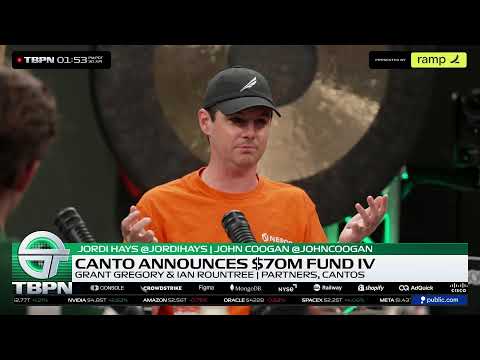
Venture firms Harpoon Ventures (raising $155 million) and Kantos (raising $70 million) both closed new funds focused on national security, hard tech, and defense innovation. Both firms emphasized the importance of tempo and iteration speed in hardware—a lesson learned from SpaceX and other pioneers.
Kantos co-founder Ian Roundtree highlighted the importance of getting on the learning curve as quickly as possible:
"You can't sit in a lab. You need to field technology. We've backed so many people now that a week to them is like a month to everybody else. They'll just blow your mind with how quickly they move."
Harpoon's Larson Jensen, a former Navy SEAL and Olympic medalist, discussed his vision for a venture-style NBPA fund that would allocate player capital into high-growth opportunities rather than low-yield post-career income plans. He's also interested in nuclear energy, AI, and forward-deployed capital in emerging markets.
Both firms see defense tech as far from saturated. While there's been a boom in formation, the best companies are still being built, and the market is large enough to support multiple winners across categories—drones, autonomy, space, energy, and more.
🏗️ Hard Tech Keeps Shipping
Several startups made major announcements this week, underscoring the momentum in hard tech and infrastructure:
- Etched raised $25 million for rack-scale inference hardware optimized for transformers, featuring low-voltage inference and cluster-scale memory. CEO Gavin Uberti emphasized that "being faster isn't enough. You have to be able to do that at a price people can afford."
- Oasis Devices launched a smart ring for private dictation, enabling whisper-based transcription and trackpad-style editing. The ring is designed to replace keyboards and work seamlessly with Whisper Flow.
- Tax Wire raised $25 million to build a managed solution for global sales tax compliance, targeting the $5 trillion in remitted sales tax annually.
- Monogram raised $40 million for a general-purpose AI application that generates complete visual interfaces—not just text responses—in roughly 1.5 seconds. CEO Aaron Bali described it as the shift from command-line to graphical user interfaces, but for AI.
- Omen AI raised $31 million to build blood monitoring systems for mission-critical machines, starting with data center liquid cooling systems. The company is already working with multiple neoclouds.
📡 The Future of Computing Platforms
A recurring theme across conversations: What comes after smartphones? Founders are exploring rings, glasses, voice interfaces, and visual AI—all betting that the next platform will blend input modalities (voice, touch, camera) with instant, interactive visual outputs.
Monogram's approach is particularly interesting: voice in, visual interface out. As Bali explained:
"Talking is four or five times faster than typing. But listening is four times slower than reading. And seeing is even faster than reading. So, the fastest, most frictionless experience is voice in and then visual output back."
If these bets pay off, the next decade could see a fundamental shift in how we interact with computers—moving from keyboards and screens to ambient, multimodal interfaces that feel more natural and immediate.
🔮 Final Thoughts
This week reinforced several key themes:
- AI is a net job creator for companies that adopt it aggressively.
- Space is consolidating, with Rocket Lab making a bold move to compete with SpaceX.
- Defense and hard tech capital is flowing, and the best founders are shipping faster than ever.
- New computing paradigms are emerging, blending AI, voice, and visual interfaces.
The common thread? Speed, iteration, and a bias toward action. Whether it's AI-driven hiring, space infrastructure, or next-gen interfaces, the winners are those who move fastest and learn from the market in real time.
The future is being built—by founders who refuse to sit in a lab.
More from TBPN

The AI Race Gets Complicated: GLM 5.2, Infrastructure Constraints, and the High-
📰 AI Makes the Front Page — And Washington Is Paying AttentionThe artificial intelligence narrative has officially grad...

The Creator Consolidation Paradox: Why Smart Glasses Are Winning While Independe
📱 The Creator Economy's Uncomfortable TruthA fascinating tension emerged from this year's Cannes Lions: the most succes...

How David Holz Built a $40B Business Without VCs — And Now He's Reinventing Medi
🚀 The Founder Who Refused to Follow the RulesDavid Holz has done something rare in Silicon Valley: he built a generatio...

Inside Jake Paul's New $100M Fund: Strategic Allocation, Netflix Disruption, and
🥊 From Content Creator to Institutional CapitalJake Paul and his partner Jeff Woo announced they've successfully raised...

Market Turbulence as Fed Pivots Hawkish, AR Glasses Struggle, and the Battle Ove
🔴 Fed Turns Hawkish: Markets Sell Off as Rate Hikes LoomMarkets pulled back sharply following signals from the Federal ...

SpaceX's Historic Run, the Biggest VC Exit Ever, and the Battle for Wearable Com
🚀 SpaceX Surges Into the Elite ClubSpaceX delivered one of the most dramatic after-hours rallies in recent memory, clim...