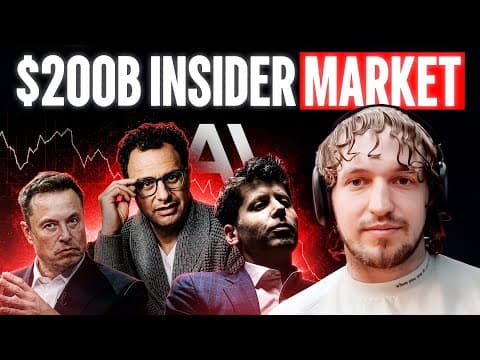
🎯 Inside the Wild West of Anthropic Secondaries: A $10B+ Shadow Market
💰 The Private Markets Gold Rush
The secondaries market for private tech companies has exploded into something far stranger than most people realize. Private market raises now exceed IPO capital raises, marking a fundamental shift in how late-stage capital flows. The market has logged over $200 billion in recorded secondary market transactions plus funding rounds in recent years, creating a feeding frenzy of brokers, SPVs, and opportunistic middlemen.
Nowhere is this phenomenon more visible than in the Anthropic secondary market, where deals can carry 10% one-time fees plus carry. If $10 billion of a funding round flows through secondary-style clients, there's $1 billion in fees up for grabs. That scale has attracted everyone from traditional venture funds to individual brokers operating out of San Francisco apartments — some literally advertising their Anthropic access on dating apps.
"Simply brokering an anthropic secondary deal made me more money than my entire net worth from working in my 20s. This is insane." — Anonymous broker on Twitter
🏗️ Two Types of Secondaries: Company-Approved vs. Shadow Market
The secondary market broadly breaks into two categories:
Primary Secondaries (Company-Approved):
Despite the contradictory name, these are net-new capital raises where funds create SPVs and SPVs on top of SPVs to invest in funding rounds. The company receives the capital directly, and employees are allowed to sell shares through company-run tender offers. Anthropic recently conducted employee tenders allowing sales of up to $30 million per employee at the round price. This clears selling pressure before an eventual IPO and keeps transactions above board.
Unauthorized Secondaries (The Wild West):
This is where things get messy. Platforms like Forge and Hiive operate marketplace-style models, broadcasting mass emails to hundreds of thousands of potential buyers claiming access to blocks of shares — often at discounts of 20% or more to prevailing round prices. These platforms don't verify share authenticity, don't enforce rigorous KYC, and charge fees around 3.5% for essentially an introduction.
Anthropic and OpenAI actively send cease-and-desist letters to these platforms. Why? Because when family offices and institutional investors see secondary markets offering steep discounts, it undermines the company's ability to raise capital at their intended valuation. It also creates legal risk around securities violations — specifically, regulations requiring 6-month holding periods for unlisted securities.
🎭 The Cast of Characters: Brokers, Buyers, and Nested SPVs
The market structure is Byzantine. You can't simply call Anthropic and buy shares — bylaws and charters aren't public, and access is tightly controlled. Instead, a multi-tiered broker ecosystem has emerged:
- First-layer brokers: Connected to actual sellers or company-approved allocations
- Second-layer brokers: Know buyers but need access, so they broker to first-layer brokers
- Third-layer brokers: Retail-facing, packaging deals from upstream sources
- Fund operators: Create SPVs to aggregate smaller buyers, charging fees at each layer
Many brokers — even those employed at traditional funds — now make more money from secondary transactions than from primary deal flow. That profit motive has pulled talent and capital into this space at an accelerating rate.
The SPV nesting can go three or four layers deep. Why? Because of coincidence of wants. If a seller has $8 million worth of Anthropic shares but buyers only want $2 million each, an SPV structure allows the deal to close. Each layer charges management fees, and most participants aren't registered broker-dealers, so they structure fees as fund management rather than transaction commissions.
⚠️ Fraud, Forwards, and Fake Share Certificates
The unregulated nature of this market has opened the door to outright fraud and borderline scams. Industry insiders estimate 10-20% of executed deals involve some form of fraud. The fraud takes multiple forms:
1. Outright Fake Shares:
Share certificates can be forged. Buyers who don't verify cap table access or conduct proper due diligence can unknowingly purchase phantom equity. In some cases, brokers resell fraudulent shares without realizing it themselves, creating liability chains that are hard to untangle.
2. Employee Forward Contracts:
These are agreements to purchase employee shares in the future, often structured to circumvent company bylaws. The risk? Employees can default or have their shares rescinded. In one notable case, a well-known firm sold a block of xAI shares via employee forwards. The employee was later named in an xAI v. OpenAI lawsuit for alleged corporate espionage, and all their shares were rescinded by the company. Buyer-side brokers were left holding worthless contracts after fees had been paid and pocketed.
3. Gross Negligence and Opportunism:
Some brokers take client money, promise shares, then attempt to trade their way into a position rather than securing shares upfront. If the company's valuation rockets before they execute, they're stuck holding cash instead of equity, leaving clients high and dry. In other cases, brokers who receive refunds after a deal falls through don't inform their LPs and instead gamble the capital trying to recover paper losses.
"There was a European family office that invested in a deal I'm quite convinced blew up. The GP got refunded but didn't tell the LP — just tried to trade the money to make it back. Unless he's made 500%, it's not going to work out."
🚀 What Happens When Anthropic IPOs?
The IPO is when this house of cards either settles cleanly or collapses messily. The outcome depends on two factors: DTCC and brokerage AML procedures, and SPV distribution rules.
Here's how the waterfall works:
- First-layer SPV receives shares from the company and asks LPs: cash or stock?
- Second-layer SPV (which is an LP of the first) receives allocation and asks its LPs the same question
- Third-layer SPV repeats the process
Each handoff can take a few days to two weeks depending on banking infrastructure and DTCC processing times. If any SPV in the chain has discretionary distribution rules — say, the GP decides to hold shares longer to maximize carry — downstream investors are stuck waiting.
Even worse: some GPs may hedge positions on the gray market while waiting for shares, assuming a quick settlement. If distribution takes an extra month due to upstream delays, hedging strategies can unravel, leading to lawsuits.
Once the IPO occurs, Anthropic's legal leverage largely evaporates. The company transitions from a private transfer agent to DTCC, and there's little game-theoretic reason for Anthropic to void unauthorized transactions post-IPO. They're not raising another private round. The market structure concerns that drove cease-and-desists no longer apply. However, brokerages may still scrutinize transactions flagged by Anthropic, potentially freezing accounts or requiring additional documentation before allowing sales.
📉 The Coming Legal Battles
Litigation will take years. The questions are messy:
- If someone entered a contract deemed illegal by company bylaws but acted in good faith, who's liable?
- If an employee signed a forward contract violating their employment agreement, is the buyer entitled to damages?
- If a GP spent fee revenue before shares were delivered, can LPs recover their capital?
The precedent doesn't exist yet. Courts will have to navigate facts and circumstances case-by-case, and the outcomes will shape how future private secondary markets operate.
One thing is certain: the people getting hurt worst are small investors who put significant personal capital into these vehicles, trusting brokers who either committed fraud, engaged in gross negligence, or simply got in over their heads.
🔮 Lessons for Capital Markets
This isn't just an Anthropic story. It's a blueprint for how late-stage private markets now operate. Companies stay private longer, valuations balloon, and liquidity becomes a premium product. The traditional venture model — where capital is locked until IPO or acquisition — no longer holds for the mega-rounds of the 2020s.
The market has responded with a Cambrian explosion of intermediaries, platforms, and synthetic instruments. Some are professional and add value. Others are parasitic. The lack of regulatory oversight and enforcement means bad actors can operate until fraud becomes too blatant to ignore.
Parallels to crypto's low-float, high-FDV meta are striking: constrained supply, speculative frenzy, and a wave of new participants who don't fully understand the risks. Eventually, the cycle will turn, and investors burned by locked, illiquid, or fraudulent positions will retreat to traditional VC funds.
But in the meantime? The secondary market for Anthropic and similar companies represents tens of billions of dollars in deal flow, with fee structures that dwarf traditional venture economics. The ball of money may eventually move elsewhere, but the infrastructure being built today — platforms, credit products, and professional due diligence services — will define the next generation of private markets.
✅ How to Protect Yourself
For anyone holding secondary positions or considering entering this market, here are the key takeaways:
- Verify cap table access: Use tools like PitchBook or request documentation proving shares are real
- Understand SPV structure: Know how many layers exist and what distribution rules apply
- Check reputation: The secondary market is reputation-driven — ask for references and track records
- Avoid platforms with no KYC: Mass-email marketplaces with no vetting are red flags
- Read the contracts: Understand whether you're buying direct equity, forwards, or synthetic exposure
- Listen to your gut: If a deal feels off, walk away — recovering capital through litigation is painful and uncertain
For smaller investors in tokenized or per-based instruments, those derivatives fall under different regulations and may carry less counterparty risk — though aggressive funding rates remain a concern.
🎬 The Endgame
The Anthropic secondary saga is a microcosm of where capital markets are headed: private for longer, larger in scale, and wilder in structure. The IPO will be the moment of truth, when synthetic claims meet real equity and the legal battles begin.
For now, the market remains a high-stakes game of reputation, access, and asymmetric information. The insiders with real connections make fortunes. The unlucky or naive get left holding worthless paper.
And somewhere in San Francisco, someone is still listing their Anthropic access on a dating app. 📱
More from Bankless
All-Time Highs, Political Hurdles, and the Coming Strategic Bitcoin Reserve
📊 Markets Rally — But Is It Too Frothy?The first week of May delivered all-time highs across equities — with the S&P 50...
The Search for Bitcoin's Creator: A Four-Year Investigation Into Cryptography, I
🎬 The Most Thorough Bitcoin Documentary Ever MadeAfter four years of meticulous investigative work, journalist Bill Coh...

The Last Week of April 2026: When the Hormuz Blockade Met the AI Boom
The final week of April 2026 delivered a market paradox for the ages: oil prices surging to wartime highs, a grinding Mi...
The Global Oil Shock No One Saw Coming — And Why Prices Could Hit $200 by Summer
📍 The Setup: A Tight Market in the Eye of the StormGlobal oil markets are sitting on a powder keg. Despite what appears...
The NYSE Goes On-Chain: Tokenized Equities, 24/7 Markets, and a New Market Struc
🚀 Big Move: NYSE and Securitize Bring Public-Company Equity On-ChainThe New York Stock Exchange and Securitize announce...
Quantum Shock: Why 2029 Is Now a Hard Deadline for Crypto’s Security Assumptions
Highlights Two new quantum papers — from Google and a Caltech-linked neutral-atom team — sharply lower resource estim...