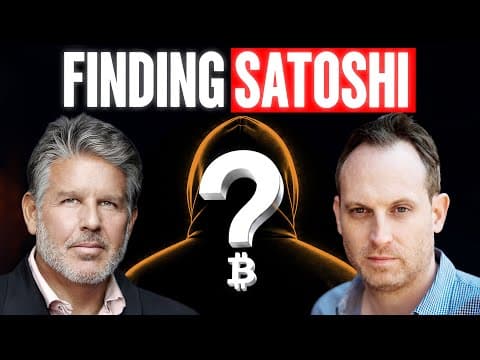
🔍 Finding Satoshi: The Billion-Dollar Mystery Finally Solved?
🎬 The Most Thorough Bitcoin Documentary Ever Made
After four years of meticulous investigative work, journalist Bill Cohen and private investigator Tyler Moroni have released what many are calling the definitive documentary on Bitcoin's mysterious creator, Satoshi Nakamoto. Their film, Finding Satoshi, takes a radically different approach from previous attempts to unmask Bitcoin's founder—going beyond linguistic analysis and digital forensics to secure on-camera interviews with relatives, friends, and co-workers of the individuals they believe created Bitcoin.
The result is a documentary that does more than solve a mystery. It captures the ideological roots of cryptocurrency, the cypherpunk movement's vision for financial freedom, and the human stories behind one of the most consequential inventions of the 21st century.
"We believe we found the answer. What gives us confidence is that we did something nobody's ever done before—getting the relatives, friends, and co-workers of the Satoshi Nakamoto we concluded created Bitcoin to come on the record, on camera." — Tyler Moroni
📊 The Scale and Stakes of the Investigation
The documentary team's commitment to thoroughness shows in every frame. Cohen spent a year and a half interviewing cryptocurrency pioneers and industry figures—including a 90-minute conversation with Sam Bankman-Fried at the height of his power (footage that didn't make the final cut). Meanwhile, Moroni conducted deep historical research into the cryptographer community, meeting with some sources eight to ten times before they agreed to appear on camera.
At stake is not just historical curiosity but real economic power. The Bitcoin addresses attributed to Satoshi contain approximately 1.1 million Bitcoin—a fortune that has fluctuated between $80 billion and $150 billion in value. These coins have remained untouched for over a decade, a fact that became central to the investigation's conclusions.
💭 The Ideology Behind Bitcoin: Understanding the Cypherpunks
To understand Bitcoin's creator, the documentary team had to first understand the cypherpunk movement—a loosely organized group of cryptographers, programmers, and activists who believed privacy was a fundamental human right under threat from increasingly powerful governments and corporations.
Key principles of the cypherpunk worldview:
- Privacy as a basic human right requiring technological protection
- Skepticism of centralized authority—both governmental and financial
- Belief in using code and cryptography to create freedom-preserving systems
- A conviction that individuals should control their own money without third-party permission
Phil Zimmerman, creator of PGP (Pretty Good Privacy) encryption, exemplified this ethos. In the early 1990s, he developed an email encryption system so secure that the U.S. government considered it a weapon and nearly indicted him. His motivation wasn't purely ideological libertarianism—he wanted activists organizing against nuclear weapons proliferation to communicate securely.
"For the cypherpunks, using a pseudonym wasn't about doing something wrong. It was part of their life—sometimes fun, sometimes playful, sometimes performance art, but also necessary because they'd witnessed governments coming after coders." — Tyler Moroni
This context explains why Bitcoin emerged precisely when it did: Halloween 2008, at the apex of the global financial crisis. The traditional financial system stood as discredited as it had been since the Great Depression. Major banks required unprecedented government bailouts. Public trust in financial institutions collapsed overnight.
Into this moment came a white paper proposing a non-fiat currency with a limited supply of 21 million units, requiring no central authority, promising privacy, and enabling peer-to-peer transactions without intermediaries. The timing wasn't coincidental—it was strategic.
🔬 The Methodology: How Private Investigation Cracked the Case
What distinguished this investigation from dozens of previous attempts was the combination of journalistic rigor and investigative tradecraft. While Cohen brought decades of experience reporting on Wall Street and financial systems, Moroni contributed skills in forensic analysis, source cultivation, and historical reconstruction.
The investigative approach included:
- Analysis of C++ programming style in Bitcoin's original client
- Linguistic analysis of the white paper's academic writing
- Time zone analysis of online activity patterns
- Deep background research into the cypherpunk community of the 1990s
- Extensive interviews with cryptographers, computer scientists, and early Bitcoin adopters
- Crucially, securing trust and on-camera testimony from people who knew the suspects personally
The investigation initially pursued the obvious path—interviewing prominent Bitcoin advocates and early adopters. This approach yielded fascinating conversations but few concrete leads. Figures like Michael Sailor proved "mesmerizing" to interview but either didn't know Satoshi's identity or didn't want to discuss it.
"Michael Sailor is probably the most captivating person I've ever interviewed. You get done talking to him and think, 'Oh my god, I've got to take every last shekel I have and buy as much Bitcoin as I possibly can immediately.' And then you sleep on it and wake up the next morning and think, 'Okay, maybe not.'" — Bill Cohen
The breakthrough came when the team shifted focus from asking who benefits from Bitcoin to asking who had the specific skills, interests, and motivations to create it. This narrowed the field dramatically.
🎭 Why the OG Crypto Community Stayed Silent
One of the documentary's most intriguing revelations concerns why so many early Bitcoin adopters refused to discuss Satoshi's identity. The investigation team identified several possible motivations:
Economic self-interest: Many early adopters held substantial Bitcoin positions. If Satoshi were revealed to be a criminal or morally compromised figure, Bitcoin's value could collapse, destroying their investments.
Philosophical indifference: Some argued that the creator's identity simply doesn't matter. As one interviewee noted, we don't know who invented the internet, the combustion engine, or credit default swaps—we simply use these technologies.
Protective instinct: The cypherpunk community values privacy as a core principle. Exposing Satoshi, even posthumously, could feel like a violation of that ethos.
Mythological value: The mystery of Satoshi allows Bitcoin supporters to project their own ideals onto the founder. A real person with real flaws might tarnish the story that Bitcoin is a gift to humanity, free from human imperfection.
🧊 The Transhumanist Connection: Planning for the Long Future
Perhaps the documentary's most striking subplot involves the Extropians—a movement of technologists and futurists who believed humanity wasn't adequately leveraging science and technology to extend life, populate other planets, and transcend biological limitations.
Several top Satoshi candidates belonged to this movement, which raises a fascinating question: How do you store value across centuries?
If you plan to have your body cryogenically preserved—as one of the documentary's subjects did—traditional banking won't work. Banks fail. Governments collapse. Currencies hyperinflate. But a decentralized, blockchain-based system could theoretically persist through nuclear war, climate catastrophe, or civilizational collapse.
This connection between cryogenics and cryptocurrency isn't just philosophical speculation. One Satoshi candidate literally had his body preserved at Alcor, a cryopreservation facility in Scottsdale, Arizona, which for a time accepted Bitcoin as payment for its services.
"The Extropians thought a lot about the future. What do we need in the future? We need money and a way to store it. What if your bank goes bankrupt and you wake up in 200 years with nothing? But what if there's a computerized system that's decentralized, where our money can sit and wait for us?" — Tyler Moroni
This raises the tantalizing sci-fi scenario: What if Bitcoin's creator planned this all along? Preserved a 12-word seed phrase in a cryogenically frozen brain, waiting for the day when technology could restore life—and provide access to what might be hundreds of billions or trillions of dollars in Bitcoin?
⚖️ The Public Interest Question
Why does Satoshi's identity matter? The investigation team frames this as a question of public interest on several levels:
Economic transparency: Someone controls wealth equivalent to that of the world's richest individuals. In any other context, we'd want to know who holds that much economic power.
Financial system understanding: Bitcoin has evolved from a fringe experiment to an asset class worth over $2 trillion, with institutional adoption by major Wall Street firms and even government interest. Understanding its origins helps evaluate its future.
Historical record: Bitcoin represents a significant technological and social innovation. Accurate history matters, especially as the technology shapes global finance.
Trust and confidence: As Cohen emphasized, the financial system depends on confidence. Transparency about Bitcoin's origins can either strengthen or undermine that confidence, but obscurity serves no one's interests.
🔮 The Quantum Threat and Satoshi's Treasure
The documentary's relevance extends into the future through an emerging technological threat: quantum computing. As quantum computers advance, they may eventually be capable of breaking the elliptic curve cryptography that secures Satoshi's Bitcoin stash.
This creates a potential scenario where Satoshi's 1.1 million Bitcoin become a kind of global treasure hunt—whoever develops sufficiently powerful quantum computers first could theoretically claim the fortune. This possibility has sparked debates within the Bitcoin community about whether to "freeze" these addresses, though doing so would violate Bitcoin's principle of immutable property rights.
The ideal outcome would preserve the possibility that if Satoshi (or Satoshi's preserved consciousness) returns with the correct private keys, those Bitcoin remain accessible—a scenario that sounds like science fiction but represents the logical extension of cypherpunk thinking about technology, longevity, and the preservation of value across time.
📉 Would Satoshi Be Disappointed?
Both Cohen and Moroni believe Bitcoin's creator would have mixed feelings about how the project evolved:
Successes beyond imagination:
- Bitcoin's market capitalization exceeding $2 trillion
- Individual Bitcoin valued at approximately $75,000 (with peaks much higher)
- Institutional adoption by major financial institutions
- Recognition as a legitimate asset class by traditional finance
Disappointments relative to the vision:
- Bitcoin has not become a practical peer-to-peer currency for everyday transactions
- Privacy protections have eroded—addresses can be deanonymized
- Concentration of holdings among a few major players contradicts decentralization ideals
- Major Wall Street banks and institutional investors control substantial portions
- The system has not meaningfully disrupted the traditional financial institutions it was designed to replace
"They would be blown away by the value each Bitcoin has reached, but probably disappointed that the basic ideas in the white paper remain unrealized. We probably live in a world with less privacy than we did in 2008." — Tyler Moroni
Yet as the investigators note, technologies frequently evolve into something different than their creators envisioned. Bubble wrap, Listerine, and dynamite all ended up serving purposes far removed from their original intent. Perhaps this is simply Bitcoin's path—from revolutionary currency to revolutionary store of value.
🎯 A Story Still Unfolding
After four years of investigation, thousands of hours of interviews, and meticulous research into cryptography, ideology, and human nature, Cohen and Moroni believe they've identified Bitcoin's creator. But they remain open to new evidence, new perspectives, and new information.
What they've definitively accomplished is creating the most comprehensive examination of Bitcoin's origins—not just as a technical innovation, but as an ideological project, a social movement, and a very human story about privacy, freedom, and the enduring question of how to build systems that serve individuals rather than institutions.
The documentary serves as both a detective story and a meditation on what Bitcoin was supposed to be, what it has become, and what it might yet evolve into. For anyone seeking to understand why cryptocurrency matters—beyond price speculation and market capitalization—this investigation into Satoshi's identity illuminates the deeper questions about money, power, privacy, and the technological tools we build to protect freedom in an increasingly surveilled world.
The full documentary, Finding Satoshi, provides the complete picture with all the evidence, interviews, and conclusions. For those who came to crypto for the technology, stayed for the gains, but sometimes forget the original vision—this is essential viewing.
More from Bankless

The Last Week of April 2026: When the Hormuz Blockade Met the AI Boom
The final week of April 2026 delivered a market paradox for the ages: oil prices surging to wartime highs, a grinding Mi...

The Global Oil Shock No One Saw Coming — And Why Prices Could Hit $200 by Summer
📍 The Setup: A Tight Market in the Eye of the StormGlobal oil markets are sitting on a powder keg. Despite what appears...

The NYSE Goes On-Chain: Tokenized Equities, 24/7 Markets, and a New Market Struc
🚀 Big Move: NYSE and Securitize Bring Public-Company Equity On-ChainThe New York Stock Exchange and Securitize announce...
Quantum Shock: Why 2029 Is Now a Hard Deadline for Crypto’s Security Assumptions
Highlights Two new quantum papers — from Google and a Caltech-linked neutral-atom team — sharply lower resource estim...

War Timelines, Quantum Shockwaves, and a $285M Exploit: Markets Search for Equil
🧭 This Week’s Macro Setup Oil and geopolitics: A 19-minute address on “Operation Epic Fury” signaled strikes on Iran...
Three Certain Truths Reshaping Markets: Demographics, Concentration, and the Dec
Amid AI-induced opacity, geopolitical risk, and debt overhangs, a clearer macro map emerges by anchoring to three durabl...