From FTX Fallout to Unified Margin: Solana’s Resilience and Backpack’s Global Bet
When Shift Happens
April 2, 2026

From FTX Fallout to Unified Margin: Solana’s Resilience and Backpack’s Global Bet

🔥 The Moment of Reckoning

“Are you the type of person that gives up, or are you the type of person that keeps going irrespective of how severe any type of adversity is in front of you?”

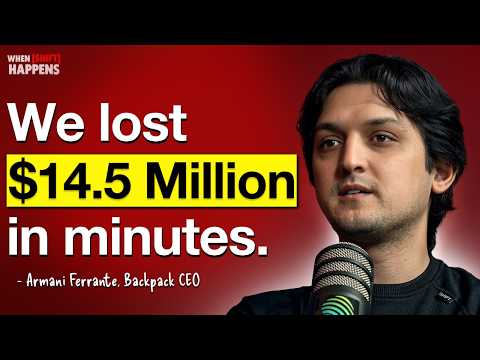
When FTX imploded, Backpack held $14.5 million on the exchange — roughly 88–90% of its balance sheet. Survival looked unlikely. The decision point became existential: capitulate or build. The choice to keep going set the tone for what followed — a deliberate recommitment to building infrastructure the industry needed, with a sharper view of risk, perception, and truth.

👤 Builder’s Profile: Engineering First, Market Structure Always

  • Armani Ferrante leads Backpack, a regulated global crypto exchange with over $420 billion in trading volume. A leading Solana builder, Ferrante helped ship core primitives: the first decentralized exchange on Solana, an early wallet, the first multisig for custody, and the first developer framework still widely used.
  • Early path: joined Alameda Research in January 2018 (brief three-month stint), then returned in 2020 to work on Solana’s ecosystem rather than FTX itself.

🔭 Privacy, Transparency, and the Panopticon

“It’s much easier to catch a criminal, ironically, with Bitcoin than if the criminal has cash.”

Public ledgers provide radical transparency — powerful for compliance, but challenging for privacy. The panopticon metaphor looms large: in open ledgers, activity is observable even if the observer is unseen. Expect a counterbalance from privacy-preserving technologies (e.g., Zcash), recognizing that no single technology offers every desired property. The future mixes tools and trade-offs.

🧱 Solana: Anti-Fragility in Action

  • Despite multiple “Solana is dead” moments — from the FTX collapse to outages and speculative frenzies — the network’s core engineering has compounded. Recent mainnet throughput comparisons show Solana operating at an order of magnitude more transactions per second than other networks.
  • Resilience has become a feature: the system absorbs shocks and strengthens. As Ferrante put it, “Nothing can kill it… the more adversity that it goes through, the stronger it becomes.”
  • Context matters: during the depths of 2022, Solana traded down to $8, yet sentiment and usage later improved. As one remark framed it, the price became “10x higher” a couple of years later — a reminder of how fast perception can diverge from fundamentals.

🎭 Culture as a Coordination Layer: The Mad Lads Moment

NFTs are social coordination tools as much as technology. Mad Lads showcased how culture and identity can mobilize a community. Think global meetups, shared identity via profile pictures, and a living social graph layered atop robust engineering. The drop crystallized that Solana’s social layer was alive, coordinated, and still building.

🏛️ The Macro Shift: Tokenization, Plumbing, and Wall Street’s Angle

  • Crypto markets feel gloomy; crypto-natives cite “maximum depression.” Meanwhile, traditional finance circles are increasingly bullish on tokenization and real-time market infrastructure. The big idea: collapse layers of intermediaries into an atomic global state machine that reduces errors, latency, fees, and settlement risk.
  • Ferrante’s market-structure parable: in the Dole Foods saga (illustrative figures cited as placeholders), a go-private offer around $13 led to litigation pushing for $15–$16. When payouts were due, claimed shareholders exceeded the official register (e.g., “1,000” vs “5,000”). The point: traditional settlement layers can diverge from the transfer agent’s ultimate ledger. Blockchains unify state and minimize such inconsistencies.
  • Settlement compression matters: from T+2/T+1 to T+0, with programmability and verifiability built in. ACH-style “optimistic” UI confirmations mask real backend delays and clawback risks. Blockchains make the true state explicit.

🧮 Why Unified Margin Matters

“You never actually have to incur the taxable event if you just borrow against your retirement account.”

Unified margin aggregates collateral across assets and venues into a single risk engine:

  • For everyday users: Borrow against assets without selling them — e.g., tap to pay and open a short-term borrow against a portfolio holding instead of realizing a taxable sale. Access to money markets that historically skewed to the wealthy becomes broadly available.
  • For professionals: Real-time, fully collateralized systems enable higher capital efficiency for basis trades, cross-asset hedging, and market making. Unlike legacy brokers that margin-call with delays and recourse, crypto risk engines operate 24/7 with instant liquidation thresholds — a different risk model that can support more leverage per unit of risk.
  • What’s next: Extend beyond crypto collateral to every tokenized asset — fiat currencies, equities, ETFs, real estate, fixed income. Converging collateral into one engine reframes capital markets.

🗾 Japan: A “Sleeping Giant” Reawakens

  • History runs deep: in 2017, over 50% of global Bitcoin trading volume came from Japan before hacks pushed activity offshore.
  • Policy momentum has turned constructive, with both the previous and current prime minister emphasizing crypto’s importance. Notably, corporate tax on crypto — currently 55% — is expected to be codified in 2026 and take effect in 2027 at 20%, a potentially transformative shift.
  • Unique market features: legacy rules once required 200% stablecoin margin (cash at issuer and cash at the exchange) — a significant constraint now evolving. Major U.S. exchanges are notably absent in Japan, creating whitespace.

🧩 Licensing, Last-Mover Advantage, and Institutional-Grade Builds

  • Backpack assembled a global licensing stack that reportedly cost FTX roughly $800 million to amass — achieved by Backpack at a fraction of that outlay through disciplined design, experienced hires across engineering, finance, legal, and compliance, and building for regulation from day one.
  • Key takeaway: there are no shortcuts in regulated exchange infrastructure. Cybersecurity architecture, custody design, risk engines, and operational controls must be production-grade.

🧠 Philosophy of the Rails

“A machine that everybody owns collectively but nobody controls individually.”

That’s the core of the blockchain thesis. The industry bifurcates into two powerful tracks:

  • Decentralized money (Bitcoin, Zcash, and privacy-first assets) focused on sovereignty.
  • Financial market infrastructure (tokenized RWAs, real-time settlement, unified margin, global collateral portability) focused on efficiency and scale.

Both matter. The next several years likely belong to the latter in terms of institutional adoption and tangible, market-level impact.

What to Watch 📈

  • Tokenization beyond crypto: Equities, funds, FX, fixed income, and real assets moving onto programmable, verifiable rails.
  • Unified margin across asset classes: Capital efficiency from a single, real-time risk engine for both retail and pros.
  • Japan’s policy turn: The shift from 55% to 20% crypto taxation (expected 2027) and evolving stablecoin rules could catalyze a major onshore market.
  • Solana’s operating capacity: Order-of-magnitude throughput leadership underpins new market structures and app classes.
  • Privacy tech adoption: Balancing transparency with rights-preserving primitives as public ledgers scale.

Memorable Lines

“Nothing can kill it… the more adversity that it goes through, the stronger it becomes.”
“It’s much easier to catch a criminal, ironically, with Bitcoin than if the criminal has cash.”
“You never actually have to incur the taxable event if you just borrow against your retirement account.”

More from When Shift Happens

🔮 Joseph Lubin on the Fork in the Road: Decentralization vs. Surveillance
Summary

The Battle for Humanity's Future: Why Ethereum's Co-Founder Believes We're at a

When Shift Happens
May 7

🌍 A Civilization at a CrossroadsJoseph Lubin, co-founder of Ethereum and founder of ConsenSys, doesn't mince words abou...

WatchRead more
🚀 The Most Bullish Moment in Crypto History – Why Every Institution is Racing to 500 MPH
Summary

From Zero to 500 Miles Per Hour: Inside the Most Bullish Chapter in Crypto's Evo

When Shift Happens
Apr 30

📊 The $400 Trillion Paradigm ShiftThe traditional financial system—encompassing global money and assets—sits at approxi...

WatchRead more
Altcoins Are Dead? Inside Bitget’s UEX Pivot, Stablecoin Rails, and a 2,200‑Person Crypto Machine
Summary

Bitget’s Universal Exchange Bet: Stablecoin Rails, Tokenized Markets, and Operat

When Shift Happens
Apr 9

“Altcoins are dead.” A crypto exchange CEO is re-architecting the business around stablecoins and tokenized everything. ...

WatchRead more
🔥 From Get-Rich-Quick to Durable Wealth: Bitcoin, Business, and Risk Discipline
Summary

Building Wealth Without Luck: Bitcoin’s Role, the Fiat Incentive Problem, and a

When Shift Happens
Apr 8

OverviewThe get-rich-quick impulse is colliding with a debt-based, inflationary backdrop that pushes investors out the r...
WatchRead more
Bitcoin, Time Preference, and the Real Hurdle Rate in an 8–10% Debasement World
Summary

From Fiat Consumption to Bitcoin Discipline: Rethinking Time Preference, Inflati

When Shift Happens
Apr 3

⏳ The Mindset Shift: From Consumption to Low Time PreferenceThe discussion frames Bitcoin as more than an asset — it’s a...
WatchRead more
🔐 Quantum Risk, AI Acceleration, and Crypto’s Post‑Quantum Race
Summary

Quantum Computing vs. Crypto: Timelines, Threat Vectors, and the Post‑Quantum Pi

When Shift Happens
Mar 30

TL;DR Quantum threat not imminent: Expectations of a 2030–2035 "doom day" have eased; no near-term break is seen in 2...

WatchRead more