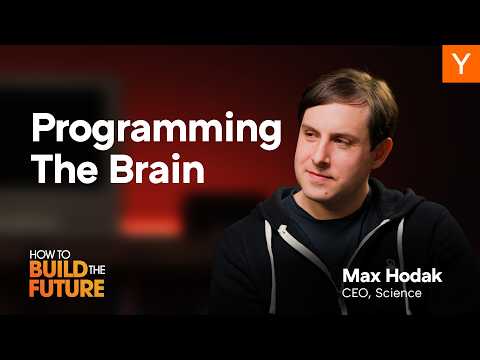
🚀 The BCI Takeoff: Restoring Vision, Reframing Medicine, and a 2035 Event Horizon
Brain-computer interfaces (BCIs) are shifting from moonshot to market. The conversation below maps the frontier: restoring sight with a postage-stamp chip, building biohybrid neural links that grow into the brain, and rethinking critical care perfusion tech. The trajectory points to a decade where neural engineering rivals — and often outperforms — traditional drug discovery.
🚀 The Takeoff Era: From Incremental to Inevitable
- BCIs are a category, not a single product. Modalities will span implants, ultrasound-based neuromodulation, and biohybrid interfaces, each suited to different use cases.
- Adoption curve: Highest-need patients first. As capabilities expand (especially bidirectional and higher-bandwidth interfaces), the risk-benefit trade-off changes — particularly with aging.
“To me, it feels like we’re firmly in the takeoff era now. Like something new has happened on Earth.”
👁️ Clinical Breakthrough: Restoring Vision With a 2mm x 2mm Retinal Implant
Science’s retinal prosthesis (“prima”) delivers form vision — not just phosphene flashes — by stimulating the retina’s bipolar cells rather than the optic nerve.
- Form factor: a 2mm x 2mm silicon chip implanted under the retina; patients wear glasses with a camera and laser that project the image to the implant.
- Clinical footprint: a large European trial across 17 sites, published in the New England Journal of Medicine last fall.
- Scale so far: more than 40 people have received the first treatments.
- Regulatory path: submitted for approval; not yet approved, with hopes for a decision later this year.
- Current qualia: reported as normal vision in black and white with a small field of view today.
- 10-year outlook: a path to near-native acuity (e.g., 20/20), color, and broader field of view.
“As far as I know, our clinical trial was the first time ever that form vision had been created — a coherent image in the mind’s eye.”
🔬 Why Bipolar Cells Work — And Optic Nerve Stimulation Didn’t
- Retinal architecture: ~150 million rods and cones → ~100 million bipolar cells → ~1.5 million retinal ganglion cells (optic nerve fibers). That’s a ~100x compression step.
- Key insight: stimulating bipolar cells preserves critical computation the retina performs before compression. Stimulating ganglion cells (or visual cortex) tends to produce unstructured phosphenes, not coherent form vision.
- Empirical dead end: optic nerve stimulation risks a ~1,000,000-degree-of-freedom calibration per patient — intractable in practice.
For historical contrast, a prior system required a 4.5-hour surgery with a titanium box on the eye and still produced only flashes that the brain didn’t assemble into images.
🧠 Bandwidth, Modality, and Use Cases
- Today’s trade-offs: spoken word is ~40 bits/sec; many can type at ~20-ish bits/sec; current cortical motor decoders hover near ~10 bits/sec. For healthy users, keyboards still win — for now.
- Ultrasound neuromodulation: a potential consumer path for a “digital Adderall” (focus/sleep modulation). High-quality ultrasound currently requires drilling through the skull, but that is expected to be overcome.
- Adoption reality: near-term implants target highly disabled populations; as capabilities grow and risks fall, the calculus shifts, especially with age-related declines.
🧩 Plasticity, Learning Loops, and Conscious Experience
- Critical periods are real (e.g., congenital cataracts corrected in adulthood often overwhelm the brain), yet adult plasticity is far greater than commonly appreciated.
“The brain is very plastic under feedback.”
There are natural case studies for brainto-brain integration: conjoined twins sharing thalamic connections ("one head with four hemispheres") report sharing meaningful conscious elements while retaining separate identities — a hint at what high-bandwidth BCI could enable.
⚙️ Engineering the Brain’s API
- Interfaces in numbers: the brain routes signals via 12 cranial nerves and 31 spinal nerves — a surprisingly well-defined I/O surface.
- Neuroscience x AI: internal model “latent spaces” in modern AI and cortical representations look strikingly similar, enabling cross-translation of neural activity into model-readable features.
- Implant design frontier: closing the skin and managing heat/power were unlocked by the “smartphone dividend” — consumer supply chains that made small, efficient electronics viable for full implantation. Fully implanted motor decoders first proved feasible in the late 1990s, but practical, closed-skin systems are a pivotal step forward.
“Reality is whatever spikes are on the cranial and spinal nerves.”
🧪 Drug Discovery vs. Neural Engineering: A Healthcare Reframe
- Drug discovery’s strike rate: powerful outliers (e.g., GLP‑1s) exist, but a common outcome is a decade-long effort ending in “no.”
- Costs vs. effect sizes: a million-dollar-per-patient gene therapy offered marginal benefit to a tiny subset in blindness — contrasted with a prosthesis restoring functional vision.
- Functional stack: hearing (cochlear implants), balance (vestibular interfaces), vision (retinal prosthesis), and a kilobit per second of motor control collectively reframe what “restoration” means.
“We can take a patient who’s been unable to see faces for a decade and allow them to read every letter on an eye chart.”
🧬 Biohybrid Neural Interfaces: Growing a New Nerve
Inspired by the ~200 million fibers in the corpus callosum, biohybrid implants seed engineered, hypoimmunogenic stem cell–derived neurons onto the device, which then engraft into the brain and form biological connections.
- One cell line, immune-shielded: avoids per-patient manufacturing and heavy gene edits in host tissue.
- Risk model: if graft cells fail, the downside is limited relative to in situ genetic modifications.
- Status: robust animal-model data; not yet in humans.
Think of it as nature’s way to add a new cranial nerve — a biological “USB port” for high-bandwidth brain-to-brain or brain-to-machine links.
🩺 Perfusion (Vessel): From ICU Ethics to Everyday Logistics
Perfusion tech (ECMO/NMP) keeps patients — and organs — alive, but current systems are bulky and expensive, creating ethical and economic bottlenecks.
- Real-world cost: one 17-year-old in Boston survived on ECMO while awaiting a lung transplant, occupying a $500,000 per month ICU suite.
- Industry reality: perfusion systems can cost ~$500,000 and often move by private jet; in one case, jet logistics eclipsed the device business.
- Clinical impact today: over 75% of U.S. liver transplants now use machine perfusion (NMP), allowing surgeries to be scheduled hours or days later.
- Design brief: compress the tech to the point a kidney can fly as checked luggage — or a patient can carry life-sustaining perfusion as a backpack. Infection control requires skin to fully heal around lines, just as neural implants required closed-skin designs to cut infection risk.
📈 The Addressable Need: Blindness and Beyond
- Age-related macular degeneration: affects ~200 million people globally; its severe form (geographic atrophy) is on the order of a million to a couple million.
- Indication breadth: the bipolar-cell approach is agnostic to the cause of rod/cone loss (e.g., retinitis pigmentosa, Stargardt’s, diabetic retinopathy) and is moving into trials for inherited retinal disease (younger patients).
- Optogenetics runway: next-gen opsins sensitive to indoor office lighting could open additional paths, though still 5–7 years from clinical translation, with known pitfalls.
🗺️ Timelines, Risk, and the 2035 Event Horizon
- Near-term: the retinal implant has completed a multi-site trial (NEJM, fall), is submitted for approval, and targets functional vision restoration today (black-and-white, small FOV) with a credible roadmap to color and ~20/20.
- Medium-term (5–10 years): higher bandwidth, richer bidirectional interfaces, and broader BCI modality mix (implantable and noninvasive).
- 2035 “event horizon”: AI and BCI as “twin plotlines.” Intelligence becomes widely available to those with the agency to deploy it; BCI remains underpriced in expectations.
“People are beginning to get that AI is real. It is still not priced in… The first people to live to a thousand are alive right now.”
Risk framing remains pragmatic: p(doom) is well below 50%, not zero. Expect “lateral options” that reframe the human condition long before any claim to have “cured all disease.”
💡 Actionable Watchpoints for Investors and Builders
- Regulatory catalysts: approval decisions for retinal prostheses following NEJM-published outcomes across 17 European sites.
- Manufacturing & scale: miniaturized, power-efficient electronics (the smartphone dividend) and supply chains for implants and smart wearables.
- Modalities to monitor: biohybrid interfaces for ultra–high bandwidth links; ultrasound neuromodulation for consumer-adjacent focus/sleep applications (pending skull-transmission breakthroughs).
- Perfusion logistics: cost/downscaling curves that convert ICU-bound systems into home- or travel-capable platforms; potential spillovers into transplantation networks.
- Demographics tailwind: aging shifts the risk/benefit crossover for restorative BCIs — from hearing and balance to motor and vision — expanding addressable markets.
“BCI is not a product; it’s a category — like pharma. Different probes and modalities will fit different applications.”
Across sight restoration, biohybrid growth into neural tissue, and perfusion that travels like luggage, the throughline is clear: neural engineering is graduating from incrementalism. The market may not be pricing it yet — but the technology curve is moving.
More from Y Combinator

The Razorpay Story: When Regulatory Hurdles Become Moats and Conviction Beats Ca
📌 Introduction: From Oil Fields to India's Payments GiantFew companies embody the journey from zero to generational win...

Solving the Billion-to-One Problem: How a Diagnostics Platform Is Rewiring Healt
Key Takeaways One in 11 babies born in America this year will be screened by a genetic test that didn’t exist a decad...

Variance Emerges from Stealth with $21M Series A — Bringing Agentic AI to Risk,
SummaryVariance has come out of stealth with a $21 million Series A, unveiling a platform of purpose-built AI agents tha...

From Scaling to Symbolic: Why 2030 Looks Like an AGI Inflection Point
🚀 The Big PictureFrontier AI is entering a new regime. The most credible near-term path to broad automation runs throug...

Bio-Industrial Breakthrough: How a Houston Reactor Rewrites Chemical Manufacturi
OverviewA Houston-built reactor is reframing what modern chemical manufacturing can look like: cleaner inputs, higher yi...

Agents, Not Prototypes: How Emergent Turned AI Into 7M Production Apps — And Wha
TL;DR7 million apps in 8 months have been built on Emergent, a YC S24 platform that lets anyone ship production software...