
For wallets, terminals and trading apps
Copy-trading infrastructure for Spot, Perps and Polymarket.
A new revenue stream, live in days.
Your users copy vetted traders. You earn on every copied fill. Five API calls, non-custodial, free to integrate.
// the whole integration, no venue branches
const venues = await client.listVenues()
const leaders = await client.listLeaders({ venue }) // graded, clean by default
const { agentId } = await client.createAgent({
venue, leaderWalletAddress: leaders[0].address,
riskConfig: { maxUsd: '500', copyPercent: 10 },
})
await client.activate(agentId, signer) // ← every venue
const { executions } = await client.listExecutions(agentId) Spot · EVMlive
spot
ERC-7579 smart session: spend cap, hard expiry
 Perps · Hyperliquidlive
hyperliquid-perps
Agent key the user approves and can revoke
 Predictions · Polymarketvalidating
polymarket-predictions
Session scoped to order signing, nothing else
The problem
Building it costs a year.
Not building it caps your revenue.
Copy trading is not a feature ticket. It is four venue integrations, each with its own credential handshake, expiry rules and failure modes. It is a custody model your security review has to sign off on, and a grading engine that can tell a profitable trader from a market maker before your users copy the wrong one. And once shipped it stays an expense: venue APIs change without notice, credentials expire mid-session, and execution needs monitoring by engineers paid to catch failures before your users do. A year of senior engineering to ship, permanent headcount after.
Meanwhile your fee revenue is capped by attention. A manual trader fills orders in the minutes they actually watch the chart; a copy agent mirrors its leader around the clock. Fills keep landing while your users sleep: the same user, a multiple of the volume, and fee revenue follows volume.
That entire build already exists here, running in production: the venue integrations, the custody model, the published audits, the monitoring, the maintenance. Your users copy vetted traders inside your product, and the fees their flow generates are shared with you from the first fill.
Integration takes five API calls and costs nothing. The revenue below is what that unlocks.
Why partners add it
You earn on every copied fill.
Every mirror carries a builder fee inside the execution path. No pricing model to design, no billing to build. Move the slider, switch venues on, and see what your flow is worth.
How hard they trade
Venues you switch on
Your revenue
$367k/mo
Active: each copy trader moves $60k/mo on perps, $8k/mo on spot and $8k/mo on predictions. Perps and spot rates are the live production rates; the Polymarket rate is what live prediction copy-trading products charge today (~1% of copied notional, per on-chain fee data) and applies once the venue leaves sandbox. Figures are your 70% share of the venue fees your flow generates; the exact split is set on your key. An estimate, not a quote.
revenue
Earning from day one
Monetisation ships inside the execution path. A copy trader converts once and generates fee-bearing volume continuously. A premium tier of your own on top is always an option, never a prerequisite.
risk
Zero custody exposure
You never hold user funds and neither do we. Spot runs through a smart session with a spend cap and hard expiry; perps through an agent key the user can revoke. Withdrawing is impossible by construction, not by policy.
scope
Months of venue work, skipped
Every venue means its own credential handshake, expiry semantics and execution quirks. That work is done and unified behind one adapter, including the traps nobody budgets for.
Running in production
Not a beta you'd be first to test.
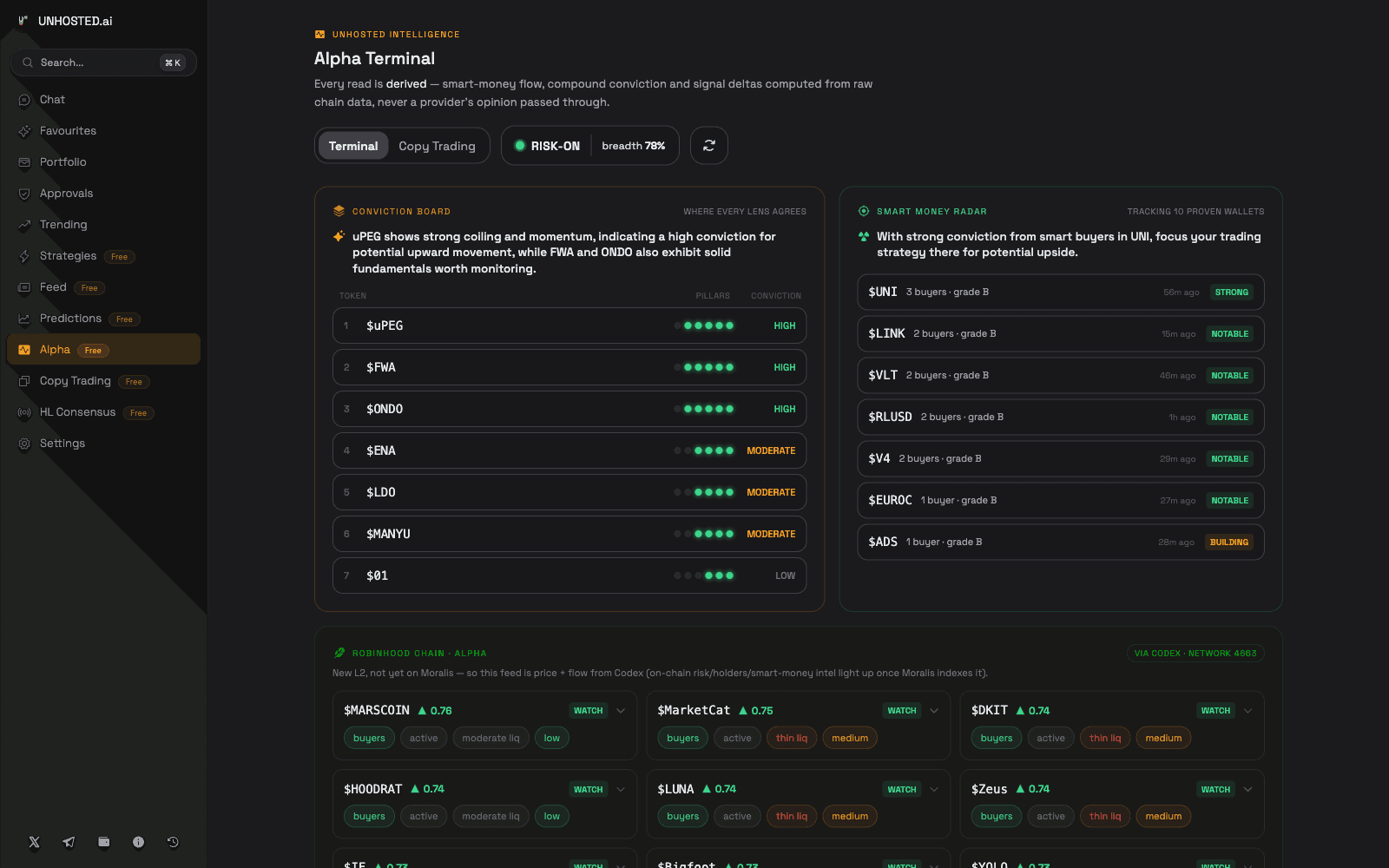
These are our own products running on exactly the API you integrate. The conviction board, the smart-money radar and copy trading are all rendered from these endpoints. We operate on these rails ourselves, so we break ourselves before we break you. Check any of them, live:
The intelligence layer ships with it
Execution is half the product.
The other half decides what to copy.
Your partner key also unlocks the Intelligence API: the engine that grades leaders, sizes copies and blocks the trades that would lose your users money. Derived scores and verdicts over live on-chain data, served from a warm cache in ~10 ms.
Where AI is used, it writes the rationale: one plain sentence over signals the engine already computed. It never invents a number and never sees raw provider data.
// request{ "wallet": "0x7717…bd7e", "venue": "hyperliquid-perps" } // response: derived, never raw provider rows{ "score": 82, "grade": "A", "verdict": "mirror-worthy", "subscores": { "winRate": 74, "profitability": 88, "consistency": 79 }, "confidence": "high"}sample values; field shapes match the live API
Custody, by construction
The backend can submit trades.
It can never withdraw.
can
- Submit trades on venues the user approved
- Mirror a leader within the user's risk caps
- Skip a copy that would be worse than not trading, logged with a machine-readable reason
can never
- Withdraw or transfer funds out
- Exceed the session's spend cap or expiry
- Act after the user revokes: sessions and agent keys die in the user's own wallet
0
critical findings
across every published audit of the stack
2025
security review + pentest
independent engagement covering the backend services, every finding resolved
Public
full reports
downloadable, including the separately audited smart-account contracts
Partner keys are hashed at rest and shown exactly once. Every user action is wallet-signed and replay-proof.
Read the audit reportsThe build you skip
You build the UI.
Everything else is already running.
Leader analytics alone is a product. On one live Polymarket screen, only 2 of the top 12 traders by monthly PnL survived our copyability gates; the rest were market makers whose fills a follower crossing the spread cannot reproduce. Every verdict ships with plain-language reasons and its evidence.
✓venue credential handshakes ×4
✓leader grading & copyability gates
✓execution engine with per-user risk caps
✓slippage & edge protection (skips, with reasons)
✓credential-expiry lifecycle & renewal
✓gateway auth, metering, rate limits
✓sandbox with paper-mode execution
→your UI ← the part you build
Free to integrate.
Earning from your first fill.
No integration fee, no minimums. Sign up, get a sandbox key in minutes, go live when your flows are proven.
01
Sign up
Self-serve, no invite. Your key and the partner console are ready in minutes; we map your wallet stack to the custody model whenever you want a call.
02
Build in paper mode
A scoped key against the sandbox: real leader data and the full activation flow, zero funds at risk.
03
Go live
Flip to live execution when your flows are proven. Metering, entitlements and your fee share are already on the key.