Invest Answers5 min read
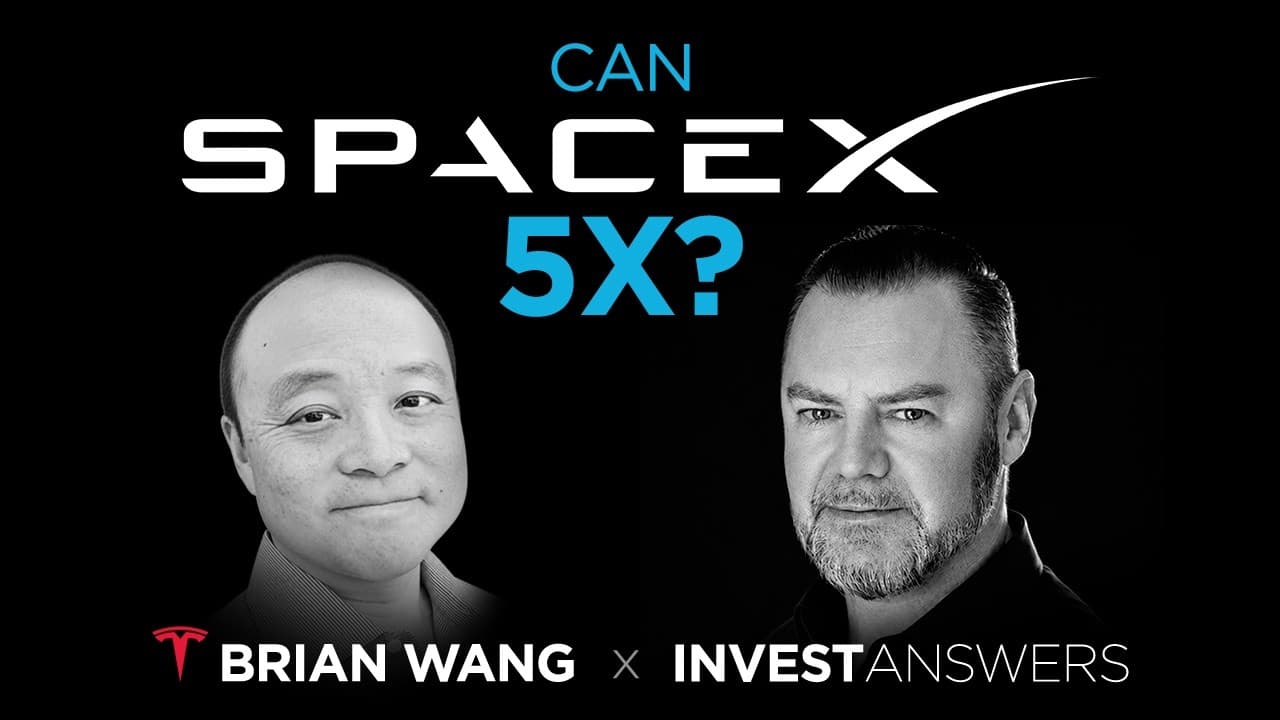
Brian Wang: SpaceX could hit 150-200 gigawatts by 2030, dwarfing Earth compute
InvestAnswers and Brian Wang argue compute scarcity, Texas politics and a possible Tesla-SpaceX merger make both stocks far cheaper than their 2030 upside implies.
AI summary of “SpaceX vs Tesla Faster Horse, Space Urgency + 2030 PTs alone and together”
Key takeaways
- Brian Wang says SpaceX could reach 150-200 gigawatts of compute by 2030, versus a conservative 80-100 gigawatt base case.
- James (InvestAnswers) sandbags 2030 market caps at $10 trillion for Tesla standalone and $15 trillion for SpaceX standalone.
- Wang pegs a combined Tesla-SpaceX entity's 2030 market cap above $50 trillion, calling the forecasts conservative, not insane.
- Both speakers put merger odds near 30%, rising slightly, with James betting on a January announcement.
- Wang says compute monetization is rising from roughly $50 billion to $70 billion per gigawatt and could double from here.
A political "pin" on data centers looks less severe than feared
The episode opens on a day the hosts describe as a market "bloodbath," driven partly by fears that newly elected Democratic officials will choke off AI data center growth. Brian Wang walks through Texas governor-elect Hinojosa's platform, noting she wants data centers to pay for electricity and water and avoid NDAs, but is not trying to halt development outright. He says roughly 70%-plus of the 10 gigawatts SpaceX wants approved in Texas is already permitted and therefore insulated from her policies, and that outgoing governor Abbott's moratorium leaves a window before January 19 to lock in more approvals.
Wang cites an industry estimate that "maybe 41% of planned data centers could face a state pause," though he calls this a rough ballpark between 10% and 40%. He also notes a broader Democratic sweep ("losses across the board... we lost six governorships") that could cut both ways: some new governors may still compete for data center jobs and tax revenue, as he says is happening in Louisiana, which is subsidizing SpaceX's launch facilities.
Space-based compute: an "insane" target with real launch bottlenecks
Wang says Elon Musk has tweeted that SpaceX aims to match monthly terrestrial compute additions with orbital compute by late 2028, which Wang calls "an insane target." He estimates this would require around 200 launches a month with a 200-ton payload Starship, compared with roughly 160 Falcon 9 launches in an entire year currently. Government approval is a separate constraint: he says only about 140 launches are currently approved across Florida and Texas facilities, versus a federal executive order target of 1,000 launches a year that he says would still fall short of what the 2028 plan needs.
Wang also flags political risk to launch approvals, saying the administration "could quash" new launch permissions, which would be "a terrible tragedy" and could push SpaceX to launch outside the United States, delaying plans by a year or two.
Compute is getting scarcer, and Wang sees SpaceX capturing the overflow
Wang argues recent political and permitting friction is making ground-based data centers harder to build everywhere except where SpaceX already has approvals and fast construction (he cites a 66-day build time, versus "two and a half years" for CoreWeave). He expects this to let SpaceX's market share rise "from 20, 40% to as high as 70, 80," potentially even 100% in some view.
On pricing, he says per-gigawatt monetization has moved from about $50 billion to $60 billion and now toward $70 billion, and could double. He also raises the idea that struggling hyperscalers could hand idle, unhoused chips to SpaceX to run in its faster-built data centers rather than let them sit idle and weigh on hyperscaler balance sheets, a dynamic he expects "to start happening in mid-2027."
"I think the reveal is coming. And we know why they're afraid to reveal is because they don't want the Chinese copying them." — Brian Wang (on Optimus V3)
Tesla's robotaxi and FSD ramp
The host says Tesla has around 1,400 unsupervised cybercabs operating in Texas and Florida, and expects that figure to reach 2,000 this month and 10,000 by January in an optimistic scenario. Wang estimates 10 million robotaxis (including customer-owned vehicles joining a fleet) could arrive "as early as 2028" in a perfect scenario, though he is "pretty confident" only about reaching a million by the end of next year.
Wang separately argues robotrucking could be more lucrative than robotaxis because trucking miles are "all commercial" and paid everywhere, with drivers representing 44%-50% of trucking cost; he estimates a half million dollars of annual profit per automated truck versus smaller robotaxi economics. On FSD, the host notes 1.7 million paid subscribers and a target of 6 million by 2027, which Wang supports by expecting adoption rates on older vehicles to rise from 30% toward 80%-90%.
Optimus: less about hands, more about edge compute
Wang offers an unconventional theory on home demand for Optimus: he argues the robot's value at home comes less from manual dexterity and more from its onboard AI5 chip, which he likens to "a petawatt of compute," making it a capable edge-computing device. "The utility of it to use hands is a cherry on top that makes penetration easier," he says. The host notes Fremont is tooled for roughly a million Optimus units a year with an initial ramp of 20,000 a month, and a larger Texas facility targeting 10 million units.
Merger odds and the mechanics of a combined entity
The host maintains a 30% odds estimate for a Tesla-SpaceX merger by year-end, saying the new political environment "increases the chance slightly" given urgency to classify the business as a national security priority, while Wang flags bureaucratic complexity as a offsetting risk. Wang's own best guess, if forced to bet, is a January announcement. Both raise the cautionary example of Marvell's acquisition of Lumentum, where arbitrage selling pushed Marvell below the deal ratio, and the host says the share-exchange ratio between SpaceX and Tesla recently moved toward 3:1.
2030 price targets: large gaps between "sandbagged" and bull cases
The host presents his own deliberately conservative 2030 targets: a $10 trillion market cap for Tesla standalone, $15 trillion for SpaceX standalone, and $25 trillion for a merged entity with no added synergy assumed — implying roughly 6.6x, 6.1x and 7.3-7.6x returns respectively from current levels. Wang's bull case is far larger: he models SpaceX alone reaching 150-200 gigawatts of compute by 2030 and a market cap "over 20 trillion," while a merged company could see "one plus one... equal three," producing combined valuations he puts in the tens of trillions and, in his most expansive framing, describes as potentially "a thousand trillion dollars."
"So, people say, well, how can something be worth more than the world? It's because I'm building the world into a 10x, 100x, a thousand x." — Brian Wang
The two disagree on how far to extrapolate: the host repeatedly calls his own numbers "sandbagged" for conservatism, while Wang pushes back that they are "conservative," not "insane," and offers scenarios built on AI5/AI7 chip counts across cars, Optimus units and data centers rather than gigawatts alone. Neither gives a single reconciled figure, leaving the size of the eventual combined company's valuation as an open question hinging on launch cadence, chip supply and the merger actually happening.
Written by AI from the video's transcript. It can compress, misattribute or miss context — the original video is the source. Not investment advice.