Y Combinator4 min read
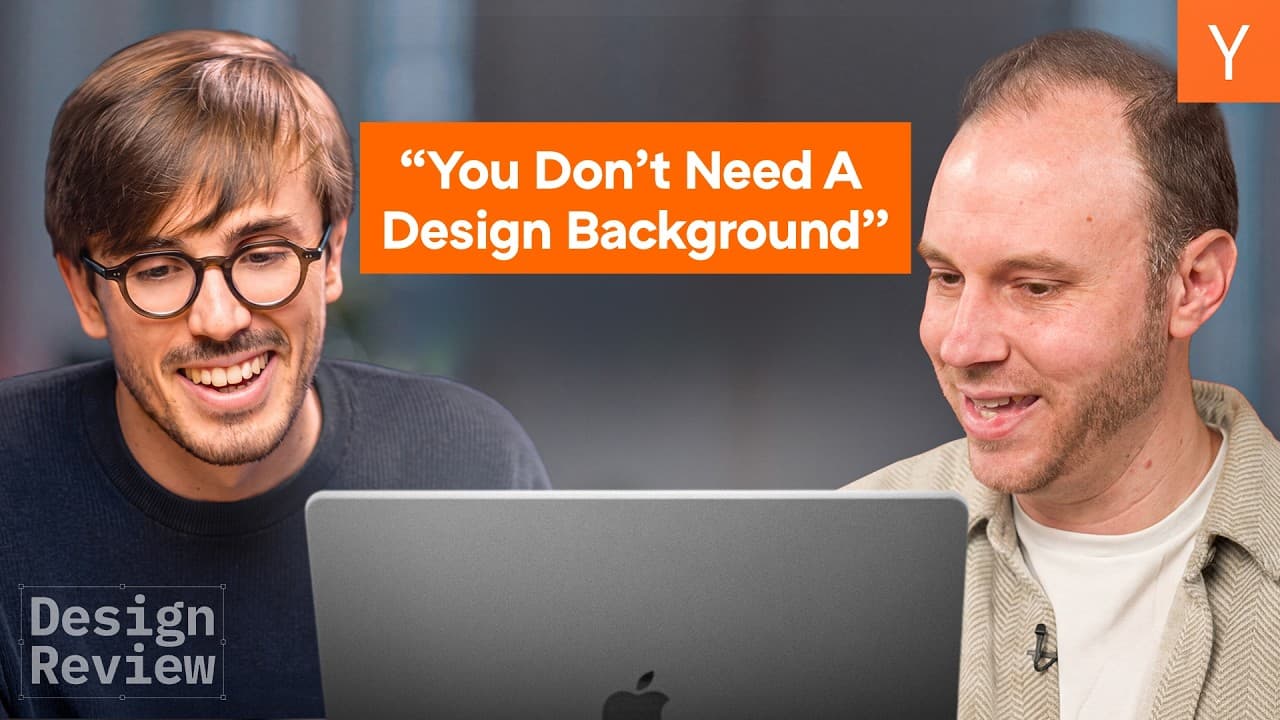
Shopify's Marvin Schwaibold: 91 prompts to build one carousel animation
The Shopify design studio lead shows how AI tools turn designers into full-stack builders, then critiques five startup websites for clarity and motion.
AI summary of “The New Full-Stack Designer”
Key takeaways
- Marvin Schwaibold says his Shopify studio prototypes Sidekick and admin redesigns directly in code rather than only in Figma.
- He rebuilt a real grass video as a WebGL shader over a weekend using Codex and ChatGPT together, iterating with a topographic depth map.
- He describes recreating a Mike Matas-style portfolio carousel that took 91 prompts, exposing variables via a tool called Dialkit.
- Reviewing five submitted sites, he and Aaron Epstein repeatedly flag unclear primary calls-to-action and "scroll jacking" as the main design failures.
- Schwaibold argues AI raises the "ceiling" for designers but still can't judge what looks good, calling himself more editor than crafter now.
AI has shifted the design process from Figma to code
Marvin Schwaibold, who leads the product design studio at Shopify, told the host that his process "hasn't really changed" in structure but the tooling has moved from aesthetic layout work in Figma toward AI-driven workflows using Codex and Claude Code. He now treats Figma mainly as "a scratch pad" before moving quickly into working prototypes he can test on his phone.
He described the designer's role shifting toward curation and quality control rather than execution.
"AI has definitely raised the ceiling for all of us, but it's not a crafter... it doesn't know what looks good and what looks bad and that's for me to decide."He said designers are "in the driving seat," breaking complex tasks into subtasks for agents and iterating back and forth.
Inside Shopify's product design studio
Schwaibold said his team has spent the last year redesigning major Shopify surfaces, including Sidekick (the company's AI infrastructure layer managing the admin) and the mobile "green app." He described two parallel efforts: one team polishing the admin interface in Figma, the other automating store management through conversational AI via Sidekick.
He showed a prototype where Sidekick surfaces suggestions on the merchant home feed — for example, rewriting a product description — that the merchant can approve to directly change the store. He credited Shopify founder Tobi with setting the mandate that "the future needs to be designed," pushing design further into the company's strategic narrative than before.
From Molly studio to Shopify
Before joining Shopify, Schwaibold ran design studio Molly in Brooklyn with partner Jay Tal for about two years, working with clients including Collins, Apple and Google. He highlighted a Collins project featuring a "bookshelf" of case studies with hand-tuned bounce animations built jointly with engineer Jesper, saying such craft signals to prospective clients the level of detail an agency can bring.
He said the studio's approach, which they called "primal," structured content so sites felt like users were exploring rather than being overwhelmed — "everything is just one layer away, and everything is progressively disclosed."
Building a grass shader and exposing variables with Dialkit
As a weekend project, Schwaibold used Codex to turn a video of real grass into a WebGL shader, then used ChatGPT in parallel to diagnose why Codex's output looked wrong. A breakthrough came from asking AI to render a topographic map of the underlying terrain, which let him understand the grass needed to sit on sloped structure rather than a flat layer.
He used a tool called Dialkit to expose variables such as grass blade length and wind strength, which also revealed that his original terrain map was "completely wrong and skewed." He applied the same approach to a portfolio carousel inspired by designer Mike Matas, which he says took 91 prompts, tuning parameters like "pull boost" to get the drag-and-collision motion feeling right.
His advice to founders and designers
Schwaibold described AI as "an infinitely patient collaborator" that won't get frustrated after 91 attempts, unlike a human engineer. His advice: keep tinkering, show the model reference examples (a carousel you like, a color palette), and don't give up after one bad result.
He also encouraged designers to use AI to "decompile" and copy admired interactions as a learning exercise, saying this teaches how to be a better collaborator with the tools going forward.
Website reviews: unclear focus and cluttered calls-to-action
Reviewing Endstack, the host and Schwaibold criticized it for lacking one primary goal, with multiple identical-colored buttons competing for attention. On SkillSync, Schwaibold argued dense sidebar tabs bury information users rarely explore, advising a "three-up" structure highlighting only top features, and criticized AI-generated decorative animations that "don't actually help my understanding of the point."
On Instaplay, they noted the primary call-to-action (creating a game) was easy to miss behind a wall of game thumbnails, and that the back/home navigation was confusing. Mintlify was praised as clean and trustworthy, with a strong logo wall for social proof, though Schwaibold felt headlines were too small against a reused background animation.
Nullify and Instinct: scroll jacking and show-stopper visuals
Reviewing Nullify, Schwaibold strongly criticized "scroll jacking," saying
"you use the native scroll on websites and don't hinder the speed at which a user wants to interact with the content."He called it an arrogant design choice and said video carousels should be easier to tap into and browse.
Instinct, a space-technology site, was praised for clear positioning and an effective 3D moon animation as a "show stopper" component, though both noted inconsistent typography between the serif logo and sans-serif body text, and a carousel that didn't support swipe or drag gestures. Schwaibold plugged an open-source tool from his team, Blossom Carousel, as a fix for exactly that problem.
Written by AI from the video's transcript. It can compress, misattribute or miss context — the original video is the source. Not investment advice.