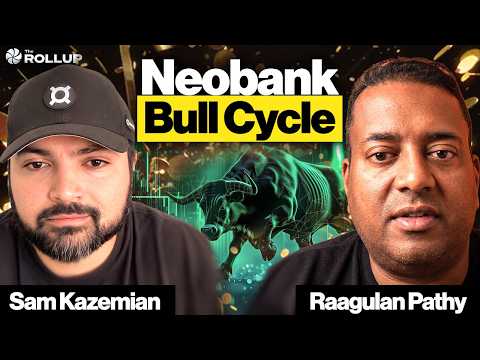
🏦 The Neo-Bank Super Cycle: Scale, Distribution & The Race to Rebundle Banking
🚀 The Unbundling & Rebundling of Banking
The traditional banking system is undergoing a fundamental transformation — one that's being driven by stablecoins, tokenization, and a new generation of neo-banks competing for global distribution. According to industry operators, banking is being unbundled, with every component of the financial stack — from settlement to brokerage services — being separated and then strategically reassembled by web3-native platforms.
Rob Hadock from Dragonfly recently crystallized this shift: "Banking is being unbundled." Before recent regulatory clarity, banks were required to participate in nearly every aspect of the settlement process. Platforms like Venmo or PayPal required users to wire deposits into corporate bank accounts. With stablecoins, that intermediary step is eliminated. Users can hold regulated stablecoins — essentially treasuries and money market fund securities — without traditional bank deposits.
The key insight? As more banking features get unbundled and rebundled into new platforms, demand for stablecoin infrastructure explodes. Companies are increasingly holding treasuries of regulated stablecoins not just for speculation, but for running day-to-day operations — both for inbound payments and outbound payouts.
"It's not just when crypto goes up. The demand for places that can hold stablecoins is expanding across business operations, neo-banks, and even traditional companies looking for more efficient treasury management." — Sam, CEO of FRA
🌍 The World Wants to Bank in America
One of the most compelling narratives emerging from the stablecoin and neo-bank ecosystem is this: the world desperately wants access to the U.S. banking system and capital markets. Historically, opening a U.S. bank account or accessing dollar-denominated financial services has been nearly impossible for individuals and businesses outside select countries.
Ragulan Pathy, CEO of Cast, recently shared this perspective during meetings with senior officials at the SEC:
"The world essentially wants to bank in America. They want access to dollars, U.S. dollar bank accounts, and the ability to trade U.S. stocks. Stablecoins and the infrastructure we're providing is basically a way for them to do that. There is unlimited demand for that."
Cast operates a globally distributed platform, with usage evenly split across regions. The thesis is simple: people have discovered that moving money via stablecoins is more efficient than traditional rails, and once that realization takes hold, adoption follows a path similar to e-commerce in the 1990s. Retail might grow 2% annually, but online shopping was growing 20%. Stablecoins are following the same trajectory — continuously eating away at traditional banking's market share.
📊 Tokenization Goes Mainstream: Robin Hood & The Equity Explosion
Tokenized equities are no longer a theoretical construct. Robin Hood Chain has emerged as a major player, offering tokenized stocks that provide 24/7 access to U.S. equities for a global audience. Vlad Tenev, Robin Hood's CEO, has been making the case on national television, defending the company's approach even as traditional market participants — including some CEOs of tokenized companies — push back.
The implications are profound. Tokenized equities enable:
- Global access: Anyone, anywhere can trade U.S. stocks outside traditional brokerage hours
- On-chain composability: Pair trading, liquidity provision, and even activism may become possible
- New financial primitives: Credit against tokenized holdings, instant settlement, and integration with DeFi protocols
However, structural questions remain. Most tokenized stocks on Robin Hood Chain are structured as debt instruments, not direct equity. Robin Hood technically remains the on-ledger entity. This raises fascinating possibilities:
"What if there's on-chain activism? What if a DAO accumulates a large position in a tokenized stock and wants to propose something? Will Robin Hood act as a proxy agent? These are questions that will have to be answered as this space matures." — Sam, CEO of FRA
Other major players are positioning as well. NASDAQ and the New York Stock Exchange are both building alternative trading systems (ATS) to facilitate 24/7 tokenized trading. The infrastructure is being built in real-time, and identity, KYC, and interoperability across platforms will become critical battlegrounds.
🏗️ The Identity Layer & The FRA Strategy
FRA is positioning itself as the global identity layer for neo-banking and neo-brokerages. Rather than competing directly with specialized products like Cast's stablecoin cards or other neo-bank features, FRA is building a platform where businesses and individuals can access a unified account with composable features:
- Single KYC across services: Users complete identity verification once, and that credential can be routed across multiple applications
- Modular app store: Features like earning yield, equity trading, and card issuance will be structured as standalone applications that plug into the FRA platform
- Built-in rewards & referral codes: Each application will have originators, enabling builder codes and campaign-based incentives (e.g., "2% cashback on equity purchases this month")
FRA's philosophy: don't reinvent the wheel. If another platform excels at a particular feature (like Cast's card infrastructure), integrate it rather than compete. The goal is to bring liquidity, credit, and composability to the table, while allowing other teams to build on top of the platform.
"We're not going to tokenize Nvidia ourselves. But we want to give accounts and businesses the ability to hold tokenized assets, compose with them, and access credit against them. That's where we add value." — Sam, CEO of FRA
⚖️ The Moat Question: Scale, Brand & Trust
A critical question emerged during the discussion: If banking is being unbundled and multiple platforms offer similar services, where is the moat?
Ragulan Pathy offered a compelling analogy: sports teams. He asked: "What moat does the Miami Heat have on you?" The answer isn't a technological barrier or proprietary infrastructure — it's brand, culture, and trust.
People stick with financial platforms not because of lock-in effects, but because of how the service makes them feel. Most individuals have access to multiple banks (JP Morgan, Bank of America, Citi), yet they remain loyal to one. The same dynamic applies to neo-banks.
Cast's strategy reflects this:
- Product velocity: Ship as many features as possible, ensuring users can do everything they need within one platform
- Cultural resonance: Build partnerships with musicians, celebrities, and cultural events (Cast was in New York for Fashion Week exploring brand collaborations)
- Customer service: Cast aims for one-minute response times and hired aggressively to ensure users feel supported
"We want people to be fans of our platform the same way they're fans of a sports team. That emotional connection — that trust — becomes the moat." — Ragulan Pathy, CEO of Cast
But there's another moat that emerged in the conversation: economies of scale.
📈 The Scale Game: Go Big or Go Home
Sam pressed Ragulan on a critical point: how does Cast negotiate cashback deals, hotel partnerships, and other perks that drive user acquisition? The answer was blunt:
"It's a catch-22. Partners ask, 'What scale do you have?' So we push maximum scale first. Once you have scale, you can cut better deals. But you can't have that conversation if you're doing $5-10 million a month in card volume. You need to be doing hundreds of millions a month — tens of billions annually — before these negotiations become relevant."
Cast is willing to subsidize rewards and run at a loss to capture market share, banking on the thesis that scale will eventually unlock better economics. Those better economics will then fund even more aggressive user acquisition, creating a flywheel.
Ragulan's thesis is stark:
"I don't believe all these neo-banks will survive. My thesis is go big or go home. Cast will be a $100 billion company, or we'll fail. There's no in-between. We're running lean, but our job is to squeeze out everyone and win."
The market is already reflecting this dynamic. Ragulan receives two to five M&A inquiries per day from smaller neo-banks and fintech companies that have failed to achieve liftoff. Many raised significant venture capital, acquired licenses, and built products — but couldn't generate the critical mass of users needed to negotiate favorable terms with partners.
"Neo-banks were so hot 18 months ago. Everyone wanted to be one. But the market quickly realized that if you don't have a regional edge, a customer acquisition edge, or a subsidy edge — if you don't have *an edge* — you're not going to make it."
🔑 Key Takeaways
- Stablecoins are digitizing dollars and enabling global access to the U.S. banking system and capital markets
- Tokenized equities are live and raising new questions about activism, proxy voting, and on-chain governance
- Identity and KYC will become critical infrastructure as financial services fragment and reassemble across multiple platforms
- The moat in neo-banking is a combination of brand/trust and economies of scale — not just technology
- The neo-bank market is consolidating rapidly, with only the largest platforms likely to survive long-term
- Go big or go home is the prevailing strategy — scale unlocks better economics, which funds more growth
The race is on. The platforms that can capture users, build trust, and achieve the scale necessary to negotiate favorable partnerships will dominate. The rest will become acquisition targets — or footnotes.
More from TheRollupCo

Markets Shrug Off Hot CPI as Animal Spirits Return – ETH Breaks Out, Tokenizatio
📊 The Hot CPI Print That Didn't MatterFriday morning delivered a CPI reading that should have tanked markets — but inst...

The Ethereum Comeback: Why the World's Second-Largest Crypto Is Poised for a Maj
📊 Market Sentiment Shift: From Rage Quit to Rally CryEthereum has emerged from one of its darkest narrative periods in ...

The SEC Just Changed the Game: Tokenization Exemptions, Clarity Act Odds, and Wh
🚨 Breaking: Arc Invest to Launch First Tokenized Fund Under New SEC FrameworkIn what could mark the official opening of...

SpaceX, Bitcoin, and the Art of Concentrated Conviction: A Masterclass in Long-T
The markets are ripping. Bitcoin is trading at $81,000, bulls are firmly in control, and bears remain sidelined. Yet ben...

Social Trading, Hyperliquid, and the New Era of On-Chain Wealth Creation
💰 The New Financial LandscapeThe crypto markets are entering a fundamentally different phase—one where on-chain busines...

The Disbelief Phase Is Over: Inside the Institutional Crypto Era
🚀 The Bottom Is In—Welcome to the Belief PhaseAfter months of sideways action and widespread skepticism, crypto markets...