
🤖 Inside Coinbase's AI Vision: Agents, Tokenized Compute, and the Post-AGI Economy
The intersection of artificial intelligence and blockchain technology is no longer theoretical—it's happening in real time, reshaping how financial infrastructure operates and how value flows through digital economies. Lincoln Murr, who leads AI product development at Coinbase, recently shared insights into this rapidly evolving landscape, touching on everything from tokenized compute markets to the imminent proliferation of autonomous financial agents.
💡 Intelligence as a Utility: The Commoditization of AI
A foundational shift is underway in how the market views artificial intelligence. As Sam Altman has articulated, inference and intelligence are becoming utilities—comparable to electricity or water in their essential nature. This transformation carries two major implications: explosive growth in usage and a continual decrease in costs.
What makes this particularly relevant to crypto is the role of tokenization in creating more efficient markets for these utilities. Traditional infrastructure for utility markets—futures, hedging instruments, and speculation vehicles—already exists for electricity and commodities. Now, similar financial primitives are emerging for compute and inference, but with the speed, transparency, and cost efficiency that blockchain enables.
"If you think that compute resources are going to become larger, there's an ability to speculate on that, where today people can't get access to OpenAI or Anthropic besides some pre-IPO shares... It's a more direct pure form of speculation."
The practical applications extend beyond speculation. Large enterprises anticipating significant AI-related costs can use tokenized structures to hedge against compute expenses, similar to how farmers use corn futures markets. This creates a more decentralized price discovery mechanism—one set by market forces rather than monopolistic hardware manufacturers.
📊 The Rise of Agentic Finance
Perhaps the most transformative development is the emergence of what Murr calls "agentic finance"—a paradigm where AI agents don't just assist with financial decisions but actively manage portfolios and execute trades autonomously.
The current state of agent-driven trading is compared to the early days of mobile apps—"the flashlight app, QR code scanner, beer drinking app era" of agents. Simple, experimental use cases proliferating rapidly before consolidation and maturation. But the trajectory is clear: agentic finance will ultimately just become finance.
Key developments in this space include:
- Orchestration gap solutions: Many users have investment theses but lack the time or expertise to translate broad ideas ("I want exposure to quantum computing") into actual portfolio positions across crypto, equities, and prediction markets. Agents excel at this translation and active management.
- 24/7 portfolio management: Unlike human traders who forget positions or miss liquidation warnings, agents provide continuous monitoring and rebalancing.
- Premium data access: Autonomous agents are already paying for enhanced data feeds via payment rails like X402, creating a positive feedback loop where better information leads to better returns, which justifies higher data costs.
Coinbase has launched two products addressing different user comfort levels with agent autonomy:
- Coinbase Advisor: A human-in-the-loop product offering regulated financial advice within the retail app
- Coinbase for agents: An MCP (Model Context Protocol) integration allowing agents to operate their own portfolios on the Coinbase platform, make trades autonomously, and pay for services with X402
🔐 The Security Question: Are Frontier Models Too Dangerous?
Recent controversy around DeepSeek's Fable 5 and other advanced models highlights growing tension between innovation and security. The Trump administration's initial moves to restrict high-intelligence models, followed by policy reversals, underscores the complexity of managing AI capabilities that excel at cybersecurity and exploit detection.
The crypto ecosystem faces particular vulnerability. Smart contracts are immutable, and massive value is locked in protocols that could theoretically be exploited by sufficiently advanced AI models with cybersecurity capabilities. This creates what Murr describes as a "short-term chaos" scenario:
"If Mythos and these other models that are amazing at cybersecurity get leaked to the public or otherwise made available through open source means... we're going to have this short-term period of just complete chaos where all sorts of different projects and protocols are going to see hacks both in Web3 and Web2."
However, this chaos would likely be temporary. Once the initial vulnerability window closes, these same models would serve defensive purposes—scanning code for vulnerabilities before deployment and actually improving security beyond current standards.
The nationalization question adds another dimension. Trump's interest in the government taking equity stakes (around 5% has been discussed) in frontier AI labs like OpenAI raises concerns about favoritism and misaligned incentives. While such stakes could align government and industry interests around American AI dominance, they might also discourage support for newer entrants that threaten incumbents.
🇺🇸 vs 🇨🇳 The Global AI Race
American dominance in AI development is clear, with Anthropic, Google, and OpenAI leading the frontier. China's response has been strategic: open-sourcing models and dramatically undercutting on price. Chinese alternatives are marketed as delivering approximately 95% of the capability at 5% of the cost.
Rather than viewing this as a threat, Murr sees it as providing "capitalist incentive for intelligence to be proliferated" and keeping American labs innovating under competitive pressure. Moreover, even if Chinese models achieve cost parity or superiority, the physical infrastructure remains crucial:
- Data centers must be built on American soil for security and regulatory reasons
- Supporting infrastructure (electricity, water, cooling) creates domestic economic activity
- Chip manufacturing and the broader technology stack remain strategically important
The inference cost differential is stark in practice. Premium API usage (like Claude Opus) can cost 10-20 cents per complex interaction, while Chinese alternatives might cost a penny. This pricing pressure is forcing a market recalibration, though the view from Coinbase is that adoption is still so early that even cheap inference will drive massive token usage growth as companies globally begin implementing AI.
🚀 Coinbase's Vision: Backbone of the Post-AGI Economy
The strategic direction at Coinbase centers on a clear thesis: "Make Coinbase the backbone of the post-AGI economy."
This vision rests on several pillars:
- Financial accounts for agents: As agents proliferate across the internet, they'll need their own financial infrastructure. Coinbase for agents provides this primary account layer.
- Settlement infrastructure: X402, Base (Coinbase's Layer 2), and USDC create the rails for internet-native microtransactions at billion-plus transaction scale.
- Enterprise adoption: Major infrastructure providers are integrating these payment rails—Cloudflare now accepts X402 payments for agent-based website crawling, gating access to 25% of internet traffic through crypto payment channels.
The product philosophy mirrors the shift from web to mobile in the 2010s. The 2020s are defined by "mobile to agents"—a transition requiring some retooling of consumer-facing interfaces but leveraging existing infrastructure.
"If there's a product on Coinbase that exists, your agent can use it. If your agent is going to be making a payment, it's going to have something to do with the Coinbase stack."
Crypto's natural fit for agents stems from its machine-readable nature. While humans carefully verify addresses and transaction details multiple times, agents process this information instantaneously. The technology was almost purpose-built for autonomous entities operating at scale.
🎯 The Missing Piece: Consumer Demand
Despite significant progress on the supply side—with AWS, Vercel, Cloudflare, and Stripe all adopting agentic payments on crypto rails—clear consumer demand remains underdeveloped. The infrastructure exists, the enterprise integrations are happening, but mainstream users aren't yet making micropayments with their agents or engaging with these systems in daily life.
This represents the biggest opportunity for builders: creating consumer-facing applications that bring these capabilities to average users in seamless, intuitive ways. The pattern repeats the broader crypto challenge—robust infrastructure seeking killer consumer applications.
Looking forward, payments and trading are positioned to become the dominant use cases for AI interacting with money over the next 6-12 months, driven by the practical benefits of 24/7 autonomous management, elimination of emotional trading, and the ability to act on complex strategies without manual implementation.
✨ What This Means
The convergence of AI and crypto is accelerating beyond pilot programs and experiments into production-ready infrastructure supporting real economic activity. Key themes emerging from this landscape include:
- Intelligence commoditizing into a tradeable utility with market-driven pricing
- Autonomous agents gaining financial independence through blockchain-based payment rails
- Traditional finance functions increasingly delegated to AI with varying levels of human oversight
- Infrastructure-layer legitimization happening faster than consumer adoption
- Global competition driving both innovation and cost efficiency in AI capabilities
The question is no longer whether AI and crypto will integrate, but how quickly the consumer layer catches up to the infrastructure that's already being built beneath it.
More from TheRollupCo

Onchain Equity Trading Goes Live — And It's Already Beating Traditional Brokerag
🔥 The Impossible Just Happened: Day-One Execution Beats TradFi The tokenization thesis isn't coming anymore — it's her...

The House of All Finance Is Being Built Brick by Brick—And Chain Link, Aerodrome
📈 Pre-Bull Phase: Why This Rally Feels DifferentBitcoin is pushing toward $80,000. Ethereum is climbing past $2,500. So...

The Dawn of Agentic Commerce: AI Agents Have Already Made 16.2 Million Payments
💡 The Internet Finally Gets Native PaymentsAfter three decades of digital commerce, the internet is finally getting wha...

The Wrong Proposal at the Wrong Time: How Ethereum's Yield Wars Are Shaping Inst
📊 Permanent Capital vs. Mercenary Capital: A New Era for Digital Asset TreasuriesThe institutional playbook for Ethereu...
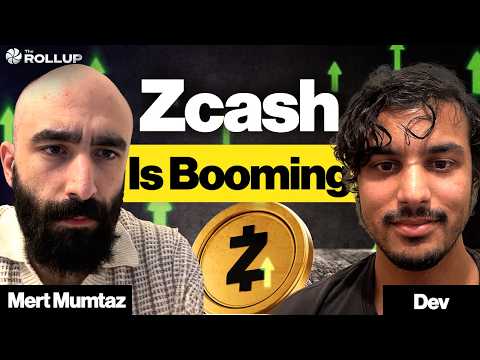
Inside Zcash's Post-Ironwood Era: Formal Verification Solves Security Concerns,
🛡️ Ironwood: A Defining Moment in Zcash Security The Zcash ecosystem has successfully navigated one of its most critic...

Liquidity Is Back: Treasury's Bond Buyback Program Ignites Historic Crypto Rally
💰 The Bottom Is In: Markets Explode on Treasury Liquidity SupportWednesday, August 19th delivered one of the most decis...