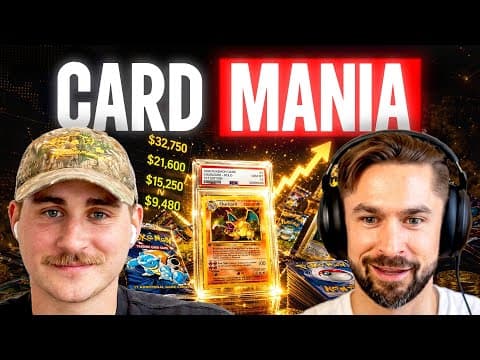
🃏 The Pokémon Card Market is Doing Hundreds of Millions in Volume — And It's Going On-Chain
📦 The Physical Collectibles Boom: Pokemon, One Piece, and Beyond
The trading card market is experiencing a moment unlike anything seen before. While NFTs captured attention during the 2021 bull run, physical collectibles — particularly Pokémon and One Piece cards — have quietly evolved into a vibrant, multimillion-dollar marketplace with all the hallmarks of an emerging asset class.
According to Andy, founder of the gotcha platform Monster, these platforms are seeing hundreds of millions of dollars in volume per month across pack openings and card redemptions. The largest platforms, like RIPs and Arena Club, are not crypto-native at all — yet they've become infrastructure for a thriving secondary market where graded cards change hands at eye-popping valuations.
"These platforms are having to buy more Pokémon cards constantly. It's about 30% of the volume played through that gets redeemed by users — millions of dollars of inventory being replenished weekly."
The appeal is partly nostalgic, partly speculative, and partly cultural. Millennials who grew up with Pokémon in the late 1990s and early 2000s now have disposable income and a deep emotional connection to the IP. As a result, vintage cards like the base set Charizard have seen their value climb steadily, while modern high-end cards continue to outperform expectations.
🏆 Grading, Liquidity, and Market Structure
One of the most defining characteristics of the trading card market is its dependence on grading companies — particularly PSA, Beckett, and CGC. These companies assess the physical condition of cards and assign a grade, typically from 1 to 10. A PSA 10 (gem mint) card can be worth exponentially more than an ungraded version of the same card.
But the grading system comes with friction. PSA, which dominates the market, has been overwhelmed with submissions — sometimes taking six months or more to return graded cards. In response, they've raised minimum submission fees to $100 per card and effectively stopped accepting lower-tier submissions. Worse yet, if a card grades highly and becomes more valuable, PSA can charge additional fees to return it graded — or offer to send it back ungraded if the owner can't afford the premium.
"If you have an insane card worth $100,000, a lot of people genuinely couldn't afford to get it graded. It's kind of a racket."
This bottleneck has created a liquidity crunch. Even as demand for graded inventory surges, supply is constrained by the grading process itself. Modern cards that have appreciated significantly in value can't easily be graded and flipped — leaving fewer pristine copies available on the market.
For context, a PSA 8 base set Charizard currently trades around $1,300, tracked across platforms like eBay, Fanatics, Alt, and Golden. However, the market remains opaque. Much of the trading happens offline at card shows, paid for in cash, with no centralized data tracking. Price discovery tools like pricecharting.com and Card Ladder aggregate public auction and eBay data, but they capture only part of the picture.
🎰 The Gotcha Economy: Digital Pack Openings Meet Tokenization
The rise of gotcha and repack platforms has been transformative. These apps allow users to virtually open packs of cards, view what they pulled, and decide whether to keep the card (by redeeming it physically) or sell it back to the platform at a buyback rate — typically around 70% to 96% of fair market value, depending on the card's tier.
Platforms like Courtyard, Collector Crypt, Figitals, and Bezy are crypto-native, tokenizing cards as NFTs and offering on-chain custody and trading. Meanwhile, non-crypto platforms like RIPs and Arena Club dominate in raw volume but lack blockchain integration.
What many don't realize: these platforms are quietly tokenizing millions of dollars of cards every week. As users open packs and redeem high-value pulls, the platforms must constantly replenish inventory — competing with one another and with collectors for the same scarce graded cards.
"You're competing against people who have literally millions of dollars to spend and kind of don't care what the price is because they just need more cards for their app to work."
Monster, Andy's platform, offers packs with an expected value above the purchase price — for example, a $50 pack might yield an average of $55 in card value. This strategy attracts collectors and repeat users, while the platform profits on the buyback spread and long-term engagement.
📈 Why Are Pokémon Cards Hot Right Now?
Several forces are converging to fuel the current wave of interest:
- Demographic Timing: Millennials in their mid-30s to early 40s now have real disposable income and are willing to spend thousands on nostalgic IP.
- Brand Longevity: Pokémon has been around for 30 years and is celebrating its anniversary this year, sustaining cultural relevance across generations.
- Scarcity and Reprints: Unlike Yu-Gi-Oh, which diluted value by reprinting the same cards, Pokémon reprints classic cards with a clear visual distinction — honoring the original while maintaining its value.
- Influencer Momentum: Figures like Logan Paul have brought mainstream attention to high-end cards, similar to how celebrities amplified NFTs in 2021.
- New Releases: Pokémon's recent game, Pocket TCG (Poctopia), was a massive success, reigniting interest in the cards themselves.
The One Piece trading card game has been even more explosive. Launched in the early 2020s, it has seen individual cards pull 100x returns, going from $1,000 to $100,000 in a year. One Piece benefits from a decades-old anime with a passionate global fanbase, plus a new Netflix live-action series driving renewed attention.
"If Pokémon is Bitcoin, One Piece is Ethereum in 2020–2021. It's parabolic."
⚠️ Are We at a Local Top?
Andy acknowledges the market may be overheated in the short term. Card show vendor tables sell out in seconds, similar to a sneaker drop. Gotcha platforms are seeing unprecedented volume. Auction houses are regularly closing million-dollar bids on modern sports cards, including Shohei Ohtani rookies and one-of-one cards.
But unlike NFTs, which lacked decades of brand equity, Pokémon and similar IPs have staying power. A 20% pullback in Pokémon card prices doesn't signal the end of the market — it's a natural correction in a mature collectible category. The emotional attachment and nostalgia millennials have for these cards creates a durable floor of demand.
"When the Pokémon market goes down 20%, people aren't going to say, 'That's the end of Pokémon.' That's just not what's going to happen."
🔗 The Case for On-Chain Collectibles
Despite the physical nature of trading cards, there's a growing case for tokenization and on-chain settlement. NFTs solved many of the pain points that plague physical collectibles:
- Transparent price discovery
- Instant, global liquidity
- Composable marketplaces and data
- No custodial risk or grading monopolies
Crypto-native platforms are bringing these benefits to physical cards by acting as a Trojan horse for tokenization. As more cards are vaulted, tokenized, and traded on-chain, the infrastructure for a unified, liquid market begins to take shape.
Additionally, stablecoin payments are proving invaluable in a market plagued by chargebacks and fraud. At in-person card shows, cash is king — but crypto offers a digital equivalent with similar finality and far greater convenience.
"There's a lot of fraud in these markets. The stablecoin payment side is massive because chargebacks are a huge problem."
Tools like Only Slabs and Traded are aggregating tokenized card listings across platforms, creating OpenSea-like experiences for physical collectibles. Some traders monitor these platforms for cards listed below fair value, buy them, and redeem them for arbitrage — a strategy reminiscent of NFT flipping in 2021.
🎯 Monster's Strategy: Building for Collectors
Monster's approach centers on long-term collector engagement rather than pure speculation. The platform offers:
- Higher-than-purchase expected value on pack openings
- Generous buyback rates (87% to 96%, depending on card tier)
- Dynamic pricing that adjusts buyback offers as card values change over time
The ultimate vision extends beyond gotcha mechanics. Andy envisions a full-stack platform offering wish lists, portfolio trackers, lending, and curated marketplaces — filling gaps that still exist in the fragmented trading card ecosystem.
"The gotcha stuff is a revenue leader and a way to get a foot in the door. But we want to offer a great platform for people who love to collect things."
🧠 The Pokémon Center of the Brain
Perhaps the most compelling long-term thesis is neurological. Research has suggested that millennials who spent significant childhood time engaging with Pokémon — through games, cards, and TV — developed a distinct neural cluster dedicated to Pokémon recognition and nostalgia.
"There's like a center of neurons that grew to be our Pokémon center of the brain. Enough millennials have this that it's literally in our brains, dude."
This isn't just sentimentality — it's brand equity encoded in brain structure. That kind of attachment doesn't fade easily, and it underpins the willingness to spend thousands on a card tied to childhood memories.
✅ Final Thoughts: Physical Meets Digital
The trading card market is at an inflection point. Gotcha platforms are driving massive volume, grading bottlenecks are constraining supply, and tokenization is slowly bringing transparency and liquidity to a historically opaque market.
While the NFT market struggled with brand-building and speculation, physical collectibles benefit from decades of IP development and multigenerational fandom. Pokémon, One Piece, and sports cards aren't going anywhere — and as more of this market moves on-chain, the infrastructure built during the NFT era may finally find its product-market fit.
For now, the market is hot. Whether it's a local top or the early innings of a larger shift toward collectibles as a recognized asset class remains to be seen. But one thing is clear: nostalgia, liquidity, and tokenization are converging — and the next wave of on-chain adoption might not look like CryptoPunks. It might look like a holographic Charizard.
Learn more: Follow Andy on Twitter at @Andy8052 and check out Monster at MNSTR.xyz.
More from Bankless

Lighter: The Zero-Fee Perpetuals Exchange Built to Beat Hyperliquid at Its Own G
As Hyperliquid surges past a $60 billion market cap and cements its place in the crypto top 10, the perpetuals sector is...

Venice's Decentralized AI Strategy: Privacy, Tokenomics, and the Race to Become
🧭 Why Private AI Matters—and Why Venice ExistsThe foundational thesis behind Venice is deceptively simple: if the thoug...

The Michael Saylor Dilemma: When Mr. Bitcoin Can't Sell Bitcoin
📉 Markets Test ConvictionCrypto markets delivered a reality check in the first week of June. Bitcoin fell 17% from $72,...

Inside the Crypto Lobby: How a Handful of 25-Year-Olds Built the Most Effective
The crypto industry has gone from a handful of lobbyists explaining the difference between Bitcoin and XRP to senators, ...
The Battle for Financial Privacy: Inside Zcash's Mission to Preserve Human Agenc
🛡️ Privacy as Existential Infrastructure The debate over privacy in cryptocurrency has shifted from theoretical to exi...

Crisis of Faith: Why One of Crypto's Biggest Believers Just Sold His ETH — And W
📉 Market Sentiment Hits Rock BottomThe final week of May delivered a sobering reality check for crypto markets. Bitcoin...