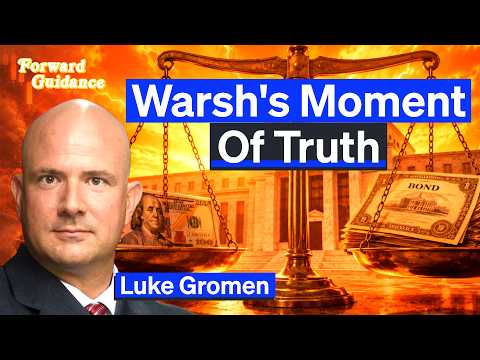
🔥 Kevin Warsh's Impossible Task: The Dollar or the Bond Market
One week before Kevin Warsh chairs his first FOMC meeting, the new Fed Chair finds himself navigating a dramatically different landscape than the one that existed when he was first nominated. What appeared to be a relatively straightforward mandate — cutting rates into a productivity boom while shrinking the balance sheet — has morphed into a crisis of competing priorities: rising inflation driven by Middle East conflict, a resilient labor market, and bond markets showing signs of stress globally.
The central question facing Warsh next week isn't just about rates. It's about revealing which crisis the Fed is willing to accept: a collapsing dollar or an exploding bond market. According to Luke Gromen of Forest for the Trees, "It's a very simple choice. The dollar or the bond market. They're going to have to sacrifice one."
📊 The Warsh Mandate: Then vs. Now
When Warsh was nominated, the curve was pricing in rate cuts. The prevailing narrative centered on disinflationary growth driven by AI and technology investments — a modern echo of the 1990s productivity boom. The plan seemed elegant: cut the front end, shrink the balance sheet, deregulate banks to absorb Treasury issuance, and let productivity gains keep inflation in check.
Fast forward to today: headline CPI has risen above 4%, driven largely by energy price shocks from the Iran conflict. The curve now prices in rate hikes, not cuts. The labor market looks stronger than anticipated six months ago. And global bond yields are breaking out across major markets (excluding China), signaling stress in the system.
Gromen notes that Warsh co-authored an op-ed in December 2018 essentially "begging the Fed to stop hiking rates" when the S&P was down just 10% from highs. That historical precedent raises questions about how hawkish Warsh will actually prove to be when markets experience real pain.
"There's a consensus on Wall Street that he's going to be hawkish. But there's a possibility that he will try to ride two horses with one ass next week by rolling out this same fairy tale that we can have disinflationary growth."
🏦 The Balance Sheet Illusion
Much of the commentary around Warsh's appointment has focused on his stated commitment to shrinking the Fed's balance sheet and restoring independence. But Gromen argues this narrative is "cynical BS" — not because Warsh is dishonest, but because the fundamental constraints haven't changed.
The core problem remains simple: "The debt is too high and there isn't enough balance sheet to finance it without the Fed's help."
At 122% debt-to-GDP with 6% deficits (and rising), the Treasury market has experienced repeated dysfunction since 2020 for one reason: there isn't sufficient private sector balance sheet capacity to absorb issuance without Fed support.
The proposed solution? A clever repackaging of quantitative easing through bank deregulation. Here's how it works:
- Step 1: Cut rates at the front end
- Step 2: Sell bonds from the Fed's balance sheet (pushing up long-end yields)
- Step 3: Deregulate banks by removing leverage requirements
- Step 4: Banks step in to buy the Treasuries the Fed is selling, drawn by the steeper yield curve
- Step 5: Without leverage constraints, banks can now lend to both the government and Main Street simultaneously
As Gromen puts it: "It's just QE done by the banks. That's it." The banks fall under the regulatory purview of the Fed, so this represents monetary financing with extra steps — a way to avoid the political optics of direct Fed purchases while achieving the same economic outcome.
⚡ The Iran Variable: How Everything Changed
The most significant development since Warsh's nomination has been the Iran conflict and its impact on oil markets. The Strait of Hormuz — through which a significant portion of global oil flows — has been effectively closed far longer than markets anticipated.
"Pro tip: If you're going to spend three years shifting issuance to the front end because the back end is blowing out, you can't be stupid and start an inflationary war that sends the front end up. That's like giving yourself a root canal with a shotgun. Very effective, but fatal."
The timing could hardly be worse. The Treasury has spent years shifting issuance toward shorter maturities to avoid stress at the long end. An inflationary shock that drives short-term rates higher doesn't just tighten financial conditions — it directly increases the government's debt service burden at the worst possible moment.
Gromen expects Iran to keep the Strait closed through fall: "I think the Iranians see this clear as day. I think Hormuz stays closed through fall. I think sometime between now and Labor Day, people start to hit tank bottoms and oil charts start to do this [spike]. And once that happens, then they're really hosed."
🇨🇳 The China Summit That Wasn't
The much-anticipated summit between President Trump and Xi Jinping was supposed to yield breakthroughs — potentially even Chinese mediation in the Iran conflict. Instead, it produced nothing but silence.
Gromen applies first principles analysis: "One first principle about Donald Trump is what? He is going to pimp that thing like it is the greatest deal since the Magna Carta or the signing of the Declaration of Independence. So if since then it's just faded away to nothing, what's that tell us about how that meeting went? Not great."
Meanwhile, China's oil imports have collapsed by four to five million barrels per day — yet the country hasn't experienced an economic crisis. How? Massive EV adoption and infrastructure. One data point: EV charging metrics in China are up 55% year-over-year.
This resilience fundamentally changes the calculus. The overwhelming consensus three months ago held that China would be "screwed" by the Hormuz closure. That narrative has proven false. China has demonstrated far more flexibility than anticipated, potentially giving Beijing strategic patience to let the situation continue while Western bond markets come under increasing pressure.
There's also evidence of continued support for Iran despite the blockade:
- An F-15 may have been shot down by a Chinese shoulder-fired missile
- China has provided high-end radars capable of detecting U.S. stealth technology
- Russia is shipping supplies to Iran via the Caspian
- China is providing support via rail connections
While these flows don't fully offset the blockade, they represent "morphine shots to Iran in a pain contest with the US."
🇯🇵 Japan and Korea: Emerging Market Price Action
One of the most alarming developments in global markets has been the behavior of Japanese and Korean assets. Both countries are now trading like emerging markets — a dramatic shift with systemic implications.
Traditionally, when U.S. Treasury yields rise relative to Japanese Government Bond (JGB) yields, the dollar strengthens against the yen. But since late last year, the opposite has occurred: higher relative yields in Japan are driving a weaker yen. The same pattern holds for Korea.
This is classic emerging market price action. It signals that markets view rising yields not as a sign of strength, but as evidence these countries are approaching debt crises that will require currency debasement.
This shift began in October, shortly after a U.S.-China summit in Busan, Korea. The timing raises questions about whether a grand bargain was struck — a "divorce" between the U.S. and Chinese manufacturing base, with Japan and Korea positioned to absorb reshored production in exchange for deliberately weakening their currencies to keep costs manageable for American companies.
Under this framework, U.S. reshoring wouldn't primarily come to America (which lacks the labor, infrastructure, and grid capacity), but would instead flow to Japan and Korea under favorable currency conditions created through coordinated policy.
🛢️ The UAE, Swap Lines, and Leverage
The United Arab Emirates' departure from OPEC offers another window into shifting power dynamics. The sequence of events is revealing:
- UAE threatens to begin pricing oil in yuan if not provided dollar swap lines
- Treasury Secretary Bessent quickly promises swap lines
- UAE leaves OPEC, enabling higher production outside quota constraints
Tactically, this gives the U.S. access to additional oil supply at a critical moment. But strategically, it highlights an important shift: the U.S. is no longer the only game in town for swap lines.
China has established yuan swap lines with approximately 185 countries worldwide (excluding the United States). This creates negotiating leverage. As Gromen frames it using a housing analogy: "If you're trying to sell your house and there's only one buyer, buyer's got all the power. If there's two buyers, you have all the power."
There's also a deeper strategic angle to the UAE's OPEC exit. In a dollar-based oil system, producers need a cartel to manage supply and maximize the value received in paper currency. But in a system where oil can be priced in yuan and settled in gold (which China has been building infrastructure to support), the incentives flip entirely.
In a petro-gold system, the optimal strategy is to maximize production and accumulate gold as cheaply as possible in oil terms — before the gold-to-oil ratio rises from 20 barrels per ounce to 40, then 80, then 200. This changes everything about how oil producers think about cartels and production discipline.
📉 Market Implications: Near-Term Pain
Despite long-term structural tailwinds for gold, Bitcoin, and risk assets (driven by eventual debt monetization), Gromen is deeply cautious on the near term.
Global bond yields are breaking out. That's bearish for everything: "It's bad for bonds. It's bad for stocks. It's bad for risk. It's bad for gold. It's bad for Bitcoin."
Gold and Bitcoin price action is particularly telling: "I think gold and Bitcoin are telling us something wicked this way comes for risk assets."
Equity valuations are in "silly season." Gromen highlights his firm's "Adjusted Warren Buffett Metric" — total equity market cap minus U.S. federal debt, divided by GDP. This adjustment accounts for the QE era by recognizing that the Fed will monetize Treasury debt as needed.
In 2018, this metric correctly signaled 60-70% upside in indices when the standard Warren Buffett metric was flashing red. That call proved accurate through late 2021. But today, the adjusted metric is higher than it's been in 65 years — higher than 1Q 2000 and higher than 4Q 2021, both of which marked terrible entry points for equity investors.
Combining extreme valuations with rising yields and an inflationary supply shock creates a "terrible risk-reward setup."
The path forward likely requires significant pain before policymakers intervene: "They got to have everybody have the no atheists in foxholes moment. They got to get some real pain going."
🎯 What Happens Next
Gromen's base case for the coming months:
"I think the Iranians see this clear as day. I think Hormuz stays closed through fall. I think sometime between now and Labor Day, people start to hit tank bottoms and oil charts start to do this. And once that happens, then they're really hosed because now what do you do? You got to raise rates to fight inflation. Inflation's be rippling through the system. And by the way, it won't just be inflation expectations. It will be everything."
As rates spike at the front end (where Treasury issuance is concentrated), deficits won't move from 6% to 6.5% — they'll jump from 6% to 8% to 10%. This creates the conditions for a debt spiral.
Meanwhile, foreign holders of $27 trillion in net dollar assets (including $9.5 trillion in Treasuries) face simultaneous pressures: rising dollar funding costs, spiking oil prices, and potentially a strengthening dollar. What will they sell to raise dollars? Treasuries.
"I think the physical world is going to start kicking the financial world in the head sometime in the next one to two months."
💭 The Bottom Line
Kevin Warsh enters his first FOMC meeting facing an impossible task. The elegant vision of disinflationary growth through AI and productivity gains has been overwhelmed by the messy realities of geopolitical conflict, energy shocks, and unsustainable debt dynamics.
Next week's meeting will reveal which crisis the Fed chooses to address first — and which one it's willing to accept. The consensus expects hawkishness, but Warsh's history suggests he may attempt to "ride two horses with one ass" by promoting a narrative of disinflationary growth that markets are unlikely to believe.
As global bond yields break out, equity valuations reach historic extremes, and the physical world reasserts itself through energy markets, the setup for the back half of 2025 looks increasingly challenging. The question isn't whether intervention will come, but how much pain must occur first to justify it.
In the meantime, gold and Bitcoin may be sending a clear message about what's coming — even as they decline in the near term alongside everything else.
More from ForwardGuidanceBW
The Edge Isn't in Predicting the Fed — It's in Predicting What Humans Will Do Ne
📌 Welcome to the New Trading MetaMarkets have fundamentally shifted. In an era where forward guidance is dead, volatili...
Markets Face Inflection Point as Monetary Policy Tools Show Their Limits
🎯 The Peak Narrative Takes HoldThe macro landscape appears to be traversing a critical inflection point, with evidence ...

Max Hawkishness, Derivative Chaos, and the Battle for AI Infrastructure
💥 Welcome to Peak AsymmetryMarkets found themselves caught in another high-stakes episode of geopolitical theater this ...
The Trillion-Dollar Forces Driving Markets — And Why Recession Remains Off The T
💡 The Big PictureThe macroeconomic landscape is being shaped by two overwhelming forces: a trillion-dollar AI infrastru...
How Central Bank Intervention and Passive Flows Are Creating Historic Wealth Div
📊 The Taylor Rule Dilemma: Should the Fed Actually Be Hiking?Markets find themselves in an unusual predicament. Accordi...
Navigating the Imbalances: AI Infrastructure, Sovereign Debt Stress, and the New
Markets entered the week facing a delicate balancing act—managing bond volatility while supporting the AI buildout and m...