🔥 A Brutal Friday — But Context Matters
Friday delivered a harsh reminder to markets: everyone took losses. Yet amid the volatility and panic, the bigger story is being missed. While the chorus of macro experts suddenly discovered the AI rotation narrative this week, the reality is far more nuanced — and the opportunity lies in understanding when rotations happen, not reacting once they're already over.
The lesson? Following the herd guarantees losses. Understanding bucket strategies, profit-taking mechanics, and pair trading opportunities separates those who compound wealth from those who chase shiny objects at the top.
"First rule of investing: never lose money. Rule number two: don't forget rule number one." — Warren Buffett
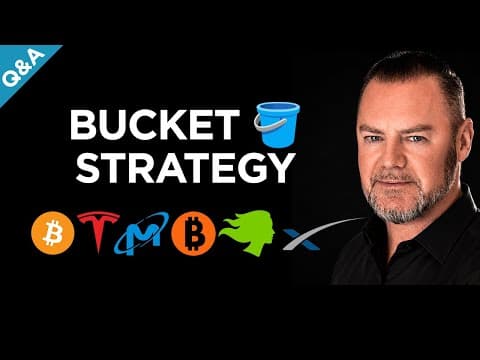
📊 The Bucket Strategy: Building a Portfolio That Compounds
The foundation of long-term wealth isn't about YOLO trades or memecoin gambles. It's about structured capital allocation across three core buckets:
- 80% Hodl Bag: Safe, high-conviction compounders held for years. Think real estate, Bitcoin (early positions from 2017), Tesla (first position also in 2017), and other structural winners.
- 20% Exotic Trading Bag: High-risk, high-reward plays — options, LEAPs, and asymmetric bets. Gains from this bucket rotate into the hodl bag, creating a self-reinforcing compounding engine.
- Money Market Equivalent: From 2017–2021, this was Bitcoin (buying in the $3K–$12K range). From 2022–2024, it shifted to MicroStrategy at an average cost basis of $16 per share (pre-split), which eventually hit $450 before the 10-for-1 split. From 2024 onward, the focus rotated into real-world AI, AGI, autonomy, and humanoid robotics.
This isn't guesswork. It's deliberate rotation into the next structural megatrend — always before the herd arrives.
🚗 Why Tesla? The Largest TAM Play on the Planet
Tesla isn't just an auto company. It's a vertically integrated platform targeting the largest total addressable markets in existence:
- Energy storage
- Autonomous vehicles
- Humanoid robotics (Optimus)
- AI compute and data infrastructure
Each of these alone represents a multi-trillion-dollar opportunity. No competitor is even remotely close to this level of integration, scale, and data advantage.
Two-year performance check: As of early July 2024, Bitcoin is down 9% over two years, while Tesla is up 121.47%. The thesis was clear two years ago, yet it was deeply unpopular at the time. The TAM of AI, AGI, autonomy, and robotics is larger than money itself — and the market is only beginning to price this in.
"The TAM of AI, AGI, autonomy, and humanoid robots is far larger than money."
🔄 Rotation Lessons: Don't Chase — Position Early
Here's where most investors get wrecked: they rotate at tops, not bottoms.
Consider Micron Technology. Over 15 years, it moved sideways with violent zigzags. Then, in the last 12 months, it exploded 11x. Now, after that move, retail investors are piling in, hoping for another 11x. But the juice has already been squeezed. A move to $1,650 (or higher) is possible, but expecting another 10x from here is statistically improbable.
The danger: Crypto holders, watching AI rip higher, are now contemplating selling beaten-down positions to chase AI stocks that have already run. This is "jumping off a cliff into rocks." The rotation happened over the last three years — not last Friday.
All the macro experts — Anthony Pompliano, Raoul Pal, CoinDesk, and others — are now discussing the AI rotation as if it's breaking news. It's not. The opportunity was in 2022, post-ChatGPT launch. The train has left the station.
📉 Bitcoin: Structural Support or Further Downside?
Bitcoin is currently trading around $62,200, having bounced modestly off a double bottom at $60K. This level sits just above the 200-week exponential moving average, a historically significant support zone that has only been breached four times since 2014.
For context, Bitcoin has effectively round-tripped back to 2021 levels — a sobering reality for those who bought at higher prices. However, the risk-reward for new entrants at this level is compelling. A conservative price target of $150K (a 2.5x from $60K) aligns with diminishing return models and historical cycle patterns.
ETF flows matter: Bitcoin ETFs have sold nearly $5 billion in recent weeks. For every $1 billion in outflows, Bitcoin falls approximately 3%. That explains the 15% decline. However, early signs suggest BlackRock may be dipping back in, and MicroStrategy will announce another purchase Monday, which could stabilize the market.
⛏️ Bitcoin Miners: A Cutthroat Business
Mining economics are brutal. The average cost to mine one Bitcoin is approximately $87,500, yet Bitcoin is trading at $62,200. That's a loss of roughly $25,000 per Bitcoin mined — clearly unsustainable.
Some miners are pivoting to AI infrastructure, converting their operations into data centers. However, this transition is complex:
- Mining operations are often in remote locations, far from necessary infrastructure
- Security and logistics challenges for data centers are significant
- Competing with players like Elon Musk (who generates nearly $2.2 billion per month renting out compute) is a tough business
Bottom line: Mining remains a high-risk, low-margin industry unless you have access to free or near-free electricity.
🔀 Pair Trading: EOS vs. Tesla
An experimental strategy currently being tested involves pair trading between Tesla and EOS using ATR (Average True Range) and trend models on a 12-hour timeframe. Since mid-March, this strategy is up approximately 140%.
The ATR model has an 85.71% win rate, while the trend model (set to "tight") has a 90% win rate. The combined approach rotates capital between Tesla and EOS based on relative strength signals:
- When the chart is rising, Tesla is outperforming
- When the chart is falling, EOS is outperforming
- Signals fire roughly every 7–10 days
EOS volatility is extreme, often swinging between $7 and $10 (a 35%+ move). This creates frequent rotation opportunities, though the strategy is not for the faint of heart.
🏥 Healthcare: A Hard Pass
Healthcare and biotech remain structurally compromised sectors plagued by fraud, waste, abuse, and regulatory landmines. Multi-billion-dollar settlements, price-fixing conspiracies, opioid litigation, and billing fraud are endemic.
The philosophy is simple: only invest in what you understand. Healthcare sits outside that circle of competence, and diluting focus by chasing unfamiliar sectors is a recipe for underperformance.
"I only invest in things I understand. I don't understand healthcare. Therefore, I don't touch it."
💰 Retirement Cashflow: The Five-Step Framework
For those targeting an annual lifestyle spend (e.g., $100,000), here's the liquidation framework:
- Keep 1 year of spending in cash or stable yield: Aim for 4–5% yield to avoid forced sales during bear markets.
- Score overvaluation: Compare current market price to intrinsic value. Trim the most overvalued asset first.
- Optimize selling: Sell in layers, only on mean-reversion spikes, and prioritize long-term capital gains to minimize taxes.
- Explore boosters: Sell covered calls, borrow against positions, or generate side income to reduce liquidation needs.
- Use a composite scoring system: Rank holdings by valuation, size, future growth potential, and tax efficiency. Sell the lowest-scoring assets first.
Most importantly: Let your winners ride. Forced selling at bottoms is the most expensive mistake an investor can make.
🚀 SpaceX IPO: What to Expect
The SpaceX IPO is set to price at $135 per share, but expect extreme volatility:
- Day 1: Over-subscription will drive prices higher, possibly to $160–$200, as retail FOMO kicks in
- Weeks 1–4: Mean reversion as early allocators take profits
- Day 15+: ETF inflows begin, creating another demand wave
Many investors who sold positions (e.g., Bitcoin) to free up cash for the IPO will discover they didn't receive allocations. They'll redeploy that cash back into their original holdings, creating a short-term bounce in assets like Bitcoin and Tesla.
Strategic approach: Don't chase on day one. Wait for mean reversion. If you're an options trader, wait for the pullback to establish positions at better risk-reward levels.
🎯 Key Takeaways
- Don't chase rotations — position early or wait for the next cycle
- Use a bucket strategy to separate safe compounders from speculative trades
- Rotate gains from high-risk trades into long-term winners
- Avoid forced selling by maintaining cash reserves and borrowing capacity
- Focus on what you understand — ignore sectors outside your circle of competence
- Let winners ride and trim only when overvaluation is extreme or concentration risk is high
The rotation to AI didn't happen Friday. It's been happening since 2022. The real opportunity now is identifying the next structural shift — and positioning before the experts catch on.