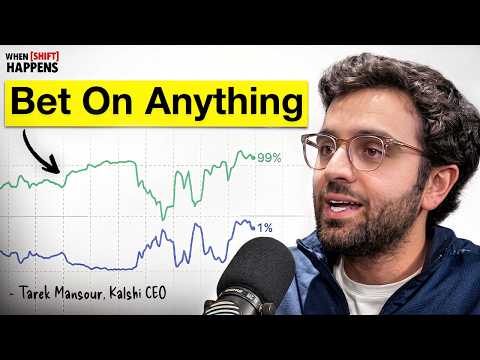
🎯 The Mathematics of Truth: Inside the Prediction Markets Revolution
📊 The Elegant Solution to Subjective Chaos
In a world drowning in debate, spin, and institutional bias, prediction markets offer something radical: mathematical certainty applied to the future itself. Rather than endless arguments about what will happen, markets create a simple mechanism—put money where your mouth is, get rewarded for being right, lose money for being wrong.
As Tarek Mansour, co-founder and CEO of Kalshi, puts it: "You're taking this complete mess of subjective emotion and debate to the clean plane of mathematics." It's an elegant concept with profound implications—the best way to price anything, including the probability of future events, is through a market where participants have real skin in the game.
🔥 From Math Nerd to Market Builder
Mansour's journey to building America's first federally regulated prediction market exchange began not with finance, but with a childhood in Lebanon defined by volatility and a single mother with sky-high expectations. Growing up amid political instability and financial stress, he found refuge in mathematics—a domain where answers are certain, proofs are elegant, and debates end definitively.
The formative experience shaped his entire approach:
- Raised by a single mother with "unwavering belief and conviction" that her sons would achieve greatness
- Developed extreme competitiveness and a "monster chip on his shoulder"
- Found safety in the certainty of mathematical proofs versus the chaos of Lebanese civil unrest
- Carried financial anxiety that "doesn't leave you" even after achieving success
After MIT, where he gravitated toward information theory and probability, Mansour landed at Goldman Sachs and then Citadel—attracted to finance's clear objective functions and the "certainty of mathematics" applied to markets.
💡 The Core Innovation: Distributed Intelligence
The breakthrough insight behind prediction markets stems from groundbreaking research: information doesn't reside with traditional authority figures or institutions—it's distributed across the crowd.
Mansour points to a 2015 study by Ted Klock on "super forecasting" that demonstrated this principle dramatically. When geopolitical experts with decades of experience competed against intellectually curious laypeople in predicting political events, the second group outperformed dramatically.
Recent validation came from a Federal Reserve paper titled "Cashing the Rise of Macro Markets," which showed that Kalshi forecasts on economic indicators—jobs, GDP, inflation, and Fed interest rates—are more accurate than any other alternatives.
"Prediction markets are the best at forecasting the future... If you take enough of a sample size, prediction markets outperform polls and expert consensus consistently."
📰 Revolutionizing Media Through Market Mechanics
Prediction markets don't just compete with traditional media—they fundamentally restructure the incentive system around truth-seeking.
Two key distinctions emerge:
- Direct Access: No intermediaries, no filter, no spin between you and the answer. Markets aggregate wisdom without editorial bias.
- Truth-Aligned Incentives: Get paid for being right, lose money for being wrong. Traditional media optimizes for engagement, clicks, and advertising revenue—not necessarily accuracy.
Mansour notes that 70-80% of Kalshi users log in daily not to trade, but simply to get informed—using prediction market prices as a more reliable news source than traditional outlets. The integration is already accelerating: "If you look at the number of times prediction markets are quoted in news over the last few years, that curve is growing extremely fast."
⚖️ The Insider Trading Debate
Should insider trading be allowed in prediction markets? Coinbase co-founder Brian Armstrong has argued it's "100% necessary." Mansour strongly disagrees.
His counterargument draws a direct parallel to equity markets: "The stock market is a prediction market—it's predicting company prices. Why is insider trading banned there?"
The answer: liquidity. If participants believe the game is rigged—that others have unfair informational advantages—they'll exit. Markets need a level playing field to function.
Mansour draws a clear line:
- ✅ Allowed: Truth-seeking research, polls, satellite data scraping, interviews—any information anyone could access with sufficient effort and resources
- ❌ Prohibited: Unique insider access that others cannot obtain regardless of effort—like Tesla employees trading on unreleased product launches or politicians trading on bills they're voting on
Enforcement combines multiple layers: KYC verification, sophisticated surveillance systems (similar to NASDAQ and NYSE), transparency (all trades are public), investigation teams, and penalties ranging from fines to criminal prosecution. Kalshi goes beyond regulatory requirements by proactively blocking politically exposed persons and athletes from trading on markets they can influence.
🚀 The Six-Year Dark Tunnel
Kalshi's success story is inseparable from an extraordinary test of endurance: six years of building before meaningful traction.
From late 2018 through the end of 2024, Mansour and his team woke up every day to work on a product that—for the vast majority of that time—nobody cared about. They spent years seeking regulatory approval for election markets, only to face repeated denials that left Mansour unable to sleep for weeks.
"There's this feeling of shame... people are looking at you and you're failing. You're constantly addressing this feeling of 'I didn't do enough' and 'this is not working.'"
What kept them going?
- Belief from family: Mansour's mother, even in the darkest moments, would say "give it a little bit longer"
- First-time founder naivety: Like climbing a mountain without looking at the peak—just taking the next step
- Sunk cost psychology: "You spent four years on this, you're going to stop now? Give it another six months."
- Mission conviction: They genuinely wanted prediction markets to exist in the world, regardless of personal success
"If it was just about being successful, we would have pivoted much earlier. There were so many opportunities—AI, crypto. But we just wanted this thing to exist."
🏛️ The Regulatory-First Playbook
While many crypto and fintech companies have taken the "ask forgiveness, not permission" approach, Kalshi deliberately chose the harder path: spending four to five years obtaining federal regulation before launching their product.
Mansour learned from Brian Armstrong's trajectory building Coinbase as the first regulatory-compliant crypto exchange in America. The principle: "Regulation is not contrary to growth—it's an enabler of growth if you get it right."
Yes, it's harder. Yes, it's less sexy. Yes, nobody wakes up excited to work on regulatory compliance. But it establishes a foundation of trust that cannot be built any other way.
This philosophy extends beyond minimum compliance. Kalshi self-regulates, going "above and beyond" current legal requirements—establishing clear lines on insider trading, proactively blocking conflicts of interest, and building institutional-grade surveillance systems.
💰 Perpetuals: The Next Chapter
Kalshi is launching the very first regulated perpetual futures (perps) in the United States.
The logic is straightforward: traditional futures were designed for assets with natural expiration dates—like grain futures tied to September harvests. But digital assets like Bitcoin have no natural end date. Forcing artificial expiries creates friction as traders constantly roll positions, paying fees unnecessarily.
"People should decide when they want to close their own position without some arbitrary end date."
Offshore exchanges have proven massive demand for perpetuals. Platforms like Hyperliquid, Binance, OKX, and Bybit have built substantial businesses around these instruments. Coinbase launched perpetual-style futures about a year ago with decent success. The customer demand is clear—now it's time to bring the product to regulated US markets.
Why does leverage matter? Mansour offers a nuanced view: leverage should expand volatility for assets that move too little to be actively traded, bringing them to a "natural level of volatility" where healthy liquidity can form. The problem occurs when leverage is applied to assets that already have sufficient volatility—creating dangerous, erratic price action.
For longer-term prediction markets (three to five years out—like AI job displacement), leverage becomes essential because cost of capital matters for institutional participants. Without margin trading, tying up capital for years makes it difficult to build liquidity in these important long-horizon markets.
🌐 Crypto, Blockchain, and the Future of Finance
While Kalshi isn't positioning itself as a crypto-first company, Mansour is an enthusiastic adopter with clear conviction on blockchain's role in next-generation financial infrastructure.
Three core benefits stand out:
- Superior Payment Rails: "Imagine you gave incredibly smart developers a mandate: reimagine what our payment infrastructure should look like and build it out. That's exactly how it happened." Blockchain-based payments are simply better than legacy systems.
- Radical Transparency: On-chain settlement enables real-time fraud detection, insider trading surveillance, and systemic risk monitoring. "Transparency in financial markets—transparency everywhere—is usually a good thing. More is usually better."
- Open-Source Enablement: The best ideas for building on Kalshi's ecosystem won't come from the core team—they'll come from external developers building on transparent, composable infrastructure.
Mansour draws a parallel to AI labs: "Imagine there was only one AI lab. We would be nowhere near where we are right now. Everyone is running and achieving things they didn't think were possible because they're being pushed by competitors." The same dynamic applies to crypto innovation.
🎯 Competition, Ambition, and the Endgame
Does Mansour obsess over competitors like Robinhood (Vlad Tenev), Coinbase (Brian Armstrong), or CME Group (Terry Duffy)?
He quotes a principle—possibly from Bezos—that resonates deeply: "Be competitor aware, but not competitor obsessed. Be customer obsessed."
That said, he expresses genuine admiration for fellow builders. "When people put out something pretty sick, I love seeing it and learning from it. What did they do? Why did they do it? Did we miss it? Could it fit for Kalshi?"
Competition isn't a zero-sum threat—it's what pushes entire industries to new heights. "I like the race. It pushes the industry. We all push each other."
As for an endgame? There isn't one. Like Apple constantly reinventing itself, Kalshi's ambition scales with its growth. After onboarding tens of millions of customers, the question becomes: how do we onboard hundreds of millions? How do we go global? How do we serve institutions managing billions in capital?
Mansour recently raised a billion dollars—and sees no shortage of ways to deploy it toward that scaled ambition.
😊 Happiness, Engagement, and What Really Matters
Is Mansour happy? He pauses on the question.
"I'm driven. I'm motivated. I'm excited. I'm engaged."
He shares a story: a friend went on an exhausting hike—feet hurting, back aching, sun beating down, desperately thirsty. Afterward, he described it as one of the best weekends he'd had. The contradiction? He was 100% engaged.
"Whatever you do, be 100% in it. 100% engaged. When you're in the day-to-day—your body is hurting—but you're excited, you're moving, you're flowing. You're fully all in."
Does being worth a few billion dollars make him happier? "Not really. That stuff stresses me more than anything."
What did matter: reaching the level where he could pay for his cousin's tuition, take care of his parents, get them nice surprises, ensure they never face financial worries again. "That's pretty awesome."
The threshold for that? Lower than people think.
Beyond that, the number is "kind of just this number that means absolutely nothing." What's exciting is the scale of impact—users loving the product, getting pissed about a button that didn't work, demanding new features. "That's significantly more exciting."
🛠️ What He's Still Holding Onto
Mansour admits he's still learning to let go—to stop being involved in every single detail as Kalshi scales beyond 150 people.
"You have a protective approach to the company. It's like your baby. You want to be involved in every single little detail. We're getting to the point where it's becoming impossible."
The transition from founder who knows everything to CEO who empowers others? It's taking longer than it should. Letting people make their own mistakes—or prove him wrong—remains a work in progress.
But for someone who spent six years in the dark, pushing through shame and self-doubt, building something the world told him was impossible? That final evolution seems inevitable.
🌟 The Bigger Picture
Prediction markets represent more than a new asset class. They're a fundamental reimagining of how society processes information, makes decisions, and allocates capital toward uncertain futures.
In a world where trust in institutions is eroding, where media incentives have diverged from truth-seeking, where expert consensus repeatedly fails, prediction markets offer a compelling alternative: let the crowd decide, with money on the line, in a transparent marketplace where accuracy is the only currency that matters.
Tarek Mansour didn't just build a company. He spent six years in the wilderness building the infrastructure for a more honest future—one where mathematics, not rhetoric, determines what we believe about tomorrow.
And now, after years of nobody caring, everyone is watching.
More from When Shift Happens

The Most Extraordinary Moment in Human History — And Why the Crypto Trade Is Jus
The markets are screaming a simple message: buy the fucking dip, you fucking idiot. But behind the memes and the volatil...

The Protocol Wars Are Over: Bitcoin Won
📡 One Protocol to Rule Them AllMichael Saylor's thesis on Bitcoin isn't just bullish commentary — it's a framework grou...
The Battle for Humanity's Future: Why Ethereum's Co-Founder Believes We're at a
🌍 A Civilization at a CrossroadsJoseph Lubin, co-founder of Ethereum and founder of ConsenSys, doesn't mince words abou...
From Zero to 500 Miles Per Hour: Inside the Most Bullish Chapter in Crypto's Evo
📊 The $400 Trillion Paradigm ShiftThe traditional financial system—encompassing global money and assets—sits at approxi...

Bitget’s Universal Exchange Bet: Stablecoin Rails, Tokenized Markets, and Operat
“Altcoins are dead.” A crypto exchange CEO is re-architecting the business around stablecoins and tokenized everything. ...
Building Wealth Without Luck: Bitcoin’s Role, the Fiat Incentive Problem, and a
OverviewThe get-rich-quick impulse is colliding with a debt-based, inflationary backdrop that pushes investors out the r...